
Introduction: Where PLCs Meet Semiconductor Standards
Semiconductor fabrication is one of the most data-intensive manufacturing environments on earth. Every process step — deposition, etch, lithography, inspection — demands real-time equipment reporting, traceable process data, and reliable remote control from a central Manufacturing Execution System (MES). The SEMI industry standards that govern this communication are collectively known as SECS/GEM (SEMI Equipment Communications Standard / Generic Equipment Model), and compliance with them is a prerequisite for operating in any serious fab.
What makes today’s integration landscape uniquely complex is that a growing share of semiconductor equipment is not controlled by dedicated workstations — it runs on industrial PLCs from Omron, Siemens, Mitsubishi, and Rockwell Automation. These are world-class controllers, but they were not designed with SEMI messaging in mind. Bridging that gap demands purpose-built SECS/GEM Software that understands both the depth of the SEMI standard suite and the distinct architecture of each PLC platform.
At Einnosys, we have spent years building and deploying PLC SECS/GEM Integration solutions across leading semiconductor fabs and OEM equipment lines. This post shares the technical realities of that work — platform by platform — and explains what to look for when choosing a qualified SECS/GEM Solution Provider for your automation program.
Why SECS/GEM PLC Communication Is Non-Trivial
PLC architectures are built around cyclic scan execution, deterministic I/O, and ladder or structured-text logic. SEMI standards, by contrast, are event-driven, message-oriented, and stateful — the GEM E30 standard alone defines multiple interlocking state machines: the Control State Model, the Processing State Model, and the Spooling Model, among others. Aligning these two paradigms is the central engineering challenge of SECS/GEM PLC Communication.
A naive integration approach — polling PLC registers on a fixed timer and forwarding values to the GEM host — will satisfy basic connectivity but will fail in production. It cannot guarantee sub-100 ms event latency, cannot accurately reflect rapid state transitions, and cannot support the Remote Command model (PP-SELECT, START, PAUSE, STOP, RESUME) without introducing control-pathway conflicts. Production-grade Industrial PLC Communication Software must be designed around interrupt-driven or change-on-value data acquisition, atomic state handshaking, and fail-safe alarm propagation — not polling loops.
Platform-Specific Integration: Four PLCs, One Standard
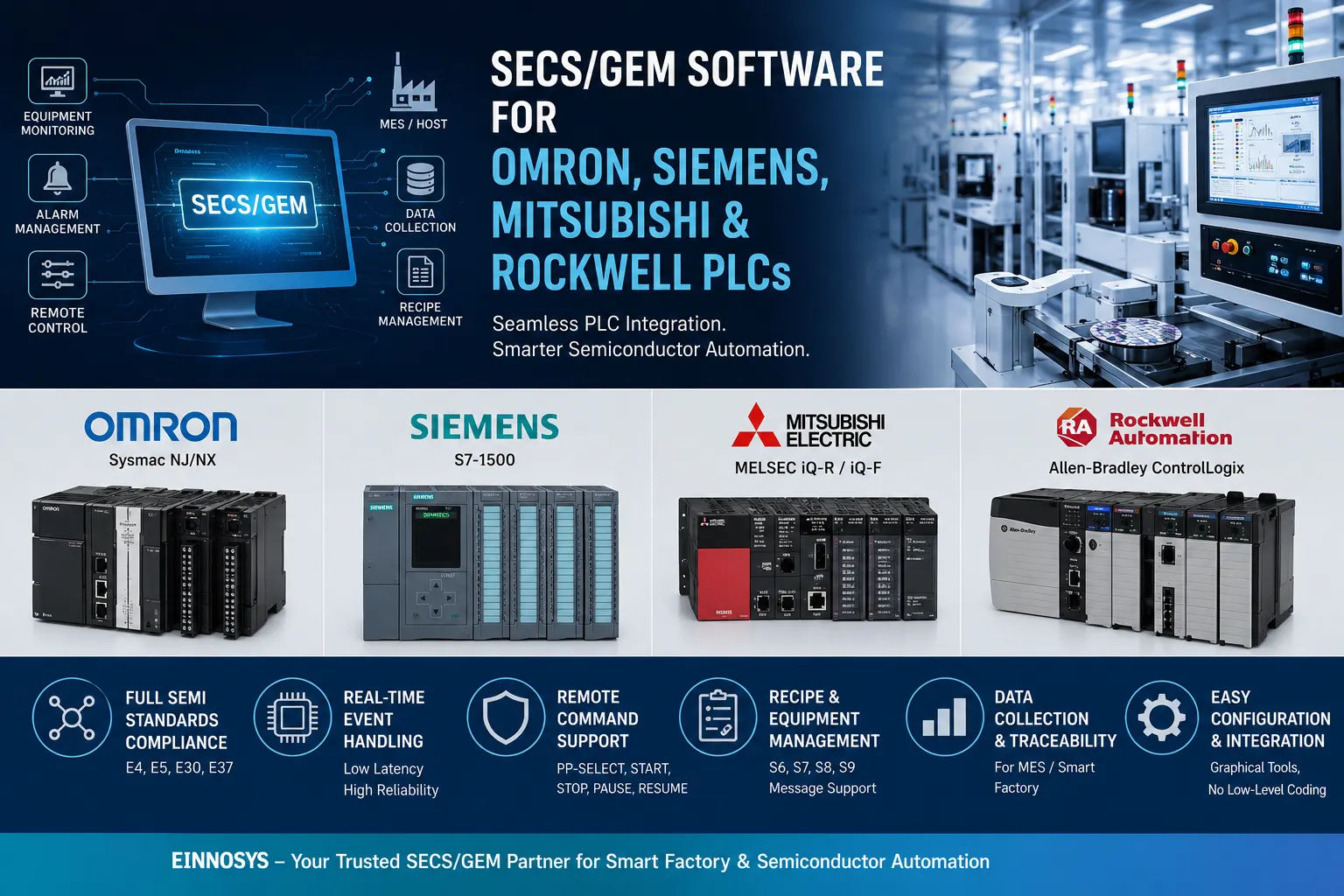
Einnosys has qualified SECS/GEM Software deployments across all four major PLC platforms used in semiconductor and advanced packaging equipment. Here is what engineers need to understand about each.
Japan / Back-End Omron NJ/NX (Sysmac)
Omron’s Sysmac platform is common in wafer-level packaging, test handlers, and die-attach equipment. Einnosys integrates via OPC-UA or EtherNet/IP, mapping SEMI SVs, DVs, and ECs directly to Sysmac global variables for low-latency semiconductor equipment communication.
Europe / Front-End Siemens S7-1500 / TIA Portal
Siemens controllers dominate European OEM equipment. Einnosys uses OPC-UA or S7 TCP/IP with data block mapping, carefully managing scan-cycle alignment to achieve the event reporting latency required by GEM E30’s Processing State transitions.
Japan / OEM Tools Mitsubishi MELSEC iQ-R / iQ-F
MELSEC controllers appear widely in coaters, developers, and etch tools from Japanese OEMs. Einnosys leverages MC Protocol for bidirectional device-memory access, with rigorous handshaking to prevent GEM state drift during processing state changes.
North America / Packaging Rockwell Allen-Bradley ControlLogix
Allen-Bradley is the dominant PLC in North American semiconductor equipment lines. Einnosys maps GEM variables to ControlLogix tag arrays over EtherNet/IP, enabling clean PLC equipment automation with full bidirectional remote command support.
What unifies these four integration paths is Einnosys’s middleware-first architecture: a dedicated GEM server process handles all SEMI messaging, maintains the GEM state machines, and communicates with the PLC through a vendor-optimized driver — cleanly separating SEMI protocol logic from PLC I/O logic. This separation is what makes Semiconductor PLC Integration maintainable, testable, and certifiable across equipment generations.
What Einnosys SECS/GEM Software Delivers
Across every PLC platform, the Einnosys SECS/GEM PLC Communication stack is built to meet the full SEMI standard suite — not just the baseline GEM requirements. This matters because modern fabs increasingly require advanced capabilities like Process Job Management (E40), Control Job Management (E94), and substrate tracking (E90) that go well beyond a minimal GEM implementation.
- Full SEMI E4 (SECS-I), E37 (HSMS), E5 (SECS-II), and E30 (GEM) compliance
- E40 Process Job and E94 Control Job Management for advanced automation
- Real-time alarm (ALID) and collection event (CEID) management
- Remote command execution mapped to PLC output logic
- Equipment constant and recipe management via S9/S7 message pairs
- Deterministic state re-synchronization on reconnection or power cycle
- Graphical configuration tooling — no low-level socket coding required
- Detailed audit logging for fab qualification and compliance reporting
This comprehensive capability stack is what separates a genuine SECS/GEM Solution Provider from a vendor offering a thin wrapper over a raw TCP socket library. Semiconductor fabs run qualification audits against every GEM implementation — and gaps in standard coverage are discovered during those audits, not before.
Semiconductor Equipment Communication: The Broader Automation Picture
It is worth noting that Semiconductor Equipment Communication does not end at the SECS/GEM layer. In a modern fab, GEM is the messaging standard, but the overall automation architecture also includes the MES layer (SAP, Camstar, TIBCO), the SCADA layer (in some facilities), and the equipment engineering system (EES) used for advanced process control. Einnosys designs its SECS/GEM Software to coexist cleanly with these adjacent systems — exposing data via standard interfaces so that fab IT teams can integrate GEM event data into broader analytics pipelines without modifying the SEMI communication layer itself.
For PLC Equipment Automation specifically, this means that the Einnosys GEM server can operate alongside Rockwell FactoryTalk, Siemens WinCC, or Omron SCADA systems without creating conflicting control pathways — a common failure mode when SECS/GEM is bolted onto an existing PLC automation stack by engineers unfamiliar with the GEM Remote Command model.
Conclusion: Choosing Einnosys as Your SECS/GEM Solution Provider
Effective PLC SECS/GEM Integration is not a commodity. It demands expertise in SEMI standards, deep familiarity with PLC architectures, and the engineering discipline to build middleware that performs reliably under the unforgiving conditions of semiconductor production. Getting it wrong means extended equipment qualification, failed MES audits, and — worst of all — unplanned downtime in a fab where every hour carries substantial financial consequence.
Einnosys brings proven deployments across Omron, Siemens, Mitsubishi, and Rockwell platforms, a full-stack SECS/GEM Software architecture built for production environments, and the application engineering expertise to guide your team from initial integration through fab qualification. Whether you are bringing a new tool to market or retrofitting an existing equipment line for a new customer’s compliance requirements, Einnosys has the technical depth to deliver a SECS/GEM implementation that passes audit the first time.
If your organization is navigating the complexity of Semiconductor PLC Integration — or needs a reliable SECS/GEM Solution Provider to accelerate your equipment qualification timeline — we would welcome the conversation.


