
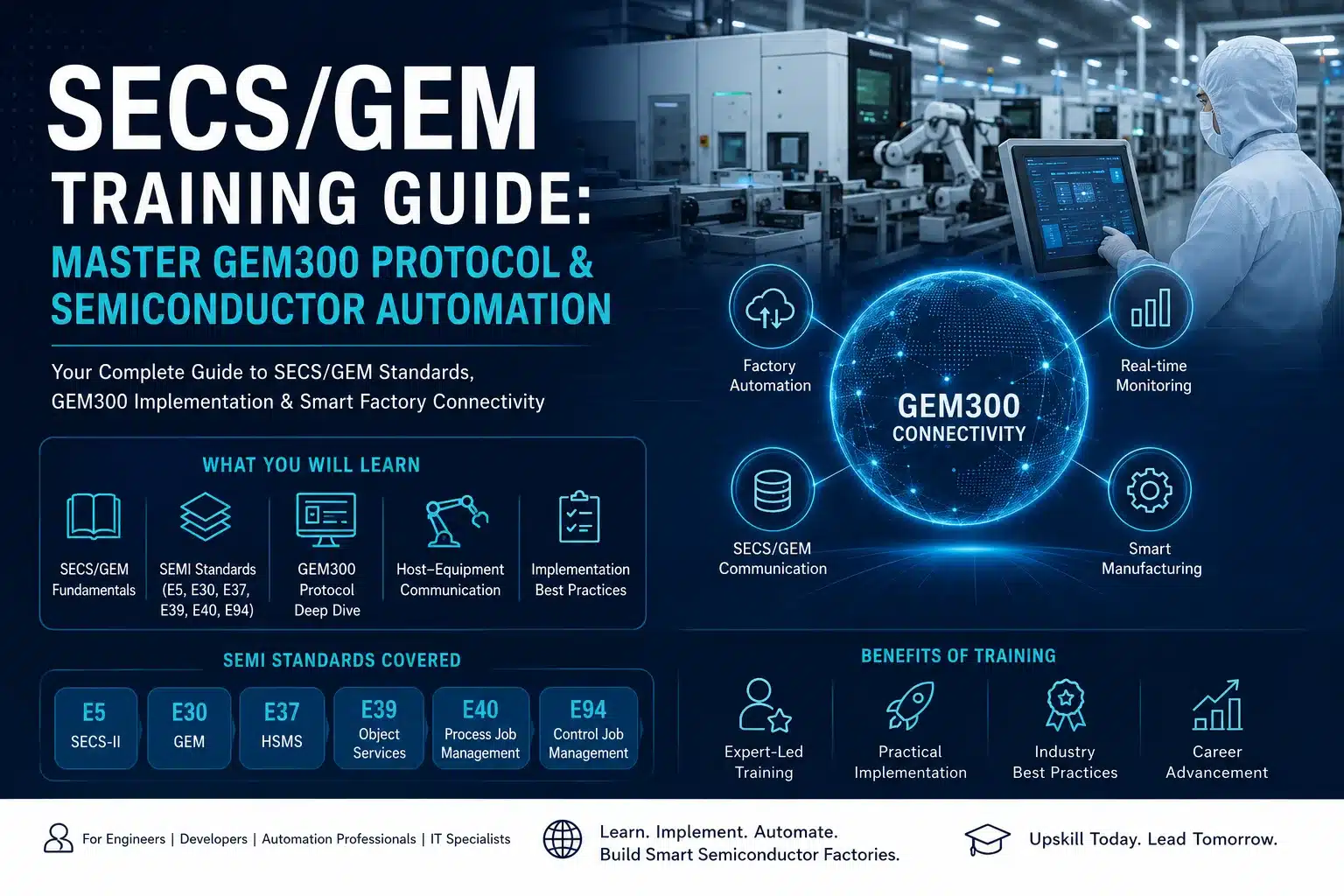
The semiconductor industry runs on precision — and nowhere is that more evident than in how equipment talks to factory systems. Whether you are an automation engineer stepping into a new fab environment or a controls architect tasked with integrating a new tool, understanding the SEMI Equipment Communications Standard is no longer optional. This SECS/GEM Training Guide is designed to orient professionals at every level — from those encountering SECS-I and HSMS for the first time to senior engineers pursuing formal GEM300 Compliance Training before a major line qualification.
Why SECS/GEM Competency Has Become Non-Negotiable
Modern semiconductor fabs operate under tight OEE (Overall Equipment Effectiveness) requirements. Every unplanned equipment outage, every failed data collection handshake, and every out-of-spec process run that slips past the host system costs real yield and real money. The SEMI GEM standard — formally defined in SEMI E30 — specifies exactly how equipment should communicate its state, alarms, events, and data to a manufacturing execution system (MES) or equipment engineering system (EES).
What makes this challenging in practice is that GEM is not a single specification. It sits within a layered stack: SECS-I (E4) or HSMS (E37) handles the transport layer, SECS-II (E5) defines the message encoding, and GEM (E30) defines the behavioral model on top. GEM300, governed by SEMI E40, E87, E90, E94, and related standards, extends this model specifically for 300mm wafer processing environments where automation density and throughput requirements are substantially higher.
A structured approach to SECS/GEM Protocol Training must therefore cover not just message formats but the state machines, collection events, and equipment constants that give those messages operational meaning.
What a Rigorous SECS/GEM Training Guide Should Cover
Engineers who have gone through informal, on-the-job exposure to GEM often know enough to get equipment certified — but not enough to troubleshoot edge cases or architect robust integrations. A professional-grade SECS/GEM Training Guide addresses this gap by building knowledge in logical layers.
Layer 1 — Transport and Encoding
Before touching GEM behavior, engineers need a firm grasp of HSMS session management: T3/T5/T6/T7/T8 timer values, connect/separate procedures, and block sequencing under SECS-II. This foundation directly affects connection stability during recipe downloads and large data transfers.
Layer 2 — GEM State Machines
The Communication State Model and the Control State Model are the backbone of any GEM implementation. Misunderstanding the transitions between ONLINE/LOCAL and ONLINE/REMOTE is a frequent source of certification failures. GEM300 Training adds the Process Job and Control Job state machines defined in E40 and E94, which together govern how multi-step processes are scheduled and monitored across carrier-handling equipment.
Layer 3 — Data Collection and Reporting
Trace Reports, Event Reports, and Variable Data Reports are how a fab’s data infrastructure gets populated. Proper Semiconductor Equipment Communication Training should include hands-on configuration of Collection Event IDs (CEIDs), Data Variable IDs (DVIDs), and Status Variable IDs (SVIDs) — and critically, how host-side subscriptions interact with equipment-side buffering during burst events.
Layer 4 — Alarm Management
SEMI E30 Section 10 defines a complete alarm model that many equipment vendors implement incompletely. A well-structured training program walks engineers through alarm categories, the alarm enable/disable mechanism, and how alarm data flows into downstream fault detection and classification (FDC) systems.
Layer 5 — GEM300 Extensions
This is where GEM300 Protocol Training separates itself from basic GEM work. E87 (Carrier Management), E90 (Substrate Tracking), E40 (Process Jobs), and E94 (Control Jobs) each introduce their own state machines, exception handling paths, and host-initiated control sequences. Engineers working on 300mm tools — lithography systems, CMP, CVD, ALD — must be fluent in all of them.
Choosing the Right SECS/GEM Training Services
Not all training programs are equal. The best SECS/GEM Training Services combine conceptual depth with practical simulation. Look for programs that provide:
- Simulated equipment environments where learners can send and receive real SECS-II messages using tools like SECS Expert, GemTalk, or equivalent simulators.
- Scenario-based labs that replicate common integration failures — a dropped HSMS connection during a recipe upload, an alarm burst that overwhelms a report buffer, a Process Job that stalls in the EXECUTING state.
- Standard-specific deep dives with access to the actual SEMI standards documents, not just slide summaries.
- Assessment benchmarks aligned with what fab qualification teams actually test during tool acceptance.
Semiconductor Automation Training at the advanced level should also introduce engineers to the broader automation context: how GEM data feeds into APC (Advanced Process Control) loops, how E142 substrate mapping interacts with E87 carrier management, and how modern MES platforms consume and act on GEM event streams in near real time.
SECS/GEM Certification Training: What to Expect
For engineers pursuing formal credentials, SECS/GEM Certification Training typically concludes with a practical assessment rather than a multiple-choice exam. Candidates are expected to demonstrate that they can configure a GEM-compliant equipment model, establish an HSMS connection, respond correctly to host commands, and generate well-formed event and alarm reports.
Some certification paths also include a GEM300 Compliance Training component where candidates must configure and test the E87 and E90 state machines against a reference host — simulating the kind of acceptance testing a new tool would face before entering production.
Certification matters because it gives fab automation teams confidence that an engineer can work independently on critical path integration tasks, not just follow a pre-written checklist.
SECS/GEM Integration Training in Real Project Contexts
The gap between classroom knowledge and production integration is real. SECS/GEM Integration Training at the applied level should expose engineers to the kinds of decisions that arise mid-project: how to handle a vendor’s non-standard CEID numbering scheme, how to negotiate with equipment suppliers over missing GEM capabilities, and how to document integration behavior in a way that satisfies both the tool supplier and the fab’s automation team.
Engineers who combine this practical integration fluency with a solid grasp of the underlying standards consistently deliver faster, more stable tool qualifications — and that directly translates to reduced time-to-production for new equipment.
Conclusion
Semiconductor automation has never been more complex, and the communication layer between equipment and factory systems is one of its most consequential pieces. Whether you are beginning with foundational Semiconductor Equipment Communication Training, advancing through GEM300 Training for 300mm environments, or preparing for formal SECS/GEM Certification Training, the return on a structured learning investment is measurable: fewer integration surprises, faster tool qualifications, and more reliable data for process control.
This SECS/GEM Training Guide reflects what experienced automation professionals actually need — not a surface survey of message formats, but a deep, layered understanding of how GEM-compliant equipment behaves, how it fails, and how to build integrations that hold up under real production conditions. The standards will keep evolving, and the engineers who stay current with them will be the ones building the fabs of the next technology node.


