
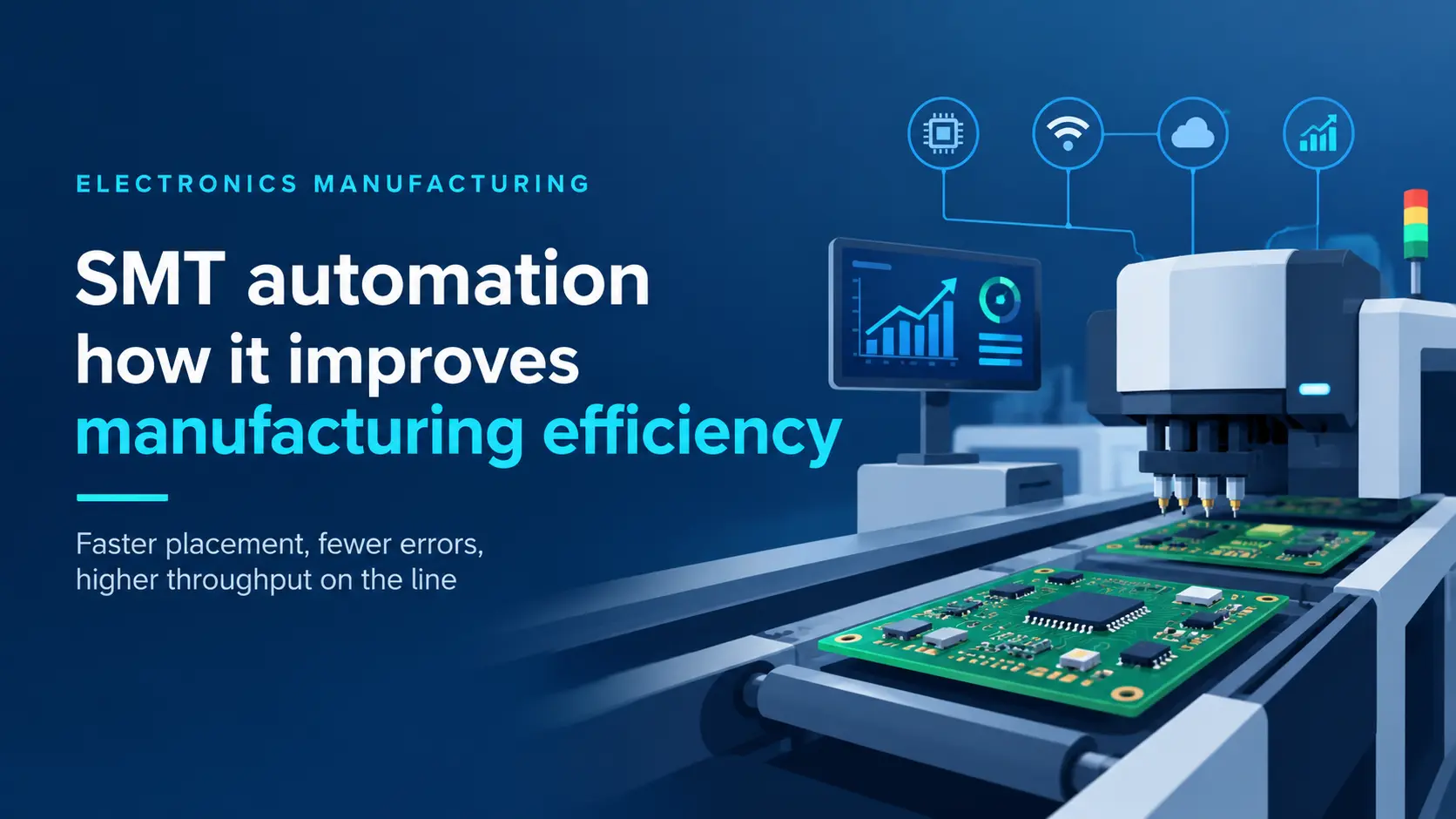
Electronics manufacturing has never faced higher expectations. Shorter product cycles, tighter tolerances, and rising labor costs are pushing SMT (Surface Mount Technology) lines to run faster, smarter, and with less manual intervention. This is where SMT automation comes in — a set of technologies and software solutions that connect, monitor, and control SMT equipment to reduce downtime, cut errors, and increase throughput.
In this article, we’ll break down what SMT automation actually means, the benefits it delivers, how it improves production efficiency, and how manufacturers can start implementing it on their own lines.
What Is SMT Automation?
SMT automation refers to the use of software and connected systems to manage, monitor, and control the equipment involved in surface mount assembly — including printers, pick-and-place machines, reflow ovens, and AOI (Automated Optical Inspection) systems. Instead of operators manually checking each machine or collecting data by hand, SMT automation links these machines together so data flows automatically between them.
At its core, SMT / Surface Mount Technology automation is about turning a line of independent machines into one connected, data-driven system. This connectivity is what allows manufacturers to catch errors earlier, respond to issues in real time, and make decisions based on live production data rather than end-of-shift reports.
SMT automation typically includes:
- Equipment connectivity between machines on the line
- Real-time production monitoring and dashboards
- Automated data collection for traceability and quality
- Machine-to-machine and machine-to-MES communication
- Standardized protocols, such as SECS/GEM, for equipment integration
Benefits of SMT Automation
Manufacturers adopt SMT automation solutions for several practical reasons, not just to modernize their floor. The most common benefits include:
- Reduced downtime — automated alerts flag equipment issues before they cause line stoppages
- Higher first-pass yield — real-time data helps catch defects earlier in the process
- Better traceability — every board, component, and process step is logged automatically
- Lower labor dependency — fewer manual checks and paper-based logs
- Faster changeovers — automated recipe management reduces setup errors
- Improved OEE (Overall Equipment Effectiveness) — data visibility highlights where time and output are being lost
For OEMs and EMS companies managing multiple lines or customers, these benefits compound quickly. A single connectivity issue or manual data entry mistake on one line can ripple into missed deadlines or quality escapes across an entire production run.
How SMT Automation Improves Production Efficiency
Efficiency gains from SMT automation come from removing the delays and blind spots that manual processes create. Consider a typical SMT line without automation: operators walk the floor to check machine status, quality data is recorded on spreadsheets, and issues are often only discovered after a batch is already affected.
With SMT manufacturing automation in place, that same line operates differently:
- Machines report status automatically, so operators and supervisors see real-time equipment health without walking the floor.
- Production monitoring dashboards show throughput, downtime, and yield as they happen, not hours later.
- Automated data logging removes manual entry errors and speeds up reporting for audits or customer requirements.
- Line balancing becomes easier when data from every machine is visible in one place, helping managers identify bottlenecks quickly.
The result is a production environment where decisions are made on current data, not assumptions — which is the foundation of SMT assembly automation done well.
SMT Equipment Connectivity and Integration
One of the biggest barriers to efficient SMT lines is equipment that can’t “talk” to each other. Printers, placement machines, ovens, and inspection systems are often supplied by different vendors, each with its own data format and communication method.
SMT equipment connectivity solves this by creating a common language between machines. Platforms like EIGEMLink are built specifically to bridge this gap, enabling SMT machine connectivity across mixed-vendor lines so data can be collected, standardized, and shared with MES, ERP, or quality systems without custom integration work for every machine.
This kind of SMT equipment integration is what allows manufacturers to move from isolated machines to a fully connected line — and it’s a prerequisite for meaningful production monitoring or Industry 4.0 initiatives.
Role of SECS/GEM and GEM300 in SMT Automation
For manufacturers working with semiconductor-adjacent or high-mix electronics production, SECS/GEM and GEM300 standards play a central role in SMT automation. These communication protocols define how equipment exchanges data with host systems, enabling standardized, reliable machine communication regardless of the equipment vendor.
- SECS/GEM provides a structured way for equipment to report status, alarms, and process data
- GEM300 extends this for automated material handling and factory-level integration, common in higher-volume or semiconductor-linked electronics production
Solutions such as EIGEM300Equipment are designed to help manufacturers implement GEM300-compliant equipment communication without building custom drivers for every tool. This matters because inconsistent equipment communication is one of the most common reasons SMT automation projects stall — the software layer only works as well as the data it can reliably pull from the floor.
SMT Automation for Industry 4.0
Industry 4.0 electronics manufacturing depends on connected, data-rich production environments — and SMT automation is one of the clearest paths to get there. Rather than treating Industry 4.0 as a separate initiative, most manufacturers build toward it by first automating equipment connectivity and monitoring, then layering analytics and predictive capabilities on top.
Smart SMT manufacturing under an Industry 4.0 model typically includes:
- Centralized dashboards showing real-time status across multiple lines or facilities
- Historical data used for predictive maintenance
- Automated traceability for compliance and customer audits
- Simulation tools to test line changes before implementing them physically
Tools like EIGEMHMI give operators and managers a unified interface to view and interact with this data, while EIGEMSim allows teams to model line changes or new product introductions before committing floor time to them — reducing the risk and cost of trial-and-error changeovers.
How to Implement SMT Automation
Manufacturers don’t need to automate an entire facility overnight. Most successful SMT automation solutions are implemented in phases:
- Assess current equipment connectivity — identify which machines can already communicate and which need integration support.
- Standardize communication protocols — implement SECS/GEM or GEM300 compliance where needed, especially for mixed-vendor lines.
- Deploy production monitoring — start with real-time dashboards so teams gain visibility before adding more complex automation layers.
- Centralize data collection — connect equipment data to MES, ERP, or quality systems for traceability and reporting.
- Expand to smart manufacturing capabilities — add predictive maintenance, simulation, and Industry 4.0 analytics once the connectivity foundation is solid.
Equipment such as EIGEMEquipment and EIGEMBox are often used at this stage, providing the hardware and software bridge needed to bring older or non-standardized machines into a connected line without a full equipment replacement.
Conclusion
SMT automation is no longer optional for manufacturers competing on speed, quality, and traceability. From equipment connectivity and SECS/GEM communication to real-time production monitoring and Industry 4.0 readiness, automation gives electronics manufacturers the visibility and control needed to run more efficient, reliable SMT lines.
Whether you’re just starting to connect your equipment or looking to build a fully smart SMT manufacturing environment, EiNNOSYS offers a connected suite of solutions — including EIGEMLink, EIGEM300Equipment, EIGEMHMI, and EIGEMSim — designed to help manufacturers implement SMT automation at their own pace, without disrupting existing production.


