
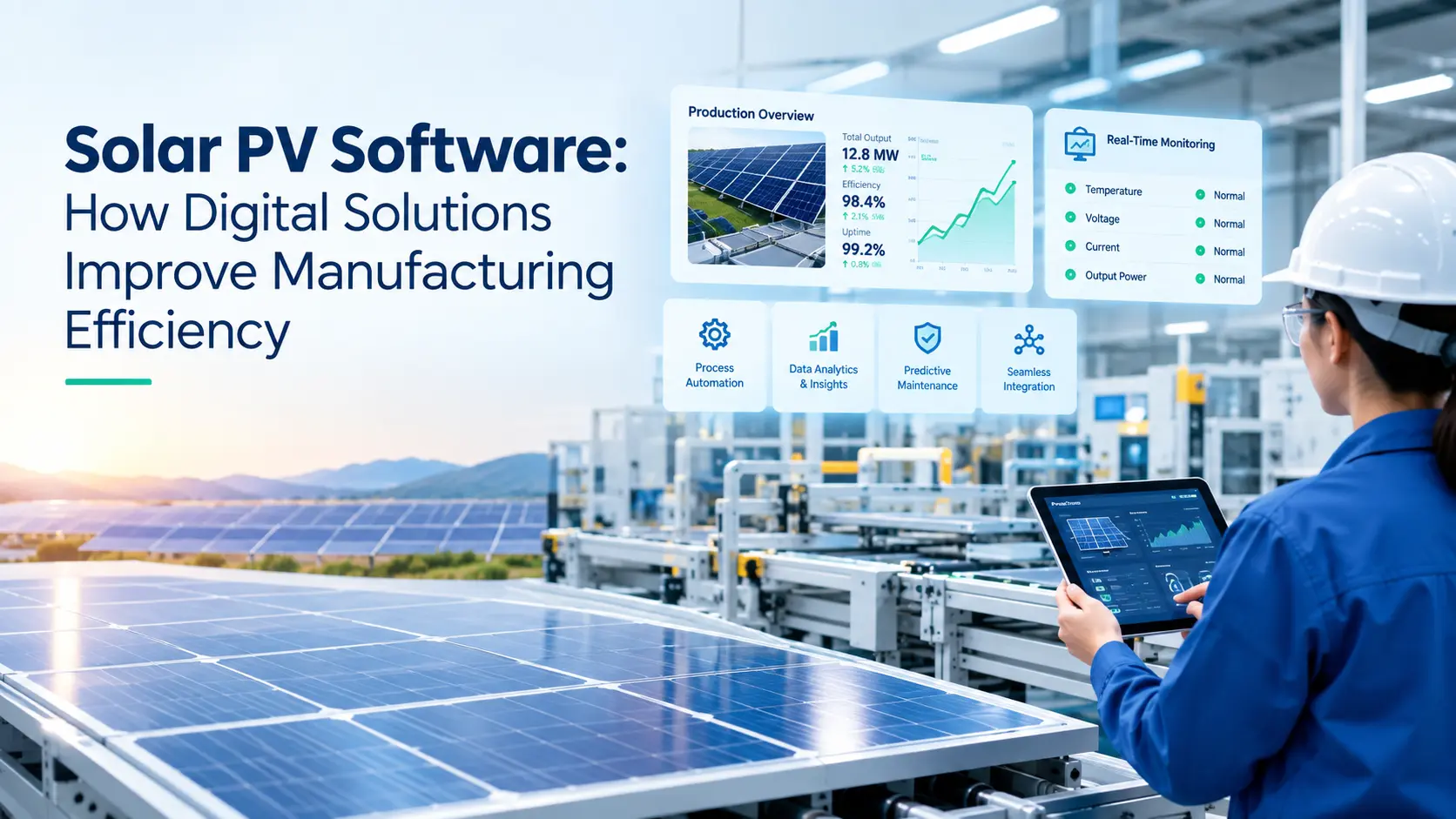
Solar PV software is now a core part of modern photovoltaic production. Solar factories run faster lines, tighter quality targets, and equipment from many vendors. As a result, manual data handling no longer keeps up. Digital tools give manufacturers a clear, real-time view of every tool on the floor. In this guide, you will learn how solar PV software improves manufacturing efficiency, which features matter most, and how to choose the right solution.
What Is Solar PV Software?
Solar PV software connects, monitors, and controls the equipment used to make solar cells and modules. It collects data from machines, sends it to factory systems, and helps teams act on it quickly. Unlike general business software, it speaks the language of production equipment.
In practice, solar PV manufacturing software covers several areas:
- Equipment connectivity and communication
- Production monitoring and data collection
- Recipe and alarm management
- Operator interfaces (HMI)
- Integration with MES and other factory systems
Together, these tools turn isolated machines into a connected production line. That connection is the foundation of solar PV manufacturing efficiency.
Why Solar PV Manufacturers Need Digital Solutions
Solar production becomes more complex every year. Cell designs change, output targets rise, and margins stay tight. Consequently, plants face several common challenges:
- Multiple equipment vendors: Each tool often speaks a different language.
- Data fragmentation: Information sits in separate systems and spreadsheets.
- Equipment downtime: Teams learn about problems too late.
- Traceability demands: Customers expect complete production records.
- Real-time requirements: Decisions cannot wait for end-of-shift reports.
Without a digital layer, engineers spend hours collecting data instead of improving the process. In addition, buyers in the USA and Europe increasingly demand full traceability, which manual processes struggle to deliver. Solar PV software removes that burden and gives teams reliable information when they need it.
How Solar PV Software Improves Manufacturing Efficiency
The biggest gains come from automation and visibility. Here is how solar PV software delivers both.
- Automated equipment communication. Machines exchange data directly with factory systems. Therefore, operators no longer type values by hand, and errors drop.
- Real-time monitoring. Teams see equipment status, alarms, and process events as they happen. In addition, they can spot trends before a small issue becomes a stoppage.
- Centralized production data. All equipment data lands in one place. Engineers can compare tools, lines, and shifts without chasing files.
- Faster troubleshooting. Event logs and alarm histories show what happened and when. As a result, teams find root causes faster and restore production sooner.
- Better equipment utilization. With clear data, planners reduce idle time and schedule maintenance more wisely. Higher utilization means more output from the same assets.
Key Features of Solar PV Manufacturing Software
Not every platform offers the same capabilities. However, strong solar manufacturing software usually includes these features:
- Equipment connectivity: Links tools from different OEMs to one network.
- SECS/GEM communication: Uses a proven semiconductor standard for machine data.
- GEM300 integration: Supports advanced automation and host control.
- HMI integration: Gives operators clear controls and status screens.
- Data collection: Captures events, alarms, and process parameters.
- Recipe management: Keeps process settings consistent across tools.
- Equipment simulation: Tests communication before live deployment.
- Industrial protocol support: Works with the protocols already on the floor.
Role of SECS/GEM in Solar PV Manufacturing
SECS/GEM is a standard that defines how equipment talks to a host system. It began in semiconductor fabs, and solar manufacturers now use it for the same reasons. A shared standard means every tool reports data in a predictable format.
For example, a SECS/GEM interface lets a host system start a process, read status, and collect alarms. It also supports remote recipe changes. Because the standard is widely known, integration takes less time and carries less risk.
However, many older tools lack a built-in interface. In that case, a solution such as SECS/GEM software from eInnoSys can add standard communication without a major equipment redesign.
Equipment Integration for Solar PV Factories
Most solar lines mix equipment from several suppliers. Screen printers, diffusion furnaces, inspection systems, and testers may each use different interfaces. Consequently, connecting them is often the hardest part of a digital project.
Strong equipment connectivity solves this by creating one integration layer. Each machine keeps its own controls, while the software translates data into a common format. Factory systems then see the whole line as a single, unified process.
This approach also protects existing investments. Manufacturers can connect new and older tools without replacing them.
How HMI and Simulation Reduce Risk
Operators need clear information at the machine. HMI software gives them live equipment status, alarms, and controls on a single screen. As a result, they respond faster and make fewer mistakes.
Simulation adds another layer of safety. Engineers can model equipment behavior and test host communication in a lab setting. Therefore, they find and fix problems before installation. This shortens startup time and protects production schedules.
Benefits of Solar PV Software for Manufacturers
The value of digital tools shows up across the whole operation. Manufacturers typically see these benefits:
- Higher equipment utilization: Less idle time means more output per tool.
- Reduced downtime: Faster alerts lead to faster fixes.
- Better production visibility: Everyone works from the same live data.
- Faster equipment integration: Standard interfaces shorten project timelines.
- Fewer manual processes: Automation frees engineers for higher-value work.
- Improved scalability: New tools and lines join the network more easily.
Over time, these gains add up. Consequently, solar PV software often pays back through higher throughput and lower operating effort.
Solar PV Software and Industry 4.0
Industry 4.0 depends on connected equipment and reliable data. Solar PV software provides both. Once machines share data automatically, manufacturers can add more advanced tools:
IoT and smart equipment: Sensors and machines feed live data into one platform.
Real-time analytics: Dashboards highlight yield trends and bottlenecks.
Predictive maintenance: Patterns in equipment data warn teams before failures happen.
AI and machine learning: Models use clean historical data to optimize processes.
Notably, none of these tools work well without a solid data foundation. Therefore, equipment connectivity should come first.
How to Choose Solar PV Software
The right choice depends on your factory. Still, these criteria apply to most projects:
- Equipment compatibility: Confirm support for your current and planned tools.
- Communication protocols: Check for SECS/GEM, GEM300, and industrial protocols.
- Scalability: Make sure the system grows with your production lines.
- Integration capabilities: Verify links to your MES and other factory systems.
- Security: Look for access control and secure data handling.
- Simulation tools: Test before you deploy.
- Vendor support: Choose a partner with proven equipment integration experience.
Finally, ask for a pilot on one line. A small trial shows real results before you commit.
The Future of Digital Solar PV Manufacturing
Solar factories are moving toward fully connected, data-driven operation. Larger lines, faster technology changes, and stricter quality demands will push this shift. Manufacturers that connect their equipment now will adapt faster later. They will also be ready to add analytics and AI as those tools mature. In short, a strong data foundation is the best preparation for the next generation of solar production.
Conclusion
Solar PV software helps manufacturers move from isolated machines to connected, data-driven factories. It improves equipment utilization, cuts downtime, and gives teams the visibility they need to act fast. As solar production keeps growing, that advantage becomes essential.
eInnoSys supports this journey with equipment connectivity, SECS/GEM, GEM300, HMI, and simulation solutions built for solar PV manufacturing. To connect, automate, and optimize your production equipment, explore eInnoSys today and start building a more efficient solar factory.


