
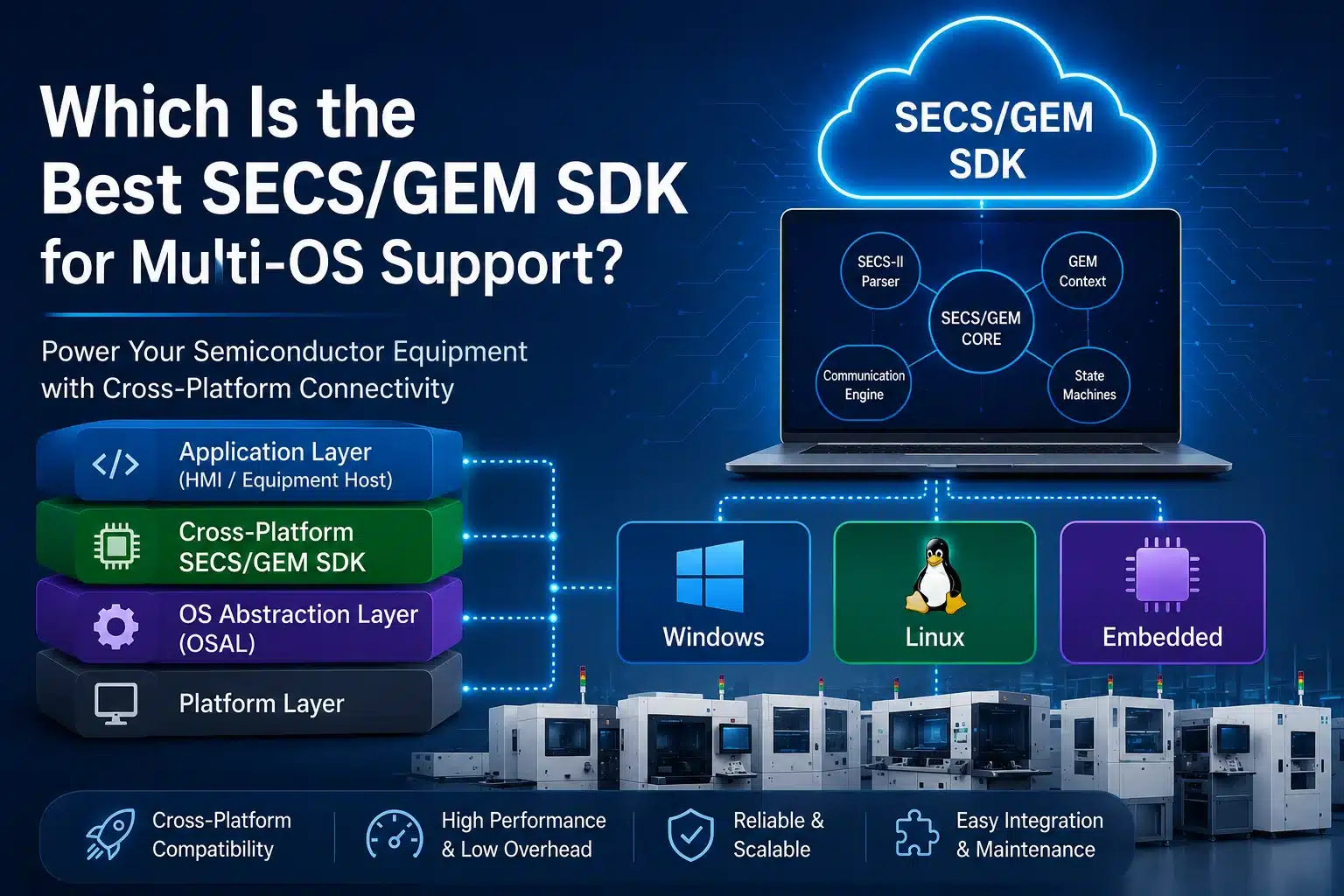
In modern semiconductor manufacturing, the pressure on Original Equipment Manufacturers (OEMs) and factory automation engineers to deliver smart-factory-ready machinery has never been higher. As fabrication plants (fabs) transition to fully automated, data-driven environments, equipment must communicate seamlessly with the factory’s Manufacturing Execution System (MES). This communication relies entirely on SEMI standards—specifically the SECS/GEM protocol suite (SEMI E4, E5, E30, and E37).
For software development teams building these control frameworks, writing a protocol stack from scratch is an operational bottleneck. Instead, utilizing a reliable SECS/GEM Software Development Kit is the industry standard for accelerating time-to-market. However, as the industry shifts away from traditional, monolithic architectures toward cloud-native ecosystems, edge computing, and specialized hardware controllers, a critical technical challenge has emerged: operating system dependency.
Historically, semiconductor equipment software ran almost exclusively on Windows-based industrial PCs. Today, equipment architectures are highly diversified, leveraging Linux for robust edge-processing, embedded RTOS (Real-Time Operating Systems) for deterministic micro-movements, and cross-platform virtualization. Consequently, selecting a Cross-Platform SECS/GEM SDK that natively supports multi-OS deployments without requiring a complete code rewrite is essential.
This comprehensive technical analysis evaluates the architectural criteria required to determine the best SECS/GEM SDK for multi-OS environments, helping you select a solution that guarantees factory automation compliance while future-proofing your equipment engineering pipeline.
1. The Core Architecture of Multi-OS Architecture
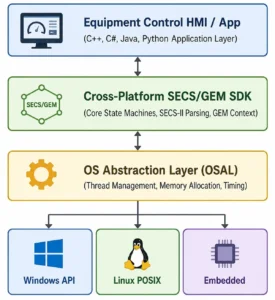
To understand what makes a solution the best SECS/GEM SDK for cross-platform deployments, engineers must analyze the underlying software compilation and abstraction layers. A truly platform-independent SECS/GEM Communication SDK must decouple the core protocol logic—such as parsing SECS-II messages and managing GEM state machines—from the OS-specific network and threading libraries.
When evaluating a SECS-II Protocol SDK, look for an explicit OS Abstraction Layer (OSAL). The OSAL handles system-level calls, including:
- Thread management (e.g., Windows Threads vs. POSIX Threads in Linux).
- Network socket manipulation (handling synchronous/asynchronous TCP/IP polling for High-Speed SECS Message Services).
- High-resolution timers are required for protocol timeout parameters ($T1$ to $T8$).
Without a clean abstraction layer, an SDK ported from Windows to Linux will suffer from latency fluctuations, thread synchronization deadlocks, and memory leaks. In high-speed semiconductor testing and sorting lines, a delay of even a few milliseconds caused by unoptimized OS context-switching can disrupt the synchronization between the equipment host communication program and the physical hardware.
2. Critical Evaluation Factors for Multi-OS Protocol Stacks
Choosing the best SECS/GEM SDK requires evaluating specific engineering vectors that directly influence system performance, long-term maintenance, and compliance stability.
Native Compilation vs. Managed Wrappers
Many commercial SDKs claim multi-OS support by wrapping a legacy Windows DLL inside a managed framework like .NET Core or Java Virtual Machine (JVM). While managed wrappers simplify multi-language binding, native compilation (e.g., pure C/C++ source compiled natively for the target architecture) offers superior performance. Native compilation ensures that the Semiconductor Equipment Communication Software directly utilizes system resources, reducing memory consumption and maximizing instruction-set efficiency on both $x86\_64$ and $ARM64$ industrial controllers.
Embedded System Constraints
If your equipment architecture deploys software directly onto programmable logic controllers or embedded microchips, a standard desktop SDK is unusable. Engineers require an Equipment Automation SDK optimized for low-footprint hardware environments, capable of running smoothly alongside PLC Software configurations without triggering memory fragmentation or violating deterministic real-time constraints.
HSMS Throughput and Network Efficiency
The integration of advanced sensors and high-frequency data collections (such as Interface A / EDA standards) means that a modern HSMS Communication SDK must process tens of thousands of messages per second. The best SECS/GEM SDK utilizes asynchronous, non-blocking I/O architectures (like epoll on Linux or I/O Completion Ports on Windows) to maintain optimal data throughput, ensuring that data logging never blocks the execution of vital machine safety logic.
3. Top Industry Contenders & Architectural Breakdown
When analyzing the global market for SECS/GEM Integration Software, three distinct architectural models emerge. Evaluating these approaches helps determine the best SECS/GEM SDK for your specific multi-OS manufacturing requirements.
| Architectural Parameter | Model A: Legacy Windows-First Stack | Model B: Open-Source / Do-It-Yourself Stacks | Model C: Modern Cross-Platform SDKs (e.g., eInnoSys EIGEM) |
| OS Abstraction Type | Managed emulation wrappers (.NET/Mono) | Manual POSIX implementation | Native OSAL (C++, C#, Java, Python native bins) |
| Data Throughput | Moderate (throttled by wrapper overhead) | Variable (highly dependent on custom code) | Optimized (up to 300% faster data transfer limits) |
| GEM Compliance Status | Fully Certified (SEMI E30 compliant) | Incomplete (requires manual state engine coding) | Fully Certified (Out-of-the-box GEM300 compliance) |
| Compilation Targets | $x86\_64$ Windows / Limited Linux | Developer Dependent | $x86$, $x86\_64$, $ARM64$ (Linux, Windows, Embedded) |
While legacy solutions provide strong stability in Windows environments, their reliance on runtime emulators like Mono on Linux often causes performance degradation during heavy automated messaging cycles. Conversely, open-source or home-grown protocol engines require months of dedicated development to achieve comprehensive GEM Compliance Software certification, creating unnecessary project risks and delayed deployments.
Modern cross-platform solutions, such as the eInnoSys EIGEMEquipment SDK, represent the ideal architectural balance. By compiling native binaries for Windows, Linux, and embedded environments, it functions as an elite SEMI Standards Software toolkit. It eliminates runtime overhead, supporting diverse development environments (C++, C#, Java, and Python) while delivering up to 300% faster message processing speeds compared to wrapped legacy alternatives.
4. Operational Impacts on Factory Automation and Yield
The software decisions made at the machine level have a cascading effect across the entire Semiconductor Factory Automation ecosystem. When an OEM builds equipment using a truly optimized Equipment Host Communication module, the end-user—the semiconductor fab—reaps immediate operational benefits.
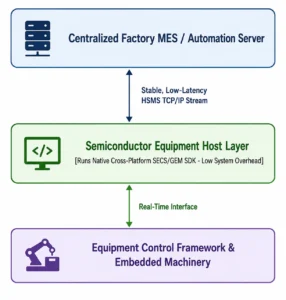
First, a native multi-OS implementation minimizes CPU and memory consumption on the tool’s industrial computer. This efficiency frees up hardware resources for critical edge-computing tasks, such as real-time Fault Detection and Classification (FDC) algorithms or advanced vision processing loops.
Second, standardization across different operating systems simplifies long-term software lifecycle management. If a tool vendor decides to migrate their hardware controller from a Windows IPC to a ruggedized Linux edge device to reduce hardware costs or increase stability, they do not have to scrap their communication layer. The best SECS/GEM SDK allows engineering teams to port their exact GEM data models, variable definitions, and event maps across platforms effortlessly, maintaining uniform behavior regardless of the host OS.
Ultimately, this seamless integration leads to predictable data collection. Fabs rely on clean SECS/GEM data to feed Recipe Management Systems (RMS) and execute real-time adjustments that optimize wafer yield. A rock-solid communication layer minimizes communication drops, reduces equipment idle time, and prevents costly wafer scraps caused by unlogged tool anomalies.
Conclusion: Selecting Your Development Foundation
Determining the best SECS/GEM SDK for multi-OS applications requires looking beyond basic feature lists. It demands a close inspection of compilation methods, native operating system abstraction capabilities, and the proven throughput efficiency of the underlying communication architecture.
For engineering teams looking to accelerate integration timelines while maintaining architectural flexibility across Windows, Linux, and embedded environments, selecting a natively compiled, feature-complete platform like the eInnoSys EIGEMEquipment SDK is an ideal choice. It delivers the cross-platform flexibility, fast compilation, and reliable SEMI compliance needed to satisfy strict factory requirements worldwide.


