
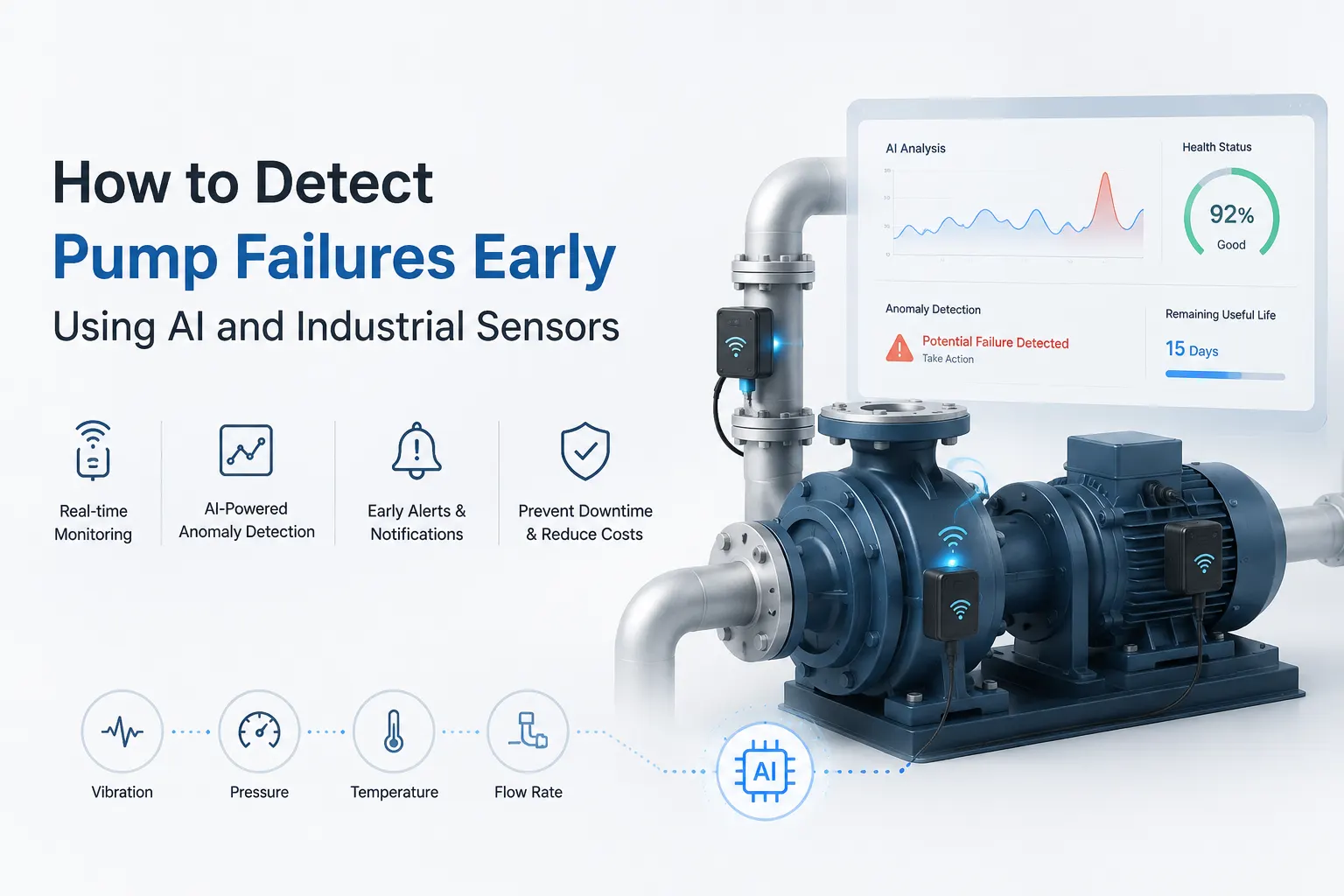
Pumps rarely fail without warning. Bearing wear, cavitation, seal degradation, misalignment, and electrical faults all develop gradually — leaving a measurable trail in vibration, temperature, pressure, and current data long before the pump actually stops working. The problem has never really been a lack of warning signs; it’s been the inability to watch for them continuously and act on them fast enough. That’s exactly the gap AI pump failure detection is designed to close.
For maintenance managers, reliability engineers, and plant operators across semiconductor manufacturing, oil and gas, chemical processing, power generation, and other process industries, moving from reactive or calendar-based maintenance to AI-driven predictive maintenance is one of the highest-leverage changes available today. Here’s how it works, and what to look for in a solution.
Why Pumps Fail?
Most industrial pump failures fall into a few recurring categories:
- Bearing wear and misalignment — introduces a distinctive vibration signature well before any audible noise or visible damage.
- Cavitation — vapor bubbles collapsing inside the pump, damaging impellers and volutes while producing a characteristic high-frequency acoustic and vibration pattern.
- Seal degradation — often shows up first as a subtle temperature or pressure change before it becomes a visible leak.
- Impeller wear and clogging — erosion, corrosion, or debris buildup that alters flow and pressure characteristics.
- Motor and electrical faults — winding degradation or phase imbalance that shows up in current draw before any mechanical symptom appears.
- Thermal stress — overheating from friction or poor lubrication that accelerates nearly every other failure mode.
Each of these leaves measurable signals days, weeks, or even months before failure. Catching that signal is the entire premise of predictive maintenance.
Why Traditional Maintenance Falls Short?
Reactive maintenance (“run it until it breaks”) is cheap on paper but expensive in practice — unplanned downtime, emergency repairs, and secondary equipment damage add up fast, and in industries like semiconductor manufacturing, a single failure can scrap an entire in-progress production lot.
Preventive maintenance (fixed schedules) reduces surprises but applies a statistical average to individual machines. It doesn’t account for the actual condition of a specific pump, so it routinely over-services healthy equipment while under-servicing pumps under harsher-than-average load.
Both approaches also depend on periodic human inspection — and a fault that develops between scheduled checks simply gets missed. Continuous, automated monitoring closes that gap.
The Sensors Behind AI Pump Monitoring
AI-based pump health monitoring relies on a compact set of industrial sensors, each tuned to a different failure signature:
- Vibration sensors — the richest data source for rotating equipment; different faults (bearing wear, misalignment, imbalance, cavitation) each produce a recognizable frequency “fingerprint.”
- Temperature sensors — a gradual rise in bearing or motor temperature is often the earliest sign of developing friction or lubrication problems.
- Pressure sensors — detect cavitation risk, clogging, and seal leakage through changes in inlet/outlet pressure.
- Current and power sensors — motor current signature analysis picks up electrical faults and can indirectly reveal mechanical issues.
- Acoustic sensors — especially effective for catching cavitation and early-stage bearing faults below the range of standard vibration analysis.
Individually, each sensor tells part of the story. AI’s real value comes from fusing them together.
How AI Turns Sensor Data Into Early Warnings
Raw sensor streams are just numbers until a model gives them meaning. AI-based pump monitoring systems typically combine several techniques:
- Baseline and anomaly detection — the system learns what “normal” looks like for a specific pump under its actual operating conditions, then flags meaningful deviations in real time.
- Fault classification — compares a flagged anomaly’s pattern against known fault signatures to identify the likely root cause, not just that something changed.
- Trend analysis and remaining useful life estimation — tracks how a developing fault evolves, so teams can schedule a fix during a planned outage instead of reacting to a sudden failure.
- Multi-sensor data fusion — combining vibration, temperature, pressure, and current dramatically reduces false positives compared to any single sensor alone.
The output isn’t a spreadsheet of raw values — it’s a prioritized, plain-language alert: which pump, what’s likely wrong, and how urgent it is.
Where This Applies Across Industries
AI pump failure detection is useful across many industries. In semiconductor manufacturing, vacuum and booster pumps are critical to process chambers. Continuous monitoring helps teams spot unusual changes before they stop production.
In oil and gas and chemical processing, early detection can reveal cavitation and seal problems. Finding these issues early can reduce costly downtime and improve equipment safety.
Power generation and water treatment also rely on pumps in remote locations. These assets can be difficult to inspect every day. AI monitoring helps maintenance teams track pump health without checking every asset in person.
In pharmaceuticals and food & beverage, unexpected pump failures can cause production delays. They may also lead to lost batches or compliance issues. Early detection gives teams more time to take action and protect both equipment and products.
Across these industries, the goal is similar. Plants can move from manual inspection rounds to continuous, AI-based pump condition monitoring. This approach can help identify problems earlier and support planned maintenance. It may also reduce unplanned downtime and emergency repairs while helping equipment operate reliably for longer periods.
The Business Case
For plant and maintenance leaders, the return on AI pump monitoring shows up in several places at once:
- Reduced unplanned downtime — early warnings convert emergency failures into planned maintenance events.
- Lower repair costs — catching a worn bearing early is far cheaper than replacing the motor it eventually destroys.
- Extended equipment life — early correction of misalignment, cavitation, and overheating limits cumulative damage.
- Smarter labor allocation — technicians focus on pumps that actually need attention.
- Improved safety and compliance — earlier detection of pressure and seal anomalies reduces the risk of leaks or unplanned shutdowns in regulated or hazardous environments.
What to Look for in an AI Pump Monitoring Solution
Not all “smart” monitoring products offer the same depth. Look for:
- Multi-parameter sensing (vibration, temperature, pressure, current at minimum) — single-parameter systems miss failure modes outside their one measured variable.
- Plug-and-play installation that doesn’t require modifying the pump.
- Machine-learning-based anomaly detection, not just static threshold alarms.
- Real-time dashboards and alerting that integrate into existing maintenance workflows.
- Cloud-based, multi-site access for organizations managing pumps across facilities.
- Secure architecture — encrypted data and role-based access, particularly important in semiconductor and pharma environments.
This is exactly where XPump by Einnosys fits. XPump is an AI/ML-based, plug-and-play pump health monitoring system that continuously tracks vibration, temperature, current, and other key parameters across pumps and motor-driven equipment, feeding that data into predictive models that flag anomalies and forecast potential failures before they cause downtime. It’s been deployed on turbomolecular, dry, rotary vane, and booster pumps in semiconductor fabs, giving maintenance teams real-time dashboards, automated alerts, and the kind of early warning that turns a potential emergency repair into a scheduled one.
Getting Started
- Start with critical pumps — the assets whose failure would most impact production, safety, or cost.
- Install sensors without disrupting operations — retrofit-friendly hardware avoids extended downtime.
- Let the system learn a baseline for each specific pump’s normal operating behavior.
- Route alerts into existing maintenance workflows so the right people can act on them.
- Expand gradually, using early results to build the case for monitoring additional assets.
Conclusion
Nearly every pump failure leaves a measurable signature — in vibration, temperature, pressure, or current — well before the pump actually stops working. AI-based pump monitoring gives maintenance teams the ability to watch continuously and act on that signal early, shifting from reactive firefighting to targeted, condition-based intervention.
If your team is evaluating how to bring this kind of predictive capability to your pumps and rotating equipment, XPump by Einnosys is worth a closer look — a plug-and-play, AI/ML-based monitoring system built for real-time pump health tracking and early failure detection across semiconductor, industrial, and process manufacturing environments.


