
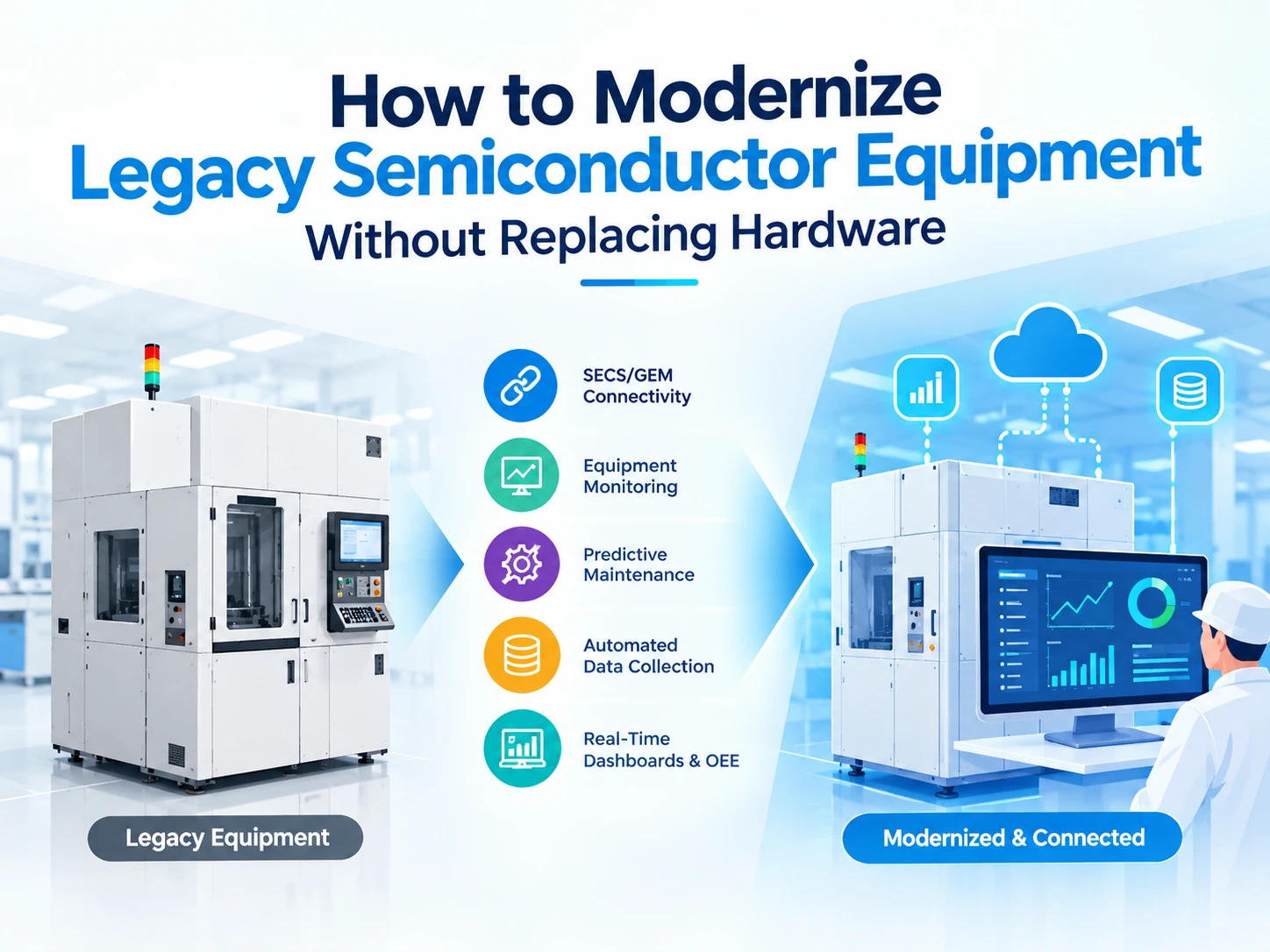
Many semiconductor fabs still use old equipment that has worked well for years. These machines often deliver stable and reliable results. However, modern factories need real-time data, host control, and process tracking. Older tools may not support these needs.
Replacing working equipment can be costly and may interrupt production. For example, installing a new tool can require a large investment, system setup, and process testing. In addition, factories may need to stop production during the change. Therefore, many manufacturers choose to upgrade legacy semiconductor equipment instead of replacing it.
The process is simple. If a tool still meets production needs, manufacturers can add the connectivity and monitoring features it lacks. As a result, they can improve data access and connect existing tools to factory systems. At the same time, they can continue using equipment that still works well.
In this article, we explain how legacy equipment modernization works, explore its main benefits, and discuss when replacing older equipment is a better choice.
Why Semiconductor Fabs Still Depend on Legacy Equipment
Fabs keep older tools for sound reasons:
- The equipment still meets process requirements. A qualified, stable process has real value.
- Replacement costs are high. New tools require significant capital investment.
- Many tools lack SECS/GEM interfaces. Without them, the host cannot communicate with the equipment in a standard way.
- Data collection is often manual. Operators record parameters and alarms by hand, which limits remote monitoring.
- MES integration is difficult. Without a standard interface, linking a tool to the Manufacturing Execution System (MES) takes custom work.
- Connecting to modern automation is hard. Proprietary or outdated controllers rarely fit current factory systems.
These gaps hurt visibility, traceability, and efficiency, even when the machine itself runs well.
What Does Legacy Semiconductor Equipment Modernization Mean?
Legacy semiconductor equipment modernization means improving connectivity, data visibility, monitoring, and automation while you keep the existing machine. The goal is to close the digital gap, not to rebuild the tool.
It helps to separate three approaches:
- Replacing the machine: You buy new equipment and requalify the process.
- Modifying the internal controller: You change the tool’s own software or hardware. This can be invasive and may need OEM support.
- Adding an external connectivity or monitoring layer: You connect to the tool through an available interface and leave the controller untouched.
The third approach is often the most practical for semiconductor equipment modernization. Feasibility still depends on the tool’s available interfaces, so a compatibility assessment comes first.
6 Ways to Upgrade Legacy Equipment Without Replacing It
1. Enable SECS/GEM Communication
SECS/GEM is the standard language between semiconductor equipment and factory host systems. Through it, the host receives equipment status, alarms, events, and process data. Where the equipment supports it, the host can also send remote commands.
Therefore, SECS/GEM for legacy equipment closes the most common gap in older fabs. For example, EIGEMBox adds SECS/GEM connectivity to compatible legacy tools without requiring software or hardware installation on the tool itself.
2. Connect Equipment to MES and Factory Automation Systems
Once a tool speaks a standard protocol, MES integration becomes much simpler. The MES can then support central monitoring, lot traceability, and automated workflows without manual data entry.
In this way, isolated tools become part of a connected line. For a wider view, see eInnoSys fab automation solutions.
3. Automate Data Collection and Equipment Monitoring
Manual logging is slow and inconsistent. Handwritten values can arrive late, contain typos, or get skipped.
By contrast, automated collection captures parameters, alarms, and status around the clock. Engineers get consistent, timestamped data and a clearer view of tool behavior. Consequently, this step is a core part of semiconductor equipment automation.
4. Improve Recipe Management and Remote Operations
With supported host communication, fabs can manage recipes centrally and send remote commands. This cuts manual recipe entry and helps prevent wrong-recipe errors.
However, what is possible depends on the equipment interface, configuration, and validation needs. Review these with your integration partner. EIGEMBox and EIStationController support these workflows where the tool allows.
5. Add Predictive Maintenance and Fault Detection
After data starts to flow, engineers can look for unusual patterns before they become failures. For instance, a change in pump or motor behavior can signal wear early.
XPump supports predictive monitoring of pumps and motors.
SeerSight supports AI/ML-based fault detection and classification (FDC).
These tools help engineers investigate issues sooner. Note that they add to good maintenance practice and do not replace it. You can read more under fab automation.
6. Digitize Analog Gauges and External Devices
Analog gauges, pressure indicators, and other add-on devices often hold key readings that never reach a system. Operators read them by eye, so the data is lost.
Digital monitoring solves this by turning those readings into data your manufacturing systems can use. EIGaugeMonitor is one such approach. Still, not every legacy device can be integrated, so a compatibility assessment is essential.
Legacy Equipment Modernization vs. Equipment Replacement
| Factor | Equipment Replacement | Legacy Equipment Modernization |
|---|---|---|
| Initial Investment | Typically requires higher capital expenditure | Depends on the solution and project scope |
| Production Disruption | May require installation, testing, and qualification | May reduce disruption when integration is carefully planned |
| Existing Equipment | Existing equipment is replaced | Existing equipment is retained if technically suitable |
| Automation Connectivity | Depends on the capabilities of the new equipment | Added through compatible interfaces or integration solutions |
| Implementation Effort | Includes procurement, installation, and qualification | Includes interface assessment, configuration, integration, and validation |
| Best Suited For | Equipment that no longer meets production requirements | Functional equipment with connectivity or monitoring gaps |
Modernization is not always the right answer. Serious mechanical failures, obsolete safety systems, unsupported components, or inadequate process capability may call for major upgrades or replacement. Evaluate the tool’s condition honestly before deciding.
How eInnoSys Helps Modernize Legacy Semiconductor Equipment
eInnoSys provides semiconductor equipment connectivity and factory automation solutions for fabs, OSATs, and equipment OEMs. The relevant products include:
- EIGEMBox: Adds SECS/GEM connectivity to compatible legacy equipment without requiring software or hardware installation on the tool itself.
- EIGEMEquipment: Provides a SECS/GEM SDK and implementation options for equipment integration projects.
- SeerSight: Supports AI/ML-based equipment fault detection and monitoring.
- XPump: Supports predictive monitoring of pumps and motors.
- EIGaugeMonitor: Helps digitize analog gauge readings for monitoring.
Real-World Example: Honeywell
eInnoSys’s published case study, Transforming Legacy Fab Equipment for Honeywell, shows this approach in practice.
The challenge: Honeywell wanted to modernize legacy semiconductor equipment without costly OEM upgrades or production downtime.
The approach: Using EIGEMBox, eInnoSys enabled non-intrusive SECS/GEM connectivity for SPTS Dry Etch and Novellus systems. The connection used the tools’ existing monitor, keyboard, and mouse ports, so the tools needed no intrusive hardware changes. eInnoSys also implemented EIStationController, SeerSight, XPump, and EIGaugeMonitor.
Documented outcomes (per the case study):
- Reduced scrap and manual process errors
- Predictive maintenance enabled through real-time monitoring
- Zero-downtime implementation
- High OEM upgrade costs avoided
- Better fab-wide visibility through unified SCADA/FDC dashboards
These results come from one project. Your results will depend on your equipment and scope. Treat the benefits described earlier in this article as general potential, not guarantees.
Recommended Implementation Roadmap
- Audit existing equipment and identify automation gaps.
- Review available interfaces, controller limitations, and communication requirements.
- Select a suitable connectivity or monitoring approach.
- Configure and validate the integration in line with production and safety requirements.
- Monitor performance and expand the solution to other suitable tools.
Compatibility, downtime, and validation needs vary with the equipment and integration scope. Plan for them early.
Conclusion
Modernizing legacy semiconductor equipment can help fabs extend tool life, improve connectivity, and reduce manual work. It also supports smart manufacturing goals. As a result, manufacturers can improve automation and access equipment data without the high cost of replacing every tool.
However, modernization is not the right solution for every situation. Before making a decision, evaluate the equipment’s condition, system compatibility, and integration needs. In addition, consider your long-term production goals and maintenance costs. This approach will help you decide whether to upgrade existing equipment or invest in new tools.
Ready to Modernize Your Legacy Semiconductor Equipment?
Explore how eInnoSys can help assess your equipment connectivity requirements and identify a suitable path toward SECS/GEM integration, factory automation, and improved equipment visibility.
Request a Demo or Discuss Your Equipment Integration Requirements.
Related Articles
- SECS/GEM Integration on Disco DFG8560
- Enabling E84/E87 Protocols on Legacy Equipment with EIGEMBox
- SECS/GEM Integration on Applied Materials P-5000 CVD SACVD


