
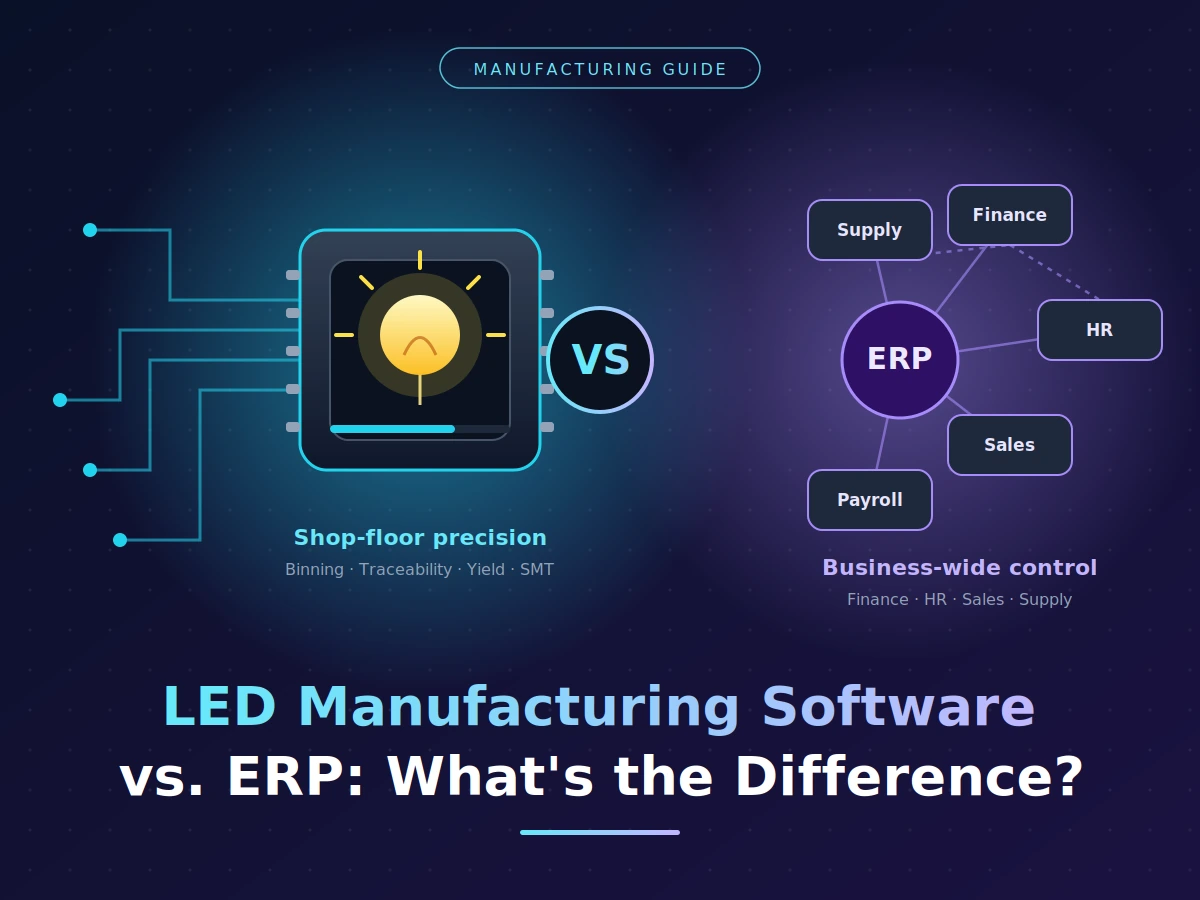
LED manufacturing software and ERP are often grouped together, but they solve very different problems. ERP manages the business. LED manufacturing software manages the production floor. Confusing the two leaves plants with good financial records and poor visibility into what their equipment is doing.
This guide explains how each system works, where they differ, and how they combine to improve production visibility, equipment connectivity, and efficiency.
What Is ERP in LED Manufacturing?
Enterprise Resource Planning (ERP) is a business-level system. It connects departments such as finance, procurement, sales, inventory, and human resources in one database.
In an LED plant, ERP typically handles:
- Purchase orders for wafers, phosphors, and substrates
- Inventory levels and warehouse records
- Sales orders and customer invoicing
- Production planning at a high level
- Cost accounting and financial reporting
ERP answers questions like “Do we have enough material?” and “Will this order ship on time?” It works with data measured in hours or days. It was not designed to talk to a die bonder, a wire bonder, or a test handler.
What Is LED Manufacturing Software?
LED manufacturing software operates on the shop floor. It connects directly to production equipment, collects real-time data, and helps teams control and improve processes as they happen.
This category includes several types of tools:
- LED production management software tracks work orders, lots, recipes, and process flow
- LED production monitoring software shows live output, yield, and line status
- LED manufacturing automation software controls equipment and reduces manual intervention
- LED equipment monitoring software tracks machine states, alarms, and utilization
LED manufacturing software answers questions like “Why did this machine stop?” and “Which lot is running on which tool right now?” It works with data measured in seconds.
LED Manufacturing Software vs. ERP: Key Differences
| Factor | ERP | LED Manufacturing Software |
|---|---|---|
| Primary Focus | Business operations | Production floor operations |
| Data Processing | Periodic business updates | Real-time production data |
| Equipment Connectivity | Often limited or indirect | Direct equipment integration and monitoring |
| Main Users | Finance, planning, procurement | Operators, engineers, plant managers |
| Typical Output | Orders, costs, inventory | Machine status, production performance, traceability |
| Communication Protocols | APIs and database connections | SECS/GEM and equipment-specific interfaces |
The biggest gap is equipment connectivity. ERP records that a lot was started. LED manufacturing software shows what happened to that lot, step by step, on each machine.
Why ERP Alone Is Not Enough for LED Production
Many plants try to stretch ERP to cover the shop floor. This usually creates problems.
- Delayed information. Operators enter data by hand, so ERP records lag behind real events. A machine can sit idle for an hour before anyone notices.
- Limited traceability. LED production involves binning, die attach, wire bonding, encapsulation, and testing. Each step affects final quality. ERP rarely captures parameter-level data for each step.
- No equipment context. ERP does not know a machine’s state, alarm history, or recipe in use. Without that context, root cause analysis becomes guesswork.
- Manual effort. Staff spend time re-keying data between machines and systems. This adds errors and slows decisions.
- A manufacturing execution layer closes these gaps. It sits between your equipment and your business systems.
How LED Manufacturing Software and ERP Work Together
The two systems are complementary, not competing. A simple way to picture the flow:
- ERP releases a production order with quantities and due dates.
- LED production management software breaks the order into lots and sends recipes to equipment.
- Equipment connectivity software collects data from each machine as the lot runs.
- LED production monitoring software displays live status, output, and yield.
- Completed lot data flows back to ERP for inventory, costing, and delivery updates.
ERP supplies the plan. Shop floor software supplies the truth about execution. When the two are integrated, planners see actual progress instead of estimates, and engineers see orders in context.
Core Capabilities of LED Manufacturing Software
- Production Visibility:-
Live dashboards show line status, work-in-progress, and throughput. Managers can spot bottlenecks without walking the floor or waiting for end-of-shift reports. - Equipment Connectivity:-
Modern and legacy tools use different communication methods. Connectivity software standardizes them, often using SECS/GEM, so all machines report data in a consistent format. This is the foundation for monitoring and automation. - Automation:-
Automation software can download recipes, start and stop processes, and handle events without manual steps. This reduces recipe errors, one of the most common causes of scrap in LED lines. - Monitoring and Alerts:-
LED equipment monitoring software tracks utilization, downtime reasons, and alarms. Teams can calculate OEE and respond to issues quickly. - Traceability:-
Lot-level and machine-level records support quality audits and customer queries. If a defect appears, you can trace it back to the tool, recipe, and time window.
When Do You Need Each System?
- You need ERP if you must manage finances, procurement, inventory, and customer orders across the business. Almost every manufacturer does.
- You need LED manufacturing software if you want real-time machine data, fewer manual entries, faster troubleshooting, and better yield control. This matters most for plants with many tools, mixed equipment ages, or strict quality requirements.
- You need both if you want a connected operation. Most growing LED manufacturers reach this point once spreadsheets and manual logs stop scaling.
Explore Einnosys Solutions for LED Manufacturing
Einnosys offers tools that cover the equipment connectivity and production layer of an LED plant:
- EIGEMBox helps connect equipment to factory systems through a ready connectivity unit
- EIGEMHMI provides an operator interface for equipment and process interaction
- EIGEMEquipment adds equipment-side communication capabilities for factory integration
- EIGEM300Equipment supports 300mm-style equipment communication standards
- EIGEMLink links equipment and host systems for data exchange
- EIGEM84 supports additional equipment connectivity needs
- EIGEMSim simulates equipment and host behavior so teams can test integration before going live
You can also read more about the LED and flat panel industry solutions from Einnosys.
Conclusion
ERP and LED manufacturing softwareserve different layers of the same operation. ERP plans and records the business. LED manufacturing software connects machines, monitors production, and automates the floor. Used together, they give plant teams accurate, real-time data and give planners reliable numbers.
Einnosys helps LED manufacturers build that connected foundation with equipment connectivity, monitoring, and automation solutions designed for real production environments. If your plant relies on manual logs or disconnected tools, Einnosys can help you move toward a more visible and efficient operation.
Related Blogs:-
Best LED Manufacturing Software for Production Management
How LED Manufacturing Software Improves Production Efficiency
Key Features to Look for in LED Manufacturing Software


