
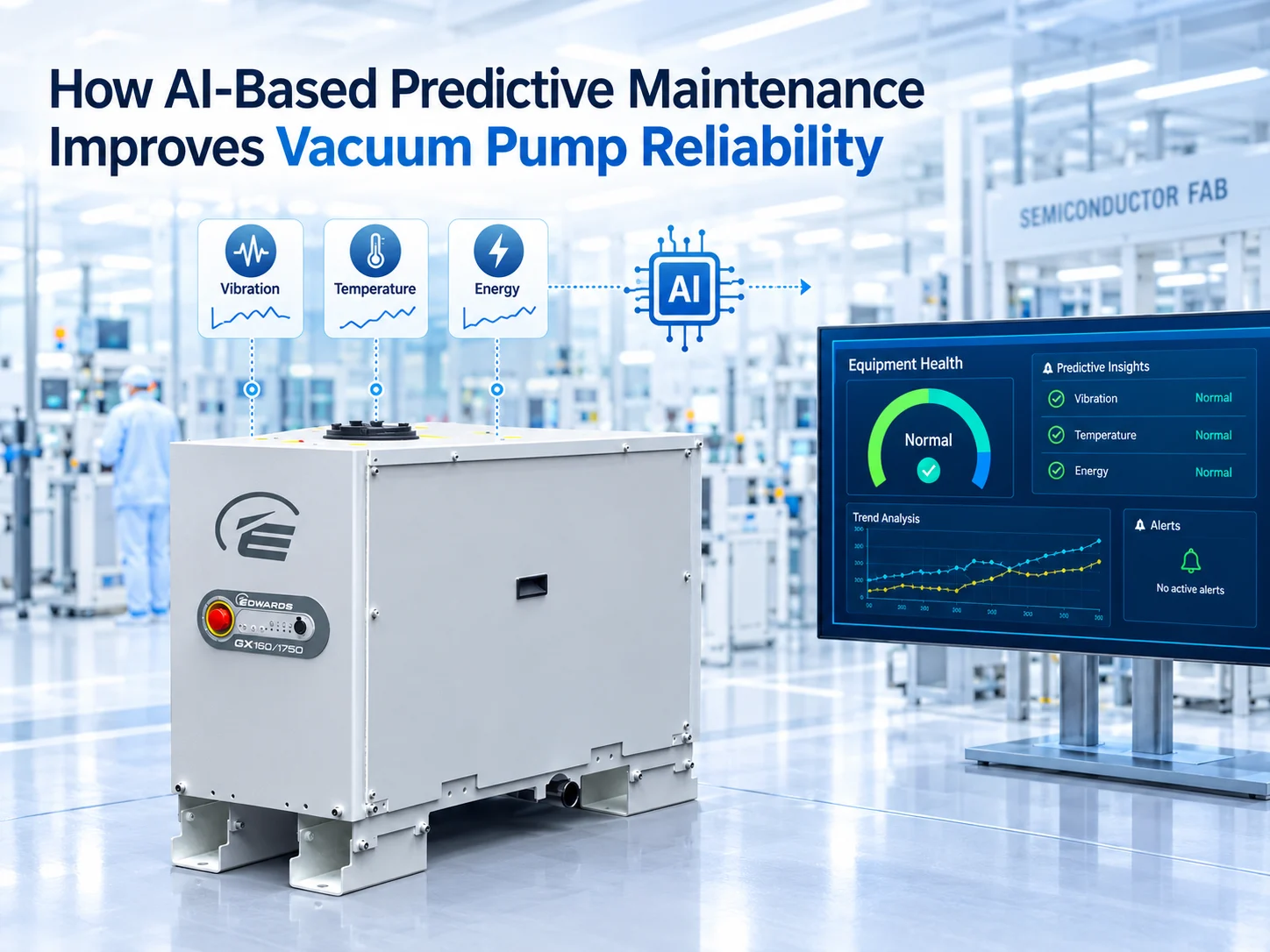
A vacuum pump rarely gets attention until something goes wrong. In semiconductor manufacturing, though, vacuum pumps support process tools that run around the clock. An unexpected pump issue can interrupt production, trigger urgent maintenance, and put process consistency at risk.
Reactive maintenance leaves teams guessing. AI-based predictive maintenance takes a different approach. It uses operating data and condition monitoring to spot abnormal patterns before they develop into serious equipment problems. This article explains how that approach applies to the Edwards GXS450 and what a practical implementation involves.
Understanding the Edwards GXS450 Vacuum Pump
The Edwards GXS450 is a dry screw vacuum pump. Two intermeshing screw rotors move gas through the pump without oil in the swept vacuum chamber. That design suits many industrial and semiconductor applications where oil-free pumping matters.
Stable vacuum performance matters because process tools depend on it. Operating conditions, such as gas load, temperature, and process byproducts, affect how a pump behaves over time. Routine maintenance remains essential. Monitoring equipment health complements it by showing how a specific pump actually behaves between scheduled service events.
Suitability depends on the configuration and the process. Not every GXS450 setup fits every semiconductor application, so always confirm against the manufacturer’s documentation.
Why Vacuum Pump Reliability Matters in Semiconductor Manufacturing
Pump problems ripple outward. Consider the main impacts:
- Production continuity: A pump fault can pause the tool it supports.
- Equipment availability: Unplanned stops reduce the time tools are ready to run.
- Maintenance costs: Emergency repairs usually cost more than planned work.
- Process consistency: Vacuum instability can affect process conditions.
- Team workload: Urgent interventions pull engineers away from planned tasks.
Fixed-interval maintenance helps, but it treats every pump the same. Two pumps with identical schedules can see very different conditions in the field.
How AI-Based Predictive Maintenance Improves GXS450 Reliability
1. Monitors Vibration Patterns
Vibration trends can reveal changes linked to mechanical wear, imbalance, or other abnormal conditions. A gradual shift from a pump’s own baseline often tells you more than a single reading. Engineers can then inspect the pump with a specific concern in mind.
2. Tracks Temperature Changes
Temperature monitoring helps teams investigate unusual operating conditions. A pump that runs warmer than usual under similar loads deserves a closer look. Temperature data also adds context to vibration and energy trends.
3. Analyzes Energy Consumption
Power consumption can shift when operating conditions change. Evaluated alongside process and equipment data, these shifts help teams separate normal process variation from genuine pump concerns.
4. Detects Abnormal Patterns Earlier
AI and machine learning models compare current operating trends with a learned baseline. They flag deviations and help teams investigate potential faults before a breakdown occurs. Detection capability depends on sensor quality, available data, equipment configuration, and model validation. No model works well without good inputs.
5. Supports Planned Maintenance
Alerts and trend analysis help teams prioritize inspections. They can schedule work around production requirements instead of reacting to a stoppage. For more on the technology, see eInnoSys’s guide to AI-based pump failure detection.
Traditional Maintenance vs. AI-Based Predictive Maintenance
| Factor | Traditional (Reactive/Preventive) Maintenance | AI-Based Predictive Maintenance |
|---|---|---|
| Maintenance approach | Fixed intervals or repairs after failure | Condition-based insights complement routine servicing |
| Fault detection | Periodic inspections and operator observations | Sensor-based trend monitoring and anomaly analysis |
| Equipment monitoring | Scheduled checks and manual readings | Ongoing monitoring using available sensor data |
| Maintenance scheduling | Based on calendar intervals or operating hours | Informed by equipment condition, alerts, and trends |
| Unplanned downtime risk | Issues may develop between scheduled checks | Early warnings may help reduce avoidable downtime |
| Data-driven decision-making | Relies mainly on maintenance logs and operator experience | Uses historical and real-time data to support decisions |
Predictive maintenance does not eliminate all failures. It also does not replace preventive maintenance. The two work best together.
How eInnoSys XPump Supports AI-Based Pump Monitoring
XPump is eInnoSys’s AI/ML-based predictive maintenance solution for pumps. It tracks vibration, temperature, and current-related signals. It also provides real-time dashboards and automated alerts, helping teams spot abnormal operating patterns and plan maintenance. Deployment options, such as cloud or on-premises, should be confirmed with eInnoSys for your site.
For a GXS450, these capabilities map directly to the monitoring goals above. XPump could help establish a baseline, flag drift in vibration or temperature, and give maintenance teams an early indication to investigate.
An important note: Sensor availability, data collection, integration feasibility, and configuration must be assessed for each installation. eInnoSys has not stated a verified, direct, plug-and-play integration with the Edwards GXS450, and none should be assumed. Also, eInnoSys is not affiliated with or endorsed by Edwards Vacuum.
To see how eInnoSys describes pump monitoring in practice, read the XPump DynaSeal TRO015H success story.
Practical Steps to Implement Predictive Maintenance for a GXS450 Pump
- Review the pump configuration and maintenance history.
- Identify available operating data and suitable sensor locations.
- Establish baseline operating conditions.
- Configure monitoring and data collection.
- Define abnormal-condition alerts.
- Validate alerts against actual equipment conditions.
- Integrate findings into maintenance workflows.
- Review performance and refine monitoring thresholds.
Throughout, the pump manufacturer’s maintenance instructions and operating limits must remain central to your strategy. Monitoring informs those decisions. It never overrides them.
Key Benefits for Semiconductor Fabs
Fabs may gain the following, depending on their data, equipment, and processes:
- Better visibility into equipment condition
- Earlier investigation of abnormal behavior
- More informed maintenance decisions
- Improved maintenance planning
- Potential reduction in avoidable downtime
- Better use of maintenance resources
These are potential benefits, not guaranteed outcomes. For broader context, see eInnoSys’s guide to pump health monitoring.
Conclusion
AI-based predictive maintenance can complement routine maintenance. It helps teams understand equipment behavior, detect anomalies, and plan interventions more effectively. Successful implementation still depends on suitable data collection, validated monitoring, and equipment-specific requirements.
For fabs evaluating pump condition monitoring, eInnoSys XPump is a solution worth exploring. You can also read more about predictive maintenance for pumps.
Improve Your Equipment Monitoring Strategy
Looking to improve vacuum pump monitoring and maintenance planning? Contact eInnoSys to explore how AI-based predictive maintenance solutions such as XPump may support your equipment reliability goals.
Related Articles
- How to Detect Pump Failures Early Using AI and Industrial Sensors
- Predictive Maintenance for Pumps: The Future of Industrial Reliability
- Pump Health Monitoring: Predictive Maintenance Tools & Strategies


