
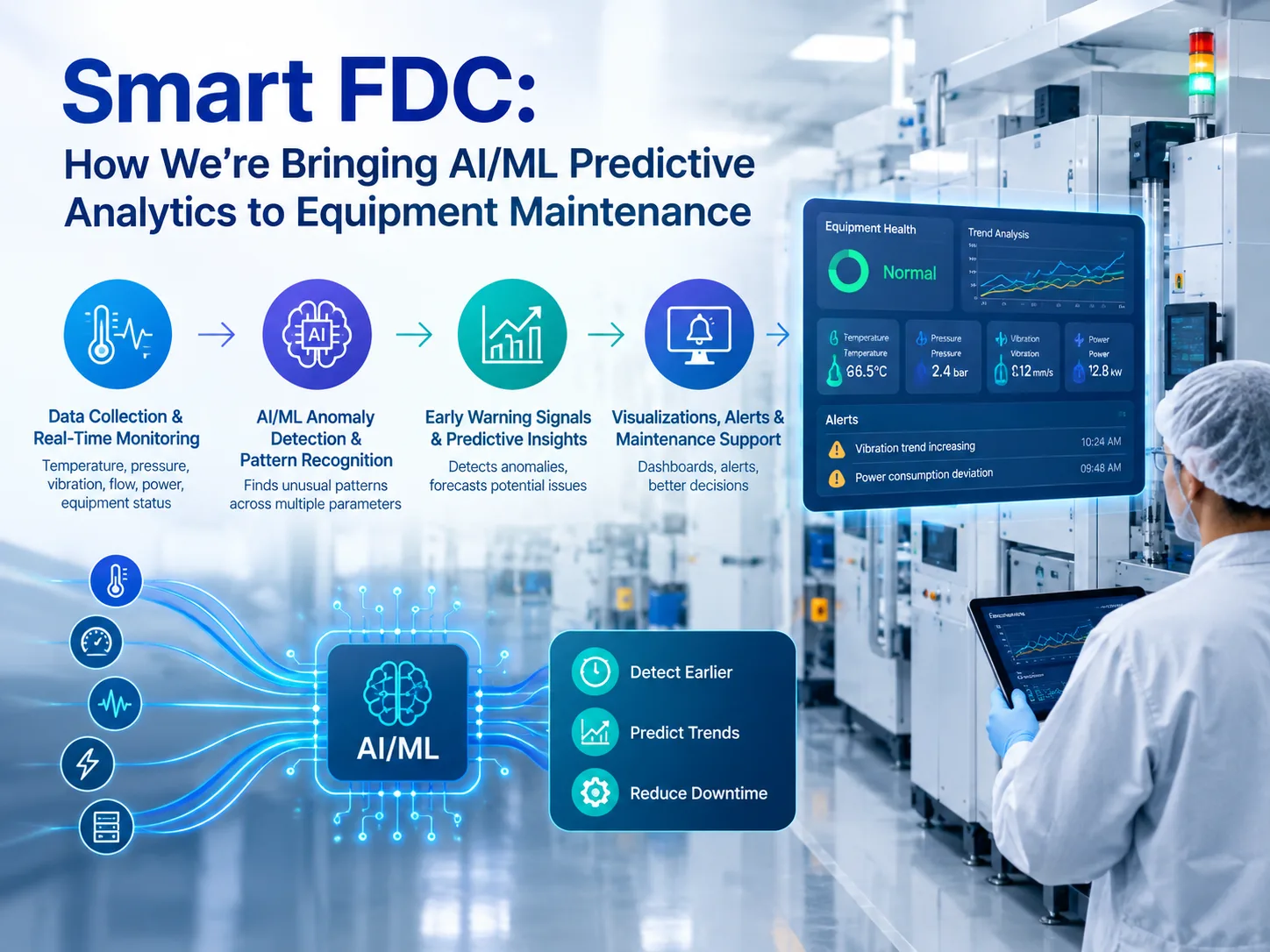
A pump trips mid-lot. A chamber drifts out of range. A tool goes down, and the maintenance team starts troubleshooting after the damage is done. Unexpected equipment failures cost fabs time, wafers, and schedule confidence. Reactive maintenance leaves teams responding to problems instead of preventing them.
Smart FDC addresses this gap. It combines Fault Detection and Classification (FDC) with AI/ML predictive analytics, so teams can see abnormal behavior earlier and plan maintenance with better information. Semiconductor equipment already produces large volumes of data. A data-driven maintenance strategy turns that data into decisions.
What Is Smart FDC?
- Fault Detection and Classification in Simple Terms
Fault Detection and Classification (FDC) monitors equipment parameters during operation. Fault detection identifies unusual behavior, while classification helps determine the type of problem. Together, these functions help engineers identify issues and respond faster.
- How Traditional FDC Works
Traditional FDC uses equipment parameters, fixed limits, and predefined rules to detect problems. For example, an alarm triggers when chamber pressure moves outside a set range. This method works well for known faults. However, it may miss unexpected problems because the rules only cover conditions defined in advance. Moreover, gradual changes can remain within set limits even when equipment performance starts to decline.
- Where AI/ML Adds Value
AI/ML-based FDC uses historical and live equipment data to learn normal operating patterns. It then identifies unusual changes that may indicate a developing problem. Unlike single-parameter checks, this approach can also detect patterns across multiple parameters. As a result, engineers gain better insights into equipment behavior and can investigate potential issues earlier.
However, results depend on data quality, model selection, and system configuration. With sufficient reliable data, Smart FDC can support anomaly detection, trend analysis, and more informed maintenance planning.
How Smart FDC Brings AI/ML Predictive Analytics to Equipment Maintenance
- Equipment Data Collection and Real-Time Monitoring
Everything starts with data. Smart FDC monitors equipment parameters such as temperature, pressure, vibration, flow, power, and operating status. As a result, engineers can track equipment performance in real time and spot changes as they happen.
- AI/ML-Based Anomaly Detection and Pattern Recognition
Next, AI/ML models compare live equipment data with learned baselines. They also look for patterns across different parameters and over time. For example, rising vibration combined with a change in power consumption may indicate a developing issue. Therefore, engineers can investigate unusual behavior before it triggers a standard alarm.
- Early Warning Signals and Predictive Insights
Anomaly detection and failure prediction serve different purposes. Detection identifies behavior that differs from normal conditions, while prediction estimates whether a problem may develop in the future. However, reliable predictions require sufficient historical data, including examples of past failures or equipment degradation. Even without this history, Smart FDC can still identify unusual patterns, although its predictive insights may be limited.
- Data Visualization, Alerts, and Maintenance Decision Support
Finally, clear information helps engineers take action. Dashboards display equipment health and performance trends, while alerts notify the relevant team about unusual conditions. In addition, these insights support better maintenance planning. For example, engineers can decide whether to inspect equipment during the next scheduled stop or investigate the issue immediately.
A practical workflow example
Consider a vacuum pump on a process tool:
- The system collects vibration, temperature, and motor current data continuously.
- The AI/ML model learns the pump’s normal operating pattern.
- Vibration begins climbing slowly while temperature stays within limits.
- The system flags the pattern as an anomaly and raises an early warning.
- A maintenance engineer reviews the trend and schedules an inspection.
In this scenario, no threshold alarm fired. The model caught the pattern, and the team gained time to plan.
Key Benefits of Smart FDC
Smart FDC can offer several practical advantages. Outcomes vary by fab, equipment, and data availability.
- Earlier identification of abnormal behavior. Pattern-based detection can surface issues before fixed limits are crossed.
- Potential reduction in unplanned downtime. Earlier warnings give teams more room to act. We do not promise specific results without verified evidence from your own environment.
- Improved equipment health visibility. Trends and dashboards make tool condition easier to see.
- More informed maintenance planning. Teams can prioritize based on observed condition, not only on calendar schedules.
- Better use of equipment data. Data that sat in logs becomes a working asset.
- Support for smart factory and Industry 4.0 initiatives. Connected, analyzed equipment data is a foundation for broader automation.
Smart FDC vs. Traditional Equipment Monitoring
| Aspect | Traditional Monitoring | Smart FDC |
|---|---|---|
| Monitoring Approach | Parameter-by-parameter review against fixed limits | Multi-parameter monitoring with learned baselines |
| Detection Methods | Thresholds and predefined rules | Rules combined with AI/ML anomaly detection |
| Pattern Recognition | Limited to known, rule-based conditions | Identifies subtle or combined patterns |
| Predictive Capabilities | Minimal | Provides trend-based insights when sufficient data exists |
| Maintenance Planning | Mostly reactive or calendar-based | Supports maintenance planning using equipment condition insights |
| Data Visibility | Alarms and logs | Dashboards, trends, and alerts |
Actual capabilities depend on available data, algorithms, configuration, and equipment integration.
How Smart FDC Supports Semiconductor Smart Manufacturing
Smart manufacturing depends on a clear data chain. Equipment connectivity gathers the data. Collection and processing prepare it. Analytics find meaning. Dashboards and maintenance workflows put that meaning in front of the right people.
SECS/GEM often plays a role at the connectivity stage, because many tools expose status and process data through this standard. Where equipment does not support it, other data sources may be needed, and integration scope should be confirmed per tool. eInnoSys offers equipment connectivity products, covered below, that can help with this first step.
Practical Applications
- Temperature: A chamber heater slowly needs more power to hold the same setpoint. The model flags the trend, and engineers inspect before a process excursion.
- Pressure: Small, repeated pressure fluctuations appear during a specific recipe step. Classification helps narrow the cause, such as a valve or a leak.
- Vibration: A rotating component shows rising vibration. An early warning prompts an inspection at the next planned stop.
- Equipment status: Unusual state transitions or longer-than-normal cycle steps suggest a developing issue worth review.
In each case, the abnormal trend triggers an investigation. Engineers make the final maintenance call.
Conclusion
Smart FDC helps manufacturers make better use of equipment data. It identifies unusual behavior, highlights important trends, and supports smarter maintenance decisions. Moreover, AI/ML-based insights help engineers investigate potential issues before they become more serious. However, Smart FDC does not replace engineering judgment. Instead, it provides useful information so engineers can make informed decisions and improve equipment maintenance.
Ready to Explore Smart FDC?
If you want to discuss Smart FDC, equipment monitoring, AI/ML analytics, or a product demonstration, the eInnoSys team is glad to talk through your equipment and data. Contact eInnoSys to start the conversation.
Related products and solutions :
- Fault Detection & Classification (FDC)
- AI/ML-Based Predictive Maintenance (XPump)
- EIGEMBox: plug-and-play SECS/GEM for legacy equipment, relevant when older tools need connectivity for data collection
- EIGEMEquipment: SECS/GEM SDK for OEMs, relevant for equipment makers building data access into new tools
- Resource: AI/ML for Semiconductor


