
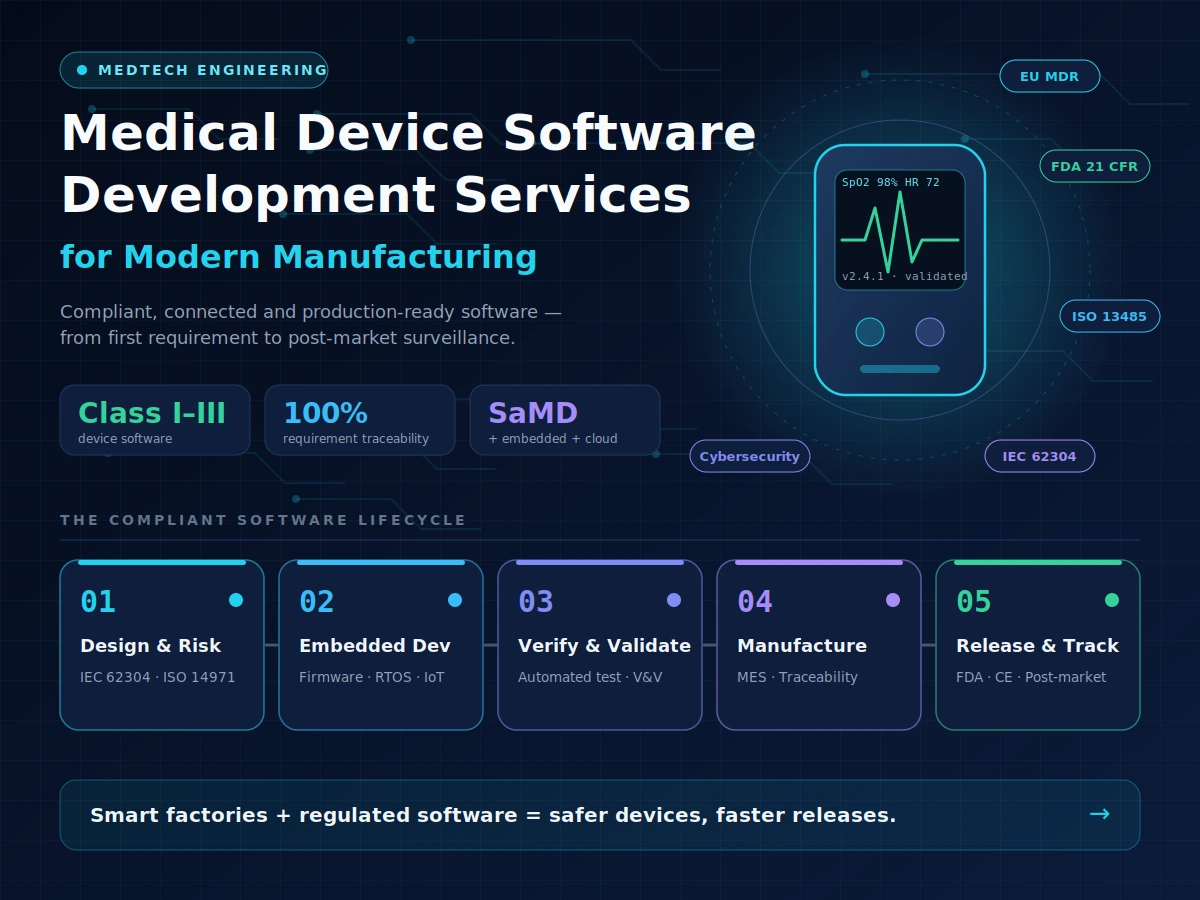
Medical device production leaves no room for error. Every part must be traceable, every process validated, and every record audit-ready. Manual methods and disconnected machines make that hard to achieve.
This is where medical device software development services make a real difference. The right software connects equipment, captures data, and enforces quality rules on the shop floor. In this guide, you will learn how software supports modern manufacturing and what to look for in a development partner.
What Are Medical Device Software Development Services?
Medical device software development services cover the design, build, and integration of software used in production. They go beyond the software inside a device. They focus on the systems that help you make the device.
These services typically include:
- Equipment communication and connectivity software
- Operator interfaces (HMI) for production machines
- Manufacturing execution system (MES) integration
- Data collection, reporting, and traceability tools
- Simulation and testing tools for validation
A skilled medical device software development company understands both engineering and regulation. That combination keeps your systems reliable and compliant.
The Role of Software in Medical Device Manufacturing
Modern factories depend on software at every stage. Manufacturing software for medical devices coordinates machines, people, and data in real time.
Here is what it helps you achieve:
- Consistency: Machines follow the same validated recipes every time.
- Visibility: Managers see production status without walking the floor.
- Compliance: Records are captured automatically, which supports FDA and ISO 13485 expectations.
- Speed: Faster changeovers and fewer manual entries reduce delays.
Software also supports medical device product development. Teams can move from prototype to scaled production with fewer surprises. Process data from early builds feeds directly into later validation work.
Equipment Connectivity and Automation
Most production lines include machines from different vendors and different decades. Many cannot share data on their own. This creates data silos and forces operators to log information by hand.
Equipment connectivity solves this problem. It lets machines talk to a central host or MES using standard protocols. As a result, you can:
- Collect process parameters automatically
- Send recipes and commands to machines remotely
- Receive alarms and events instantly
- Reduce operator error and rework
Automation builds on that connection. Once equipment is online, you can trigger actions based on live conditions. For example, a line can pause when a measurement drifts outside its limit. That protects product quality before defects pile up.
MES Integration, Production Monitoring, and Traceability
A medical device manufacturing execution system manages work on the shop floor. It tracks orders, materials, operators, and machines from start to finish. However, an MES is only as good as the data it receives.
That is why MES integration for medical devices matters so much. Connected equipment feeds the MES with accurate, timestamped information. In turn, the MES gives you:
- Real-time production monitoring: See throughput, downtime, and yield as they happen.
- Full traceability: Link each finished device to its components, machines, operators, and process settings.
- Faster recalls and investigations: Trace affected lots in minutes instead of days.
- Electronic batch and device history records: Replace paper with searchable, secure records.
Strong medical device MES software also supports genealogy tracking. If a supplier reports a defective component, you can identify every affected unit quickly. This limits risk to patients and protects your brand.
Quality Control and Manufacturing Data Management
Quality teams need reliable data. Without it, audits become stressful and root-cause analysis takes too long.
Medical device production software helps by enforcing quality at the source. It can:
- Verify inspection steps before a unit moves forward
- Flag out-of-spec results immediately
- Lock out unapproved materials or operators
- Maintain a secure audit trail of every change
Data management is just as important. Production generates huge volumes of data. Good software stores it in a structured way, so teams can analyze trends and spot problems early. Over time, this supports continuous improvement and lowers scrap rates.
Benefits of Custom Medical Device Manufacturing Software
Off-the-shelf tools rarely fit every line. Equipment types, product families, and validation rules differ from one plant to another. Custom medical device manufacturing software closes that gap.
Key benefits include:
- Better fit: Software matches your actual workflows, not generic ones.
- Easier integration: It connects to your existing machines, MES, and ERP.
- Scalability: You can add lines, products, or sites without starting over.
- Validation support: Documentation and testing align with your quality system.
- Lower long-term cost: You avoid workarounds and costly rework.
Customization also protects your investment. You keep legacy equipment productive instead of replacing it early.
How eInnoSys Supports Equipment Integration and Factory Automation
eInnoSys specializes in equipment connectivity and factory automation. Its solutions help manufacturers bring machines online and connect them to higher-level systems. For regulated sectors, the medical devices industry solutions page shows how this approach applies to your plant.
Here is how the product line supports your goals:
- EIGemBox: Adds connectivity to equipment, including older machines, without major redesign.
- EIGemHMI: Provides an operator interface for monitoring and control.
- EIGemEquipment: Enables standards-based communication on the equipment side.
- EIGem300Equipment: Supports advanced, standards-driven equipment integration needs.
- EIGemLink: Connects equipment to host systems such as an MES.
- EIGem84: Supports automated material handoff between equipment and handling systems.
- EIGemSim: Lets teams test and validate integrations without live machines.
Together, these tools reduce integration risk. Simulation shortens testing time. Standard connectivity lowers future maintenance effort.
How to Choose a Medical Device Software Development Company
Not every vendor understands regulated manufacturing. Ask these questions before you decide:
- Do they have experience with equipment integration and MES connectivity?
- Can they support validation and documentation needs?
- Do they offer testing tools, such as simulators?
- Will they customize solutions for your equipment mix?
- Do they provide long-term support?
A partner with deep integration experience will save you time, and fewer delays mean faster launches.
Conclusion
Software now sits at the center of efficient, compliant medical device production. Connected equipment, MES integration, and strong data management improve traceability, quality, and speed. The right medical device software development services turn scattered machines into one coordinated system.
eInnoSys helps manufacturers get there with proven equipment integration and factory automation solutions. If you want a reliable partner for connectivity, MES integration, and custom software, eInnoSys is ready to support your journey.
Realated blog:-
- Medical Device Software Development Companies: Services & Solutions
- Medical Device Software Development: Process & Best Practices
- Best MES Software for Medical Device Manufacturing


