
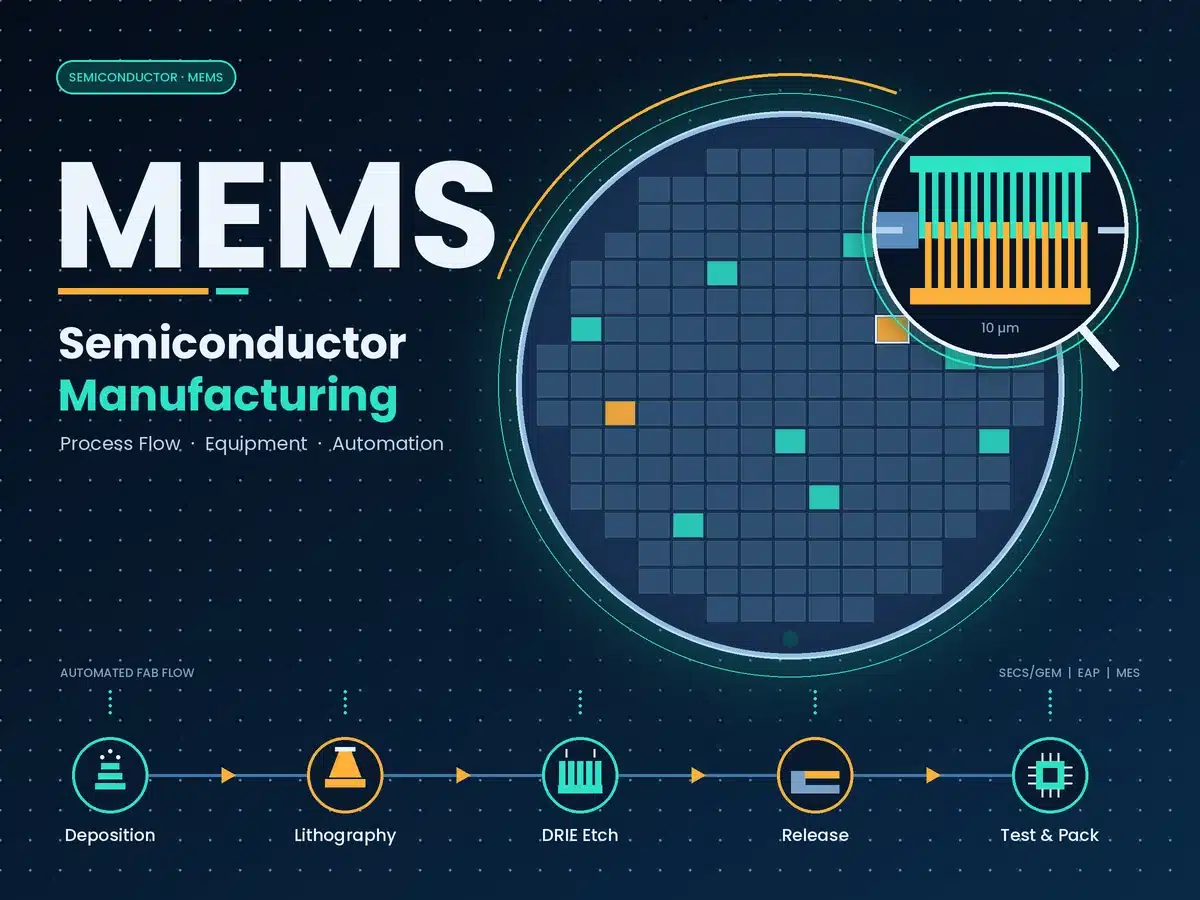
MEMS semiconductor manufacturing turns silicon wafers into tiny machines that sense, move, and control. These devices sit inside cars, phones, medical tools, and factory systems. Making them is hard. It needs precise processes, specialized equipment, and tight control over every wafer.
This guide explains the MEMS process flow, the equipment behind it, and the common applications. It also shows how automation, equipment connectivity, and MES integration help fabs run better.
What Is MEMS Semiconductor Manufacturing?
MEMS stands for micro-electro-mechanical systems. A MEMS device combines mechanical parts and electronics on one chip. Examples include accelerometers, gyroscopes, pressure sensors, and microphones.
MEMS semiconductor manufacturing borrows many steps from standard chip making. Fabs still use deposition, lithography, and etching. However, MEMS adds extra steps because it builds moving structures, not just circuits.
Key differences from conventional semiconductor manufacturing include:
3D structures: MEMS builds beams, membranes, and cavities.
Deep etching: Many devices need etching through thick silicon.
Wafer bonding: Wafers are often joined to seal cavities.
Release steps: Sacrificial layers are removed so parts can move.
Custom flows: Each device often has its own unique process.
Because of this variety, automation and equipment connectivity matter even more in MEMS fabs.
MEMS Semiconductor Manufacturing Process Flow
Every MEMS device follows its own recipe. Still, most flows share the same core stages.
- Wafer Preparation and Cleaning:-
The process starts with clean wafers, typically silicon or SOI. Cleaning removes particles and organic residue. Even tiny contamination can ruin a MEMS structure. - Thin-Film Deposition:-
Fabs then deposit thin layers of materials such as oxide, nitride, polysilicon, or metal. These layers form the structural and sacrificial parts of the device. - Photolithography:-
Lithography transfers a pattern onto the wafer using photoresist and light. It defines where each feature will be built. - Etching:-
Etching removes material to create the shapes. Deep reactive ion etching (DRIE) is common in MEMS because it cuts deep, narrow trenches. - Doping and Implantation:-
Doping adjusts electrical properties. For example, it can make a silicon area act as a pressure-sensing element. - Wafer Bonding:-
Bonding joins two wafers, often to seal a cavity or protect a sensor. It is a defining step in many MEMS flows. - Release and Sacrificial-Layer Removal:-
This step frees the moving parts. A temporary layer is etched away, leaving the structure suspended and able to move. - Inspection and Metrology:-
Measurement tools check thickness, alignment, and defects. Early detection prevents scrap and protects yield. - Dicing, Packaging, and Testing:-
Finally, wafers are cut into dies, packaged, and tested. Packaging is critical because MEMS devices are sensitive to stress, moisture, and pressure.
Key Equipment Used in MEMS Manufacturing
A MEMS fab relies on many tool types working in sequence:
- Deposition equipment: CVD, PVD, and epitaxy tools build thin films.
- Lithography systems: Steppers and aligners pattern the wafer.
- Etching equipment: DRIE and wet etch tools shape the structures.
- Doping and implantation systems: Ion implanters and diffusion furnaces tune electrical behavior.
- Wafer bonding equipment: Bonders align and join wafers under controlled heat and pressure.
- Cleaning systems: Wet benches and cleaners keep surfaces pure.
- Inspection and metrology equipment: These tools verify quality at each stage.
- Dicing, packaging, and testing equipment: These tools finish and validate the device.
- Automated material-handling systems: They move wafers and lots between tools with little human contact.
Many of these tools come from different vendors. As a result, they often speak different communication protocols. This is where equipment integration becomes a real challenge.
MEMS Equipment Integration and Connectivity
A fab cannot run well if its tools work in isolation. MEMS equipment integration links production tools with factory systems so data flows both ways.
Most fabs use the SECS/GEM standard for this. It lets equipment report status, send alarms, and receive commands from a host system. Good MEMS equipment connectivity supports:
- Equipment data collection from every tool
- Real-time equipment monitoring of state and events
- Recipe and alarm management from a central point
- Traceability and production data for every lot and wafer
Older tools may not support SECS/GEM. Solutions like EIGEMEquipment add SECS/GEM capability to equipment software. For plug-and-play needs, EIGEMBox enables SECS/GEM connectivity without deep changes to the tool. For mixed protocols, EIGEMLink works as a universal protocol converter.
MEMS Semiconductor Manufacturing Automation
Automation reduces repetitive manual work and keeps processes consistent. In MEMS semiconductor manufacturing, automation covers several areas:
- Automated process monitoring that watches parameters during every run
- Equipment status monitoring that shows which tools are running, idle, or down
- Automated lot and wafer tracking that records where each wafer is
- Data collection and analysis that supports faster improvement
- Reduced manual intervention, which lowers human error
The result is better production efficiency. Engineers spend less time chasing data and more time improving the process.
Role of MEMS Manufacturing Software
MEMS manufacturing software ties all of this together. It acts as the layer between equipment and decision-makers.
Its main functions include equipment communication, production monitoring, recipe management, alarm management, data collection, and traceability. It also connects to host systems and the MES.
On the host side, EIGEMHost provides host automation software. It lets a factory control and monitor SECS/GEM equipment from one place. Together with equipment-side software, it creates a complete connected workflow.
MEMS MES Integration
A manufacturing execution system (MES) manages production on the floor. However, it can only work well if it receives accurate data from the tools. That is why MEMS MES integration matters.
With strong MES-to-equipment connectivity, a fab can:
- Track lots and wafers through every step
- Collect process data automatically
- Control and verify recipes before each run
- Receive equipment status and event reports in real time
- Build full production traceability for audits and quality checks
Without this link, operators must enter data by hand. That slows production and increases the risk of mistakes.
Applications of MEMS
MEMS devices are everywhere. Common applications include:
- Automotive sensors: airbag, tire pressure, and stability systems
- Consumer electronics: motion sensors, microphones, and gaming controllers
- Smartphones and wearables: accelerometers, gyroscopes, and pressure sensors
- Industrial automation: vibration, flow, and position monitoring
- Healthcare and medical devices: pumps, diagnostic chips, and implantable sensors
- Aerospace and defense: navigation and inertial measurement units
- IoT devices: small, low-power sensors for connected systems
As demand grows, fabs must produce more devices with higher consistency. Automation makes that possible.
Benefits of Automated MEMS Manufacturing
Automated MEMS manufacturing delivers clear gains:
- Higher equipment utilization through better uptime tracking
- Better process visibility across all tools
- Improved traceability for every lot and wafer
- Reduced manual errors in data entry and recipe handling
- Faster production decisions based on real-time data
- Scalable equipment integration as the fab adds new tools
Explore eInnoSys’ MEMS manufacturing automation solutions to see how these benefits apply in practice.
Conclusion
MEMS semiconductor manufacturing combines complex process steps, diverse equipment, and demanding quality needs. To compete, fabs need more than good tools. They need strong equipment integration, reliable connectivity, smart automation, and tight MES integration.
eInnoSys Technologies helps manufacturers reach this goal with SECS/GEM software, host automation, and protocol conversion solutions. With the right foundation, MEMS fabs can improve yield, increase traceability, and scale production with confidence.


