
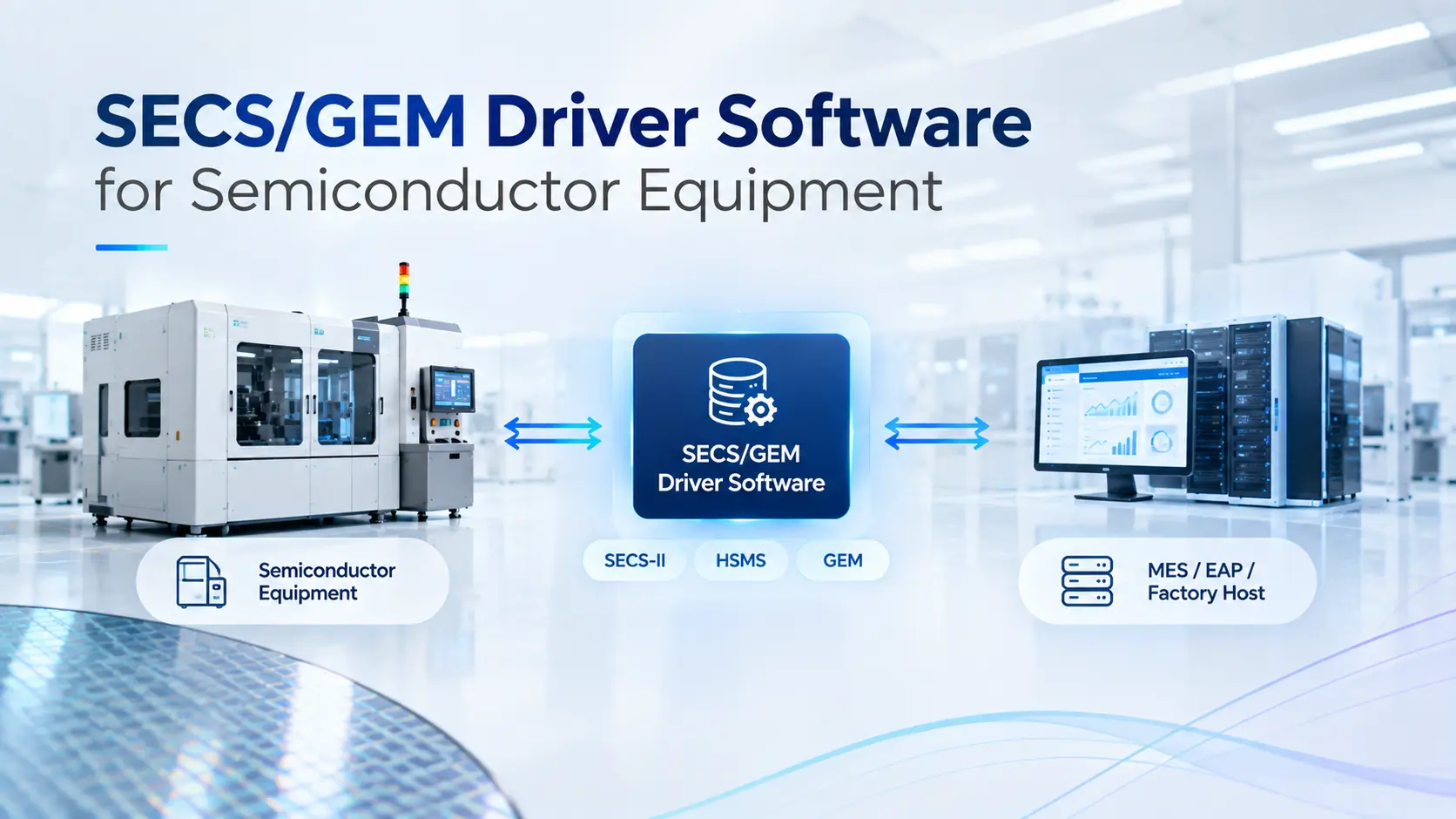
Semiconductor fabs rely on tight coordination between hundreds of tools and factory systems. These systems monitor and manage equipment across the production environment. For equipment to participate in this coordination, it needs a reliable way to communicate with the factory host. This is where SECS/GEM driver software plays an important role.
This software layer gives semiconductor equipment a standardized way to exchange status, data, and commands. It can communicate with host systems such as MES and EAP. This approach reduces the need for custom communication code for every tool.
Without a shared communication standard, each piece of equipment could require its own interface. That approach can make factory integration more complex. SECS/GEM helps address this challenge by providing a common framework for equipment-to-host communication.
This article explains what SECS/GEM driver software does. It also explains how the underlying standards work together. You will learn about common software functions and key factors for equipment OEMs to consider.
What Is SECS/GEM Driver Software?
SECS/GEM driver software is the software layer that implements the SECS/GEM communication standards inside a piece of semiconductor equipment, allowing it to exchange structured messages with a factory host. Rather than being a single protocol, SECS/GEM is a combination of related standards that work together at different layers of communication.
It helps to separate the terms. HSMS (High-Speed SECS Message Services) defines how equipment and host establish and maintain a network connection. SECS-II defines the structure and format of the messages exchanged once that connection exists. GEM (Generic Equipment Model) builds on SECS-II to define standardized equipment behaviors — things like how a tool reports its state, handles events, or responds to remote commands — so that different equipment types behave consistently from the host’s point of view.
SECS/GEM driver software is not simply a physical communication protocol; it is the software implementation that ties these layers together, translating a tool’s internal state and control logic into standardized SECS/GEM messages the host can interpret, and vice versa.
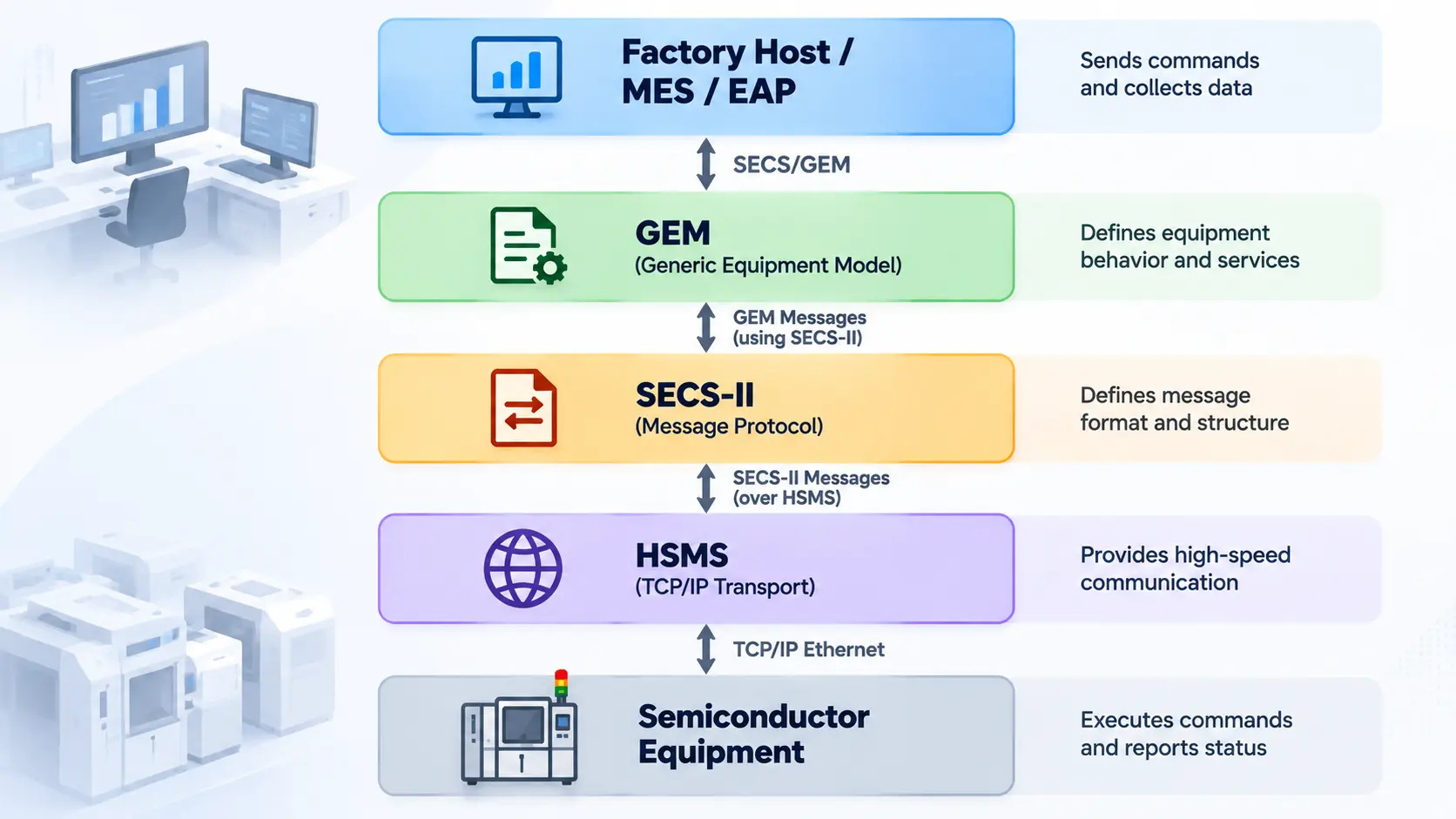
How SECS/GEM Driver Software Connects Semiconductor Equipment
At a basic architectural level, the driver software sits between the equipment’s control system and the factory host: Semiconductor Equipment → SECS/GEM Driver Software → Factory Host / EAP / MES.
This layer typically supports the exchange of several kinds of information, depending on the implementation:
- Equipment status and state changes
- Equipment variables and process data
- Collection events tied to equipment activity
- Alarms and fault conditions
- Remote commands issued from the host
- Data collection for traceability and reporting
Key Functions of SECS/GEM Driver Software
The table below summarizes the main functions this software layer typically supports. Actual capabilities vary by implementation.
| Function | What It Does |
|---|---|
| SECS-II Message Handling | Formats and parses structured SECS-II messages, such as equipment status requests, variable reports, and command responses, between equipment and host applications. |
| HSMS Communication | Manages the underlying network connection by establishing the link between equipment and host, maintaining communication, and handling reconnection when a session drops. |
| GEM Functionality | Defines standardized equipment behaviors on top of SECS-II, including equipment state reporting and host interaction responses, enabling consistent behavior across different vendors’ equipment. |
| Equipment Data Collection | Provides access to equipment variables and operational data points, allowing the host to poll or subscribe to production-related information. |
| Events and Alarms | Notifies the host about important equipment activities through collection events and communicates fault conditions using alarm handling. |
| Remote Commands | Enables the host to send supported commands through the SECS/GEM communication layer, based on the equipment’s control capabilities. |
| Logging and Diagnostics | Records message logs, connection status, and error information to support system integration, monitoring, and troubleshooting. |
SECS/GEM Driver vs. SECS/GEM Software
The terms “SECS/GEM driver” and “SECS/GEM software” are often used loosely, and their exact meaning can vary between vendors and implementations. In general use, a driver tends to refer more narrowly to the communication layer itself — establishing the connection and handling message exchange according to SECS-II and HSMS.
Broader SECS/GEM software can extend beyond that core communication function to include configuration tools, equipment modeling, structured handling of events and alarms, diagnostics, APIs for integration with other systems, and tooling to support ongoing maintenance. Which capabilities are actually present depends entirely on how a given software package is architected, so it is worth looking past the label and evaluating what a specific implementation actually provides. Neither approach is inherently better; the right fit depends on what the equipment and integration project require.
Why SECS/GEM Driver Software Matters for Equipment OEMs
For equipment OEMs, standardized communication has practical value that goes beyond compliance with a specification. A few considerations that commonly come up:
- Standardized equipment-to-host communication reduces the need to build and maintain application-specific interfaces for each customer’s host system.
- Structured data exchange makes it easier for factory systems to interpret equipment status, variables, and events consistently.
- Reliable SECS/GEM support can simplify factory integration during equipment commissioning.
- Better equipment visibility supports MES and EAP connectivity across the fab.
- Logging and diagnostics built into the driver layer can support troubleshooting during integration and operation.
- A well-structured communication layer can support more scalable integration as fabs add or replace equipment over time.
These are potential benefits that depend on implementation quality and the surrounding automation architecture, rather than guaranteed outcomes — actual results can vary by fab, equipment type, and integration approach.
SECS/GEM Driver Software in Semiconductor Factory Automation
Equipment-level SECS/GEM communication is one piece of a larger automation picture. Data that flows from equipment through SECS/GEM into the factory host can, depending on the fab’s architecture, support production monitoring, process data collection, and event management at a broader scale: Equipment → SECS/GEM Driver → EAP / Factory Host → MES / Manufacturing Systems.
This chain is part of how many fabs approach factory-level automation and smart manufacturing initiatives, since consistent equipment communication is a prerequisite for higher-level systems to make use of equipment data at all.
Important Considerations When Selecting SECS/GEM Driver Software
Evaluating SECS/GEM driver software for a given piece of equipment usually comes down to a set of practical questions rather than a single feature checklist:
- Does it support the required SECS-II and HSMS specifications correctly?
- What level of GEM functionality and equipment modeling does it provide?
- How does it handle message exchange, events, and alarms under real operating conditions?
- Are remote commands supported in a way that fits the equipment’s control architecture?
- How configurable is the software for different equipment behaviors?
- What logging and diagnostic tools are available for troubleshooting?
- Does it expose APIs or integration points needed for the broader factory environment?
- How well does it scale as equipment count or complexity grows?
- How maintainable is the implementation over the equipment’s lifecycle?
- What security considerations apply to the communication layer?
- How compatible is it with the equipment’s existing control architecture?
These questions are best worked through early in an integration project, since retrofitting communication architecture later tends to be more disruptive than planning for it upfront.
How eInnoSys Supports SECS/GEM Equipment Integration
eInnoSys works with semiconductor equipment OEMs and manufacturers on SECS/GEM connectivity, offering a SECS/GEM SDK and implementation services for teams building or upgrading equipment communication. These offerings are intended to support the kind of standardized SECS-II, HSMS, and GEM functionality described above, without requiring every equipment team to build a communication layer from scratch.
For equipment that needs plug-and-play style connectivity, solutions like EIGEMBox are aimed at simplifying SECS/GEM integration for tools that would otherwise need custom development. Depending on the equipment and integration goals, these types of solutions can support OEMs looking to add standardized equipment-to-host communication without significantly reworking existing control systems.
Conclusion
SECS/GEM driver software gives semiconductor equipment a standardized way to communicate with factory host systems, translating equipment status, variables, events, and commands into a common message format defined by SECS-II, HSMS, and GEM. That standardization is what makes reliable equipment-to-host communication and factory integration achievable across tools from different vendors, rather than something each fab has to solve individually. As fabs continue to lean on smart manufacturing initiatives, the communication software architecture behind SECS/GEM driver software remains a foundational piece of how equipment participates in that larger system.


