
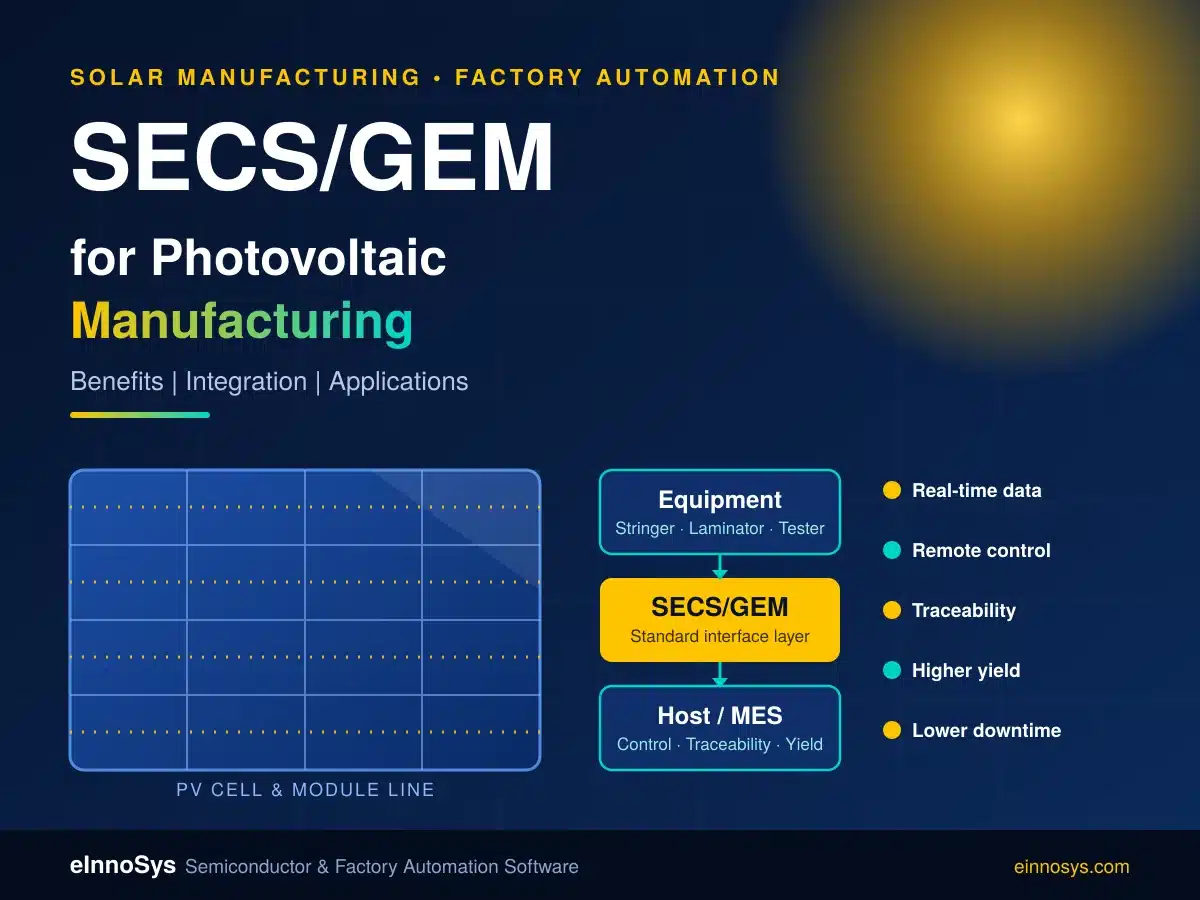
Solar manufacturing SECS/GEM software gives photovoltaic factories a standard way to connect production equipment with MES and host systems. Instead of building a custom interface for every tool, manufacturers use one proven protocol. They can collect data, monitor equipment, and control processes in real time.
As solar PV plants scale across the USA and Europe, this standardization matters more each year. This guide explains what SECS/GEM is, how it works, where it applies, and how to choose the right software.
Key takeaways
- SECS/GEM is a standard language for equipment-to-factory communication.
- It improves traceability, real-time monitoring, and data quality.
- It works for new equipment and for legacy tools.
- The right software reduces integration time and cost.
What Is SECS/GEM in Solar Manufacturing?
SECS/GEM is a set of SEMI standards for communication between manufacturing equipment and a host system. SECS (SEMI Equipment Communications Standard) defines how messages are structured. GEM (Generic Equipment Model) defines how equipment behaves and what data it exposes.
The standard began in semiconductor fabs. Photovoltaic manufacturing uses similar processes, such as thin-film deposition, diffusion, and precision handling. That is why SECS/GEM now fits solar lines well.
In practice, a screen printer, diffusion furnace, or module laminator reports its status, alarms, and process data to a host in one consistent format.
Why Photovoltaic Manufacturers Need Equipment Communication Standards
A solar line rarely uses equipment from a single vendor. Each tool often speaks its own protocol. That creates real problems:
- Every custom interface adds cost, testing time, and maintenance.
- Manual data entry introduces errors and delays.
- Limited traceability makes root-cause analysis harder.
- Slow alarm response increases scrap and downtime.
Margins in solar are tight, and quality records support warranty and compliance needs. A communication standard removes much of this friction. Engineers integrate once, then reuse the approach across tools and lines.
How SECS/GEM Works in Solar PV Manufacturing
SECS/GEM uses a host-and-equipment model. The equipment exposes its data and controls. The host reads data, sends commands, and manages production.
Most modern implementations use HSMS (High-Speed SECS Message Services) over standard TCP/IP Ethernet. Older tools may use serial SECS-I.
Core GEM capabilities include:
- State models: the host always knows if a tool is idle, processing, or in error.
- Event reporting: the equipment notifies the host when something happens.
- Alarm management: faults are sent and tracked in real time.
- Data collection: process variables are gathered for analysis.
- Remote control: the host can start, stop, or pause operations.
- Recipe management: process programs are uploaded, downloaded, and verified.
For example, when a cell tester finishes a batch, it sends an event with the results. The MES logs the data against the lot without any manual step.
Benefits of Solar Manufacturing SECS/GEM Software
- Equipment connectivity:-
One standard interface connects tools from different vendors. This shortens commissioning for new lines. - Automated data collection:-
Process data flows to the host automatically. Teams spend less time gathering data and more time using it. - Real-time production monitoring:-
Operators see equipment states, alarms, and throughput as they happen. Problems get fixed sooner. - Traceability:-
Every wafer, cell, and module can be linked to its process history. This supports quality audits and faster root-cause analysis. - Reduced manual intervention:-
Automated recipe handling and reporting cut operator errors and free up skilled staff. - Integration with MES and host systems:-
Standard messages make it easier to feed MES, ERP, and analytics platforms with reliable data.
SECS/GEM Applications in Photovoltaic Manufacturing
| Production Area | How SECS/GEM Helps |
|---|---|
| Wafer Processing | Monitors cleaning, texturing, and wafer-handling equipment while tracking wafer lots. |
| Cell Manufacturing | Collects process and equipment data from deposition, diffusion, printing, and firing equipment. |
| Solar Module Production | Connects stringers, laminators, framing machines, and other production equipment with the host system. |
| Testing & Inspection | Transfers test and inspection results to MES for grading, quality control, and traceability. |
| Material Handling | Coordinates carriers, loaders, and automated transport systems with production status. |
| Production Monitoring | Provides centralized visibility into equipment status, production data, alarms, and line performance. |
SECS/GEM Integration Architecture for Solar PV Plants
A typical architecture has four layers:
- Equipment layer: production tools with a SECS/GEM interface.
- Communication layer: software that manages connections, messages, and data translation.
- Host layer: the host application that controls equipment and collects data.
- Enterprise layer: MES, ERP, and analytics tools that use the data.
This layered design keeps equipment details separate from business systems. You can add or replace tools without redesigning the whole plant. It also makes the plant easier to scale.
Role of EIGEMEquipment, EIGEMHost, EIGEMLink and EIGEMBox
eInnoSys offers four products that cover the full integration chain:
- EIGEMEquipment adds SECS/GEM communication to photovoltaic manufacturing equipment, so tools can connect and automate faster.
- EIGEMHost handles host-side SECS/GEM communication and equipment management.
- EIGEMLink acts as the integration layer between equipment and factory systems.
- EIGEMBox gives legacy equipment SECS/GEM connectivity through hardware, which helps when modifying the equipment directly is difficult.
Together, they support both new lines and older installed tools.
How to Choose Solar Manufacturing SECS/GEM Software
Use this checklist when you compare options:
- Standards compliance: confirm support for SECS/GEM and HSMS.
- Equipment and host coverage: check that both sides of the connection are supported.
- MES integration: make sure it works with your current systems.
- Legacy support: look for options for older equipment.
- Scalability: the software should grow with new lines and plants.
- Vendor experience: choose a team that knows industrial automation.
Many manufacturers also look for a solar software company that offers broader photovoltaic software solutions and solar PV software development services. Working with one partner can simplify integration and support.
Conclusion
SECS/GEM gives photovoltaic manufacturers a standard communication layer between equipment and factory systems. It automates data exchange, improves traceability, enables real-time monitoring, and supports scalable operations.
eInnoSys brings deep experience in solar manufacturing automation, equipment integration, and industrial software. With EIGEMEquipment, EIGEMHost, EIGEMLink, and EIGEMBox, eInnoSys helps solar manufacturers connect any equipment to their factory systems with confidence.


