
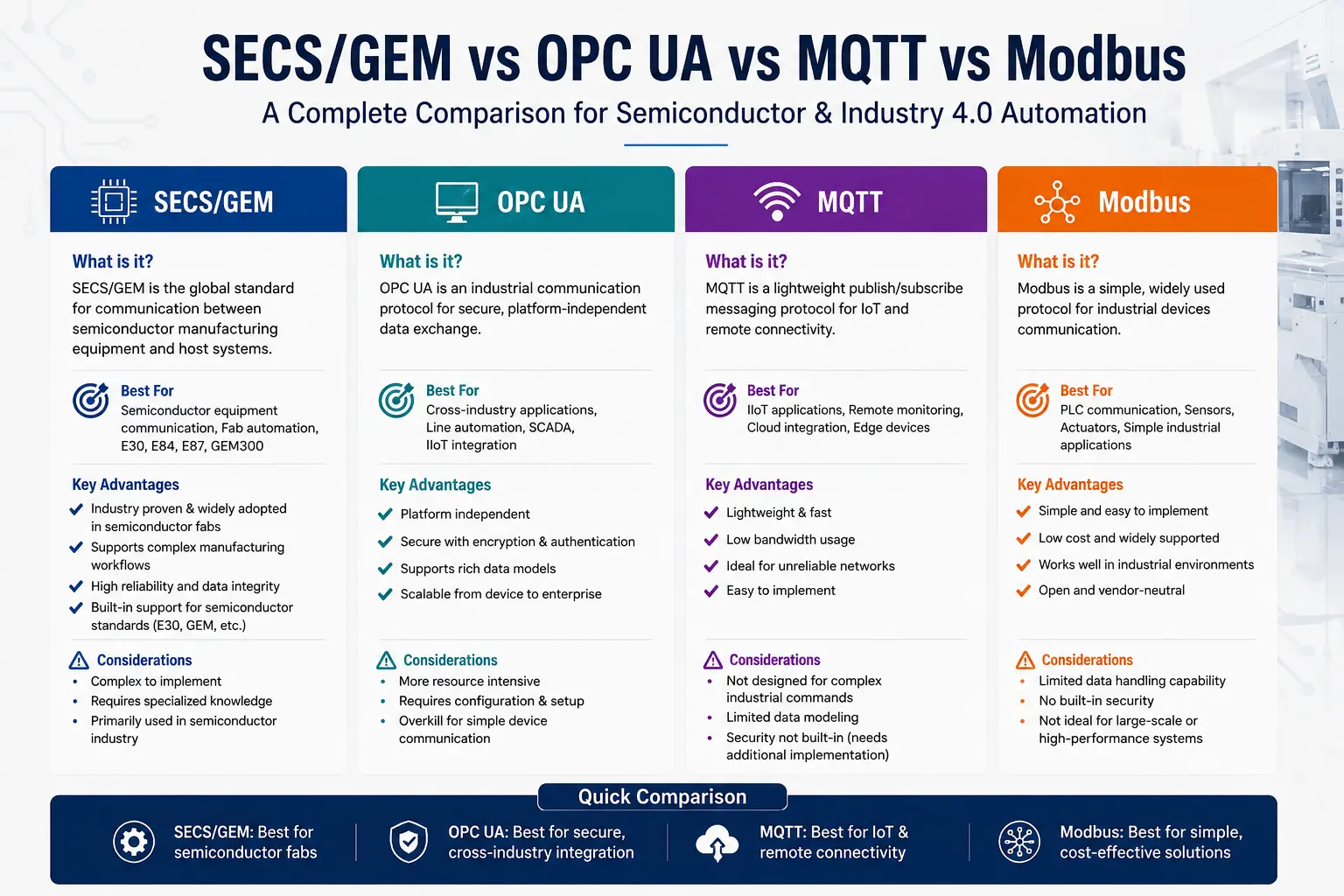
If you work in semiconductor manufacturing, factory automation, or Industry 4.0 system design, you’ve almost certainly run into a wall of acronyms: SECS/GEM, OPC UA, MQTT, and Modbus. Each one moves data between machines, but they were built for different eras, different industries, and different problems.
Choosing the wrong protocol — or forcing one protocol to do a job it wasn’t designed for — can mean months of failed integration, unreliable equipment data, or an MES system that never quite talks to the fab floor the way it should.
This guide breaks down what each protocol actually does, where it shines, where it falls short, and how semiconductor OEMs and fabs are bridging the gap between legacy equipment communication and modern smart-factory platforms with solutions like EIGEMLink.
Quick Comparison Table
|
Protocol |
Primary Industry |
Data Model |
Real-Time Capability |
Best For |
|
Semiconductor manufacturing |
Equipment state, events, recipes |
Near real-time, event-driven |
Fab equipment-to-host (MES) communication |
|
|
Discrete & process manufacturing |
Rich, object-oriented, self-describing |
Real-time, service-oriented |
Cross-vendor interoperability, Industry 4.0 |
|
|
IoT, cloud, distributed systems |
Lightweight, topic-based publish/subscribe |
Near real-time (network-dependent) |
Sensor data, cloud/edge telemetry |
|
|
Legacy industrial automation |
Simple register-based (read/write) |
Real-time (polling-based) |
PLCs, legacy field devices |
What Is SECS/GEM?
SECS/GEM (SEMI Equipment Communications Standard / Generic Equipment Model) is the communication standard defined by SEMI specifically for semiconductor manufacturing equipment. It governs how a tool — an etcher, a wafer prober, a deposition system — reports its status, alarms, recipes, and process data to a host system like an MES.
Key characteristics:
- Built exclusively for semiconductor and related industries (also used in flat-panel display manufacturing)
- Defines a structured equipment model: states, events, alarms, variables, and remote commands
- Enables host systems to control and monitor equipment behavior in real time
- Mandatory in most modern fabs — equipment OEMs must support SECS/GEM to sell into major fabs
Where it falls short:
- Not designed for cloud connectivity, IT/OT convergence, or cross-industry interoperability
- Integration can be complex, especially with legacy tools lacking native GEM interfaces
- Requires specialized engineering expertise to implement and maintain
This is exactly the gap that purpose-built connectivity middleware — like EIGEMLink, einnosys’s SECS/GEM integration solution — is designed to close, letting fabs and OEMs get legacy and modern equipment communicating with MES and analytics platforms without reinventing the driver layer for every tool.
What Is OPC UA?
OPC UA (Open Platform Communications Unified Architecture) is a vendor-neutral, platform-independent standard for industrial data exchange. Unlike SECS/GEM, it isn’t tied to a single industry — it’s used across automotive, oil & gas, pharma, and increasingly, semiconductor back-end and factory-wide Industry 4.0 architectures.
Key characteristics:
- Rich, self-describing information models (semantic data, not just raw values)
- Built-in security (authentication, encryption, signing)
- Supports both client-server and newer publish-subscribe (PubSub) models
- Strong interoperability across vendors and platforms — a major reason companies like Siemens have standardized much of their automation stack around it
Where it falls short:
- Heavier footprint than lightweight protocols like MQTT
- Doesn’t natively define semiconductor-specific equipment behavior the way SECS/GEM does
Implementation complexity can be high for simple point-to-point use cases
What Is MQTT?
MQTT (Message Queuing Telemetry Transport) is a lightweight, publish-subscribe messaging protocol originally designed for constrained networks and devices. It has become the backbone of IIoT and cloud-connected factory architectures.
Key characteristics:
- Extremely lightweight — minimal bandwidth and processing overhead
- Publish-subscribe model with a central broker, ideal for many-to-many data distribution
- Excellent for sending sensor data, telemetry, and equipment health metrics to cloud or edge analytics platforms
- Widely adopted in Sparkplug B implementations for structured industrial MQTT payloads (see HiveMQ’s work on MQTT for Industry 4.0)
Where it falls short:
- No built-in semantic data model — payload structure has to be agreed upon separately (e.g., via Sparkplug B)
- Not designed for deterministic, hard real-time control
- Lacks the equipment-state modeling semiconductor fabs need for host-level control (SECS/GEM territory)
What Is Modbus?
Modbus is one of the oldest industrial communication protocols still in active use, originally developed in 1979 for PLCs. It’s simple, robust, and still runs a huge share of the world’s legacy automation equipment.
Key characteristics:
- Simple register-based read/write model
- Extremely well-supported by legacy PLCs, sensors, and field devices
- Easy to implement and troubleshoot
- Available in serial (Modbus RTU) and Ethernet (Modbus TCP) variants
Where it falls short:
- No native security (authentication or encryption)
- Limited data typing — everything is registers and coils, no rich semantics
- Not built for the complex equipment modeling or cloud-scale data needs of modern Industry 4.0 or semiconductor environments
- Polling-based architecture doesn’t scale well for large, distributed IIoT deployments
For a deeper technical overview of the protocol’s registers and function codes, Schneider Electric’s Modbus protocol documentation remains a solid reference point.
Head-to-Head: How They Actually Compare
SECS/GEM vs OPC UA
SECS/GEM is purpose-built for semiconductor equipment-to-host communication and is often a compliance requirement in fabs. OPC UA is broader and vendor-neutral, better suited for cross-industry interoperability and factory-wide Industry 4.0 architectures. In many modern fabs, the two coexist: SECS/GEM handles equipment-level control and state reporting, while OPC UA handles broader plant and enterprise-level data exchange.
MQTT vs OPC UA
MQTT wins on lightweight, scalable telemetry — especially cloud and edge scenarios with many distributed sensors. OPC UA wins on rich semantic modeling, built-in security, and structured interoperability. Many Industry 4.0 architectures (as Inductive Automation’s Ignition platform demonstrates) use both together: OPC UA for structured plant data, MQTT/Sparkplug B for scalable data distribution to the cloud.
SECS/GEM vs MQTT
These solve different problems entirely. SECS/GEM defines what semiconductor equipment data means (states, events, alarms, recipes) and how a host controls it. MQTT is just a transport — it doesn’t care what the data means. In practice, fabs often use SECS/GEM to pull structured equipment data and then relay relevant telemetry over MQTT to cloud analytics or dashboards.
OPC UA vs Modbus
OPC UA is a modern, secure, semantically rich standard. Modbus is a decades-old, simple, register-based protocol with no built-in security. Modbus still dominates legacy PLC environments because of cost and ubiquity, but OPC UA is the clear choice for new Industry 4.0 deployments needing security and interoperability.
Choosing the Right Protocol for Your Semiconductor or Factory Environment
There’s no single “best” protocol — the right choice depends on where in your architecture you’re operating:
- Equipment-to-MES in a fab: SECS/GEM is typically mandatory and expected by fab operations.
- Cross-vendor plant floor interoperability: OPC UA is the standard to build around.
- Cloud/edge telemetry and scalable sensor data: MQTT (often with Sparkplug B) is the go-to.
- Legacy PLCs and field devices: Modbus remains common simply because so much installed equipment already speaks it.
Most mature Industry 4.0 architectures don’t pick just one — they layer these protocols, using gateways and middleware to translate between them. This is precisely where a dedicated SECS/GEM integration layer becomes critical. Rather than building custom SECS/GEM drivers for every tool, semiconductor OEMs and fabs are increasingly turning to solutions like EIGEMLink to standardize equipment connectivity and make that data available to MES, OPC UA servers, and cloud platforms alike.
Bridging Legacy Equipment with Modern Systems
A common challenge for fabs and OSAT manufacturers is that much of their installed equipment base predates modern connectivity standards, or implements SECS/GEM inconsistently across tool vendors. Getting reliable, standardized equipment data flowing into MES, APC, or Industry 4.0 analytics platforms requires more than just “turning on GEM” — it requires a robust integration layer that can normalize equipment behavior across a heterogeneous fab.
That’s the core problem EIGEMLink is built to solve — providing a practical, proven SECS/GEM connectivity solution that helps semiconductor equipment OEMs and fabs get equipment online faster, with less custom engineering per tool.
Final Thoughts
SECS/GEM, OPC UA, MQTT, and Modbus aren’t competitors so much as specialists — each excels in a different layer of the modern factory stack. Semiconductor fabs, in particular, tend to need all four working together: SECS/GEM for equipment-level control, OPC UA for plant-wide interoperability, MQTT for cloud-scale telemetry, and Modbus for legacy device support.
Understanding where each protocol fits — and where the integration gaps are — is the first step toward building a connected, Industry 4.0-ready fab. If SECS/GEM integration is your current bottleneck, explore how EIGEMLink can help standardize and accelerate your equipment connectivity strategy.


