
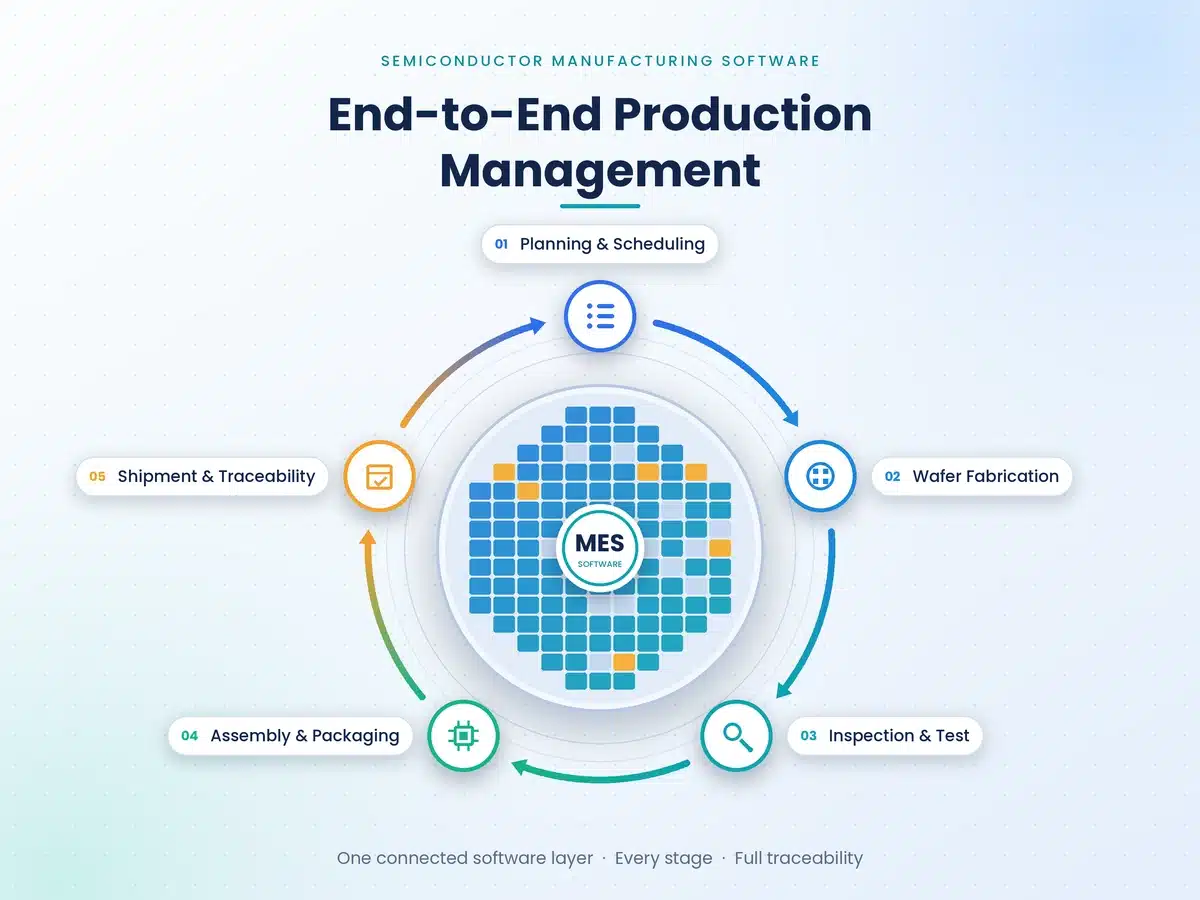
Semiconductor fabs run on precision. Hundreds of process steps, dozens of tool types, and thousands of lots move through a facility at once, so one missed status update or manual data entry error can delay output. This is why semiconductor manufacturing software has become a core part of modern fab operations.
When equipment, production systems, and data are connected, fab managers, process engineers, and automation teams get one clear view of production. This guide explains how connected software supports end-to-end production management and where eInnoSys solutions fit.
What Is Semiconductor Manufacturing Software?
Semiconductor manufacturing software connects the equipment, production systems, data, and workflows in a fab. It lets tools communicate with a host or Manufacturing Execution System (MES), so production instructions and equipment information flow automatically in both directions.
It typically handles:
- Equipment-to-host communication
- Automated collection of process, lot, and status data
- Production workflow control
- Monitoring, reporting, and traceability
Without this layer, teams depend on manual processes and isolated tools. With it, production becomes visible, consistent, and easier to manage.
Equipment Integration
Equipment integration is the foundation of connected production. Semiconductor tools come from many vendors and generations, and each may communicate differently. Software connects these tools to host and MES systems using standardized communication.
The Role of SECS/GEM
SECS/GEM is the standard for equipment-to-host communication in semiconductor manufacturing. It defines how a tool reports its state, sends event and alarm data, and receives remote commands. Software built on this standard gives the host consistent control and visibility, regardless of the equipment vendor.
Protocol Conversion for Mixed Environments
Many fabs run tools that don’t natively support SECS/GEM. Protocol conversion bridges that gap, so equipment using different communication protocols can still join a unified production environment.
Production Data Management
Manual data entry is slow and error-prone. Connected software collects equipment, process, lot, and status data automatically, directly from the tools.
This brings several benefits:
- Fewer transcription errors
- Faster access to current data
- A consistent data format across tools
- Less time spent on routine logging
Engineers can then focus on analysis and improvement instead of data gathering.
Lot and Production Tracking
Knowing where each lot is, and what state the equipment is in, is essential for managing throughput. Software tracks lot movement across tools and process steps, along with equipment status and overall production progress.
Production managers can see bottlenecks as they form, rather than discovering them in a later report. This improves scheduling decisions and makes delivery commitments easier to meet.
Workflow Automation
Many production tasks follow repeatable rules, which makes them good candidates for automation. Connected software can automate:
- Lot starts
- Recipe selection and download
- Equipment status updates
- Routine production workflows
Automation standardizes how these tasks are performed. Every lot follows the same validated logic, which reduces variation between shifts and operators.
Equipment Monitoring
Equipment issues are costly because they can stop production or affect yield. Software tracks equipment conditions continuously and reports alarms and state changes as they happen.
Equipment engineers can then identify production issues faster, respond sooner, and reduce unplanned downtime. Trends in equipment behavior also help teams plan maintenance more effectively.
Traceability
Semiconductor production requires detailed records. Connected software maintains production and equipment records for each lot, including which tool processed it, under what conditions, and when.
This traceability improves process visibility and supports investigations when a quality issue appears. Teams can trace a problem back to its source quickly instead of piecing together information from separate systems.
Semiconductor Manufacturing Automation
Each capability above feeds into semiconductor manufacturing automation. Automating equipment communication, data collection, and workflows reduces manual tasks and improves consistency across the fab.
The practical outcomes are:
- Less dependence on manual intervention
- More predictable production operations
- Faster response to equipment events
- Centralized production reporting for better decisions
Automation does not replace skilled engineers. It removes repetitive work so they can concentrate on process improvement.
Role of eInnoSys Solutions
eInnoSys provides software for equipment integration and semiconductor manufacturing automation. Its products cover different parts of the connectivity challenge.
- EIGEMEquipment
EIGEMEquipment provides SECS/GEM equipment communication and integration. It helps tool makers and fabs add standardized host communication to their equipment. - EIGEMHost
EIGEMHost handles host-side equipment communication and management. It lets the factory side connect to and control SECS/GEM-enabled tools. - EIGEMLink
EIGEMLink offers universal protocol conversion and equipment connectivity. It connects tools that use different communication protocols to a common production environment. - EIGEMBox
EIGEMBox delivers plug-and-play SECS/GEM integration for legacy equipment. It extends the life of older tools by bringing them into a connected fab without major equipment changes.
Together, these solutions support the microelectronics industry with scalable equipment integration.
Conclusion
Connected software turns a semiconductor fab into a more automated and manageable production environment. Equipment integration, automated data collection, lot tracking, workflow automation, monitoring, and traceability all work together to give teams better visibility and control from tool to host.
eInnoSys helps semiconductor manufacturers build this connected foundation with EIGEMEquipment, EIGEMHost, EIGEMLink, and EIGEMBox, supporting everything from new tools to legacy equipment.
Related Blog:-
Microelectronics Manufacturing Software: How Digital Tools Improve Production Control
Bring Legacy Equipment into Smart Manufacturing with PLC-HMI & SECS/GEM


