
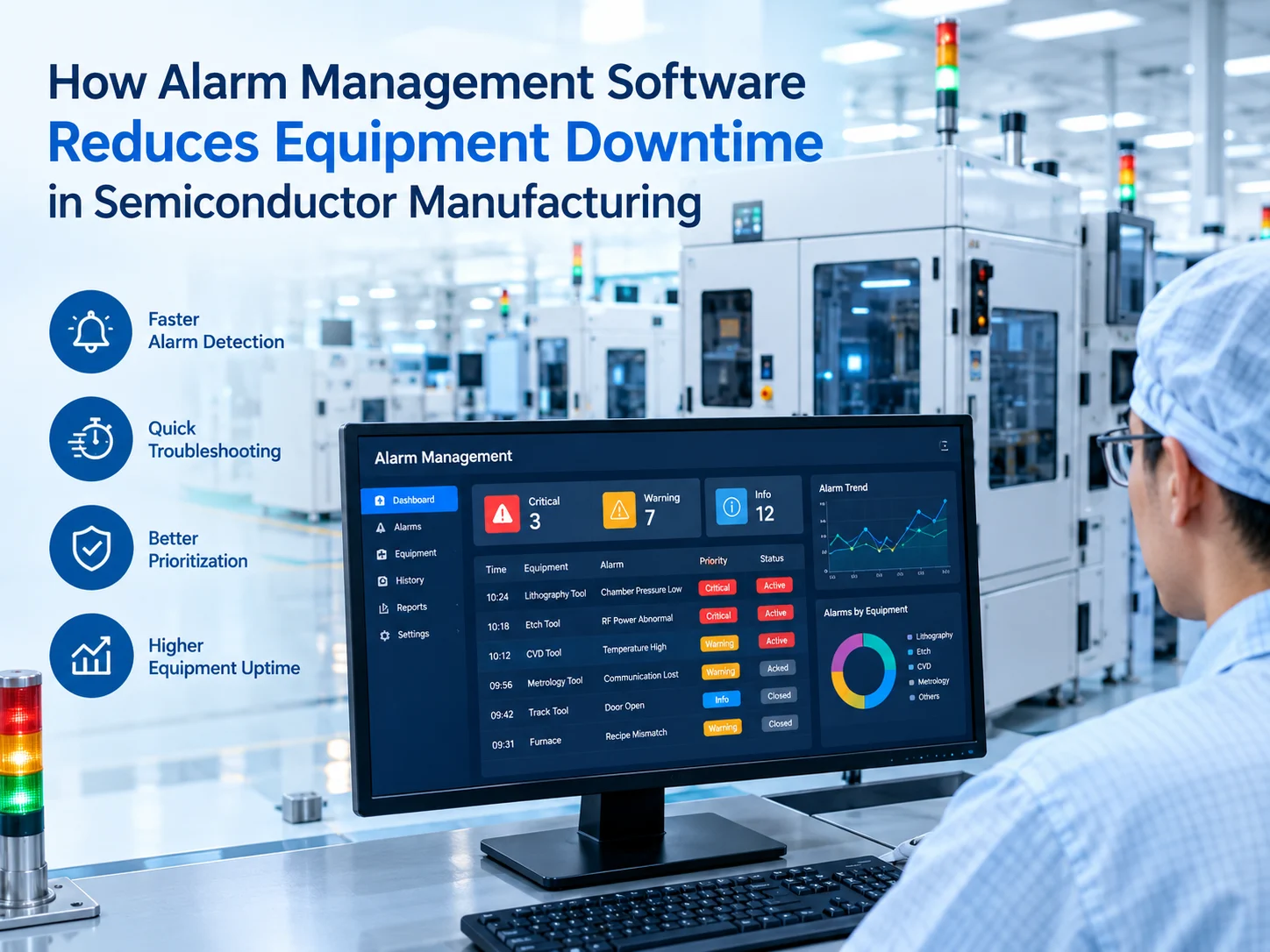
Introduction
In a semiconductor fab, a tool that stops unexpectedly puts wafers, schedules, and downstream processes at risk. Every tool generates alarms to flag abnormal conditions such as temperature drift, vacuum faults, or communication errors. The challenge is seeing those alarms quickly and understanding them in context.
Alarm management software collects equipment alarms in one place, organizes them, and keeps a searchable history. This gives engineers better alarm visibility, faster troubleshooting, and a clearer path to reducing avoidable downtime. This article explains how it works and what to look for. It also covers the role SECS/GEM plays in making it possible.
Why Equipment Downtime Is a Challenge in Semiconductor Manufacturing
Semiconductor production is a tightly sequenced flow. When one tool stops unexpectedly, the effects spread:
- Production delays. Lots wait in queue while the tool is diagnosed and restored.
- Reduced equipment utilization. Expensive tools sit idle instead of processing wafers.
- Potential yield risk. If an abnormal condition goes unnoticed, wafers may continue processing under poor conditions.
Quick fault identification matters in both fabs and OSAT facilities. The sooner a team understands what happened, the sooner it can decide whether to pause the tool, repair it, or continue production. Delays often come from poor visibility rather than the fault itself. An alarm shown only on a local screen, or one buried among dozens of others, may not reach the right person in time.
What Is Alarm Management Software?
Alarm management software is a system that gathers alarms from production equipment and presents them in a clear, organized way. In simple terms, it does four things:
- Collects alarm events from connected tools.
- Organizes them by equipment, time, and type.
- Displays them in a central view that engineers can monitor.
- Tracks them over time, so past alarms can be reviewed.
Centralized monitoring means a team no longer needs to check each machine’s own interface. A single view can cover many connected tools, which helps teams spot patterns that are invisible when each tool is treated in isolation.
How Alarm Management Software Reduces Equipment Downtime
- Detects Equipment Problems Earlier
Real-time alarm visibility lets engineers see abnormal conditions as they occur, not after a shift report or a physical walk-through. Earlier awareness gives teams more options, such as stopping a tool before a minor issue becomes a major one.
- Speeds Up Troubleshooting
An alarm is far more useful with context. Alarm descriptions, timestamps, histories, and equipment details help engineers answer key questions. What happened? When did it start? Has it happened before? With that information in one place, they spend less time gathering data and more time fixing the problem
- Improves Alarm Prioritization
Not every alarm needs the same response. Where the system supports classification, teams can separate critical alarms from warnings and informational notices. This keeps important alarms from being lost in the noise and helps teams focus on what needs attention first.
- Supports Faster Maintenance Decisions
Alarm history reveals patterns. If the same alarm keeps returning on a particular tool, that points to a repeat issue worth a deeper look. Maintenance teams can use this to plan corrective actions rather than repeatedly handling the same symptom.
- Improves Visibility Across Factory Equipment
Centralized dashboards show equipment status across connected tools at a glance. Supervisors and engineers can see which tools need attention, and comparing similar tools can show whether a problem is isolated or widespread.
Key Features to Look for in Semiconductor Alarm Management Software
When evaluating options, look for these capabilities:
- Real-time alarm monitoring for immediate visibility
- Alarm history and event logs for investigation and review
- Alarm classification and prioritization to separate critical from minor alarms
- Equipment status dashboards for a quick overview
- Notifications and escalation workflows, where supported
- SECS/GEM integration for compatible semiconductor equipment
- Reporting and analysis of recurring alarms
Alarm Management Software vs. Traditional Alarm Monitoring
| Factor | Traditional Alarm Monitoring | Alarm Management Software |
|---|---|---|
| Alarm Visibility | Often limited to individual equipment | Provides centralized alarm visibility |
| Alarm History | May be limited or scattered | Organizes historical alarm records |
| Troubleshooting | Often requires manual investigation | Provides alarm context and history |
| Alarm Prioritization | May offer basic prioritization | Supports alarm classification and prioritization |
| Multi-Equipment Monitoring | May require separate interfaces | Can consolidate alarms from connected equipment |
How SECS/GEM Supports Alarm Monitoring in Semiconductor Fabs
SECS/GEM is a set of SEMI standards that lets semiconductor equipment communicate with a factory host system. Think of it as a common language between tools and factory software. Compatible equipment can report events, including alarms and status changes, to a host. That makes centralized monitoring practical, since the software receives information directly from the tools.
SECS/GEM-enabled solutions therefore support both equipment connectivity and alarm visibility. Keep in mind that not every machine supports the same alarm messages or the same integration capabilities. What a tool reports depends on its own implementation, so integration scope should be confirmed for each equipment type.
How eInnoSys Supports Semiconductor Equipment Monitoring
eInnoSys provides semiconductor factory automation and equipment software, including SECS/GEM and GEM300 solutions. Two products are relevant to alarm visibility.
EIAMS (Alarm Management System) is eInnoSys’s alarm management solution for semiconductor equipment. According to the product page, it tracks alarms generated by equipment and compares them against other equipment of the same type. It can also execute user-defined actions in response to alarms, such as notifying personnel or stopping wafer input. It includes alarm reporting, including Pareto views of the most frequent alarms.
EIGEMBox adds SECS/GEM capability to existing equipment. This is relevant when older tools lack native SECS/GEM support but still need to connect to factory systems.
Together, compatible solutions can help connect equipment to factory systems and support equipment status and alarm visibility. Results depend on each fab’s equipment and configuration.
Conclusion
Equipment downtime is costly, and slow visibility makes it worse. Alarm management software helps by making alarms visible, prioritized, and searchable. This gives teams the context to troubleshoot faster and the history to spot repeat problems. Combined with SECS/GEM connectivity, it also brings multiple tools into one view. As a solution provider in semiconductor factory automation, eInnoSys offers products that support this approach.
Looking to improve equipment alarm visibility and semiconductor factory connectivity? Explore eInnoSys solutions
Related Articles
- SECS/GEM Message Monitoring: A Guide to Equipment Communication Analysis (SECS/GEM integration)
- How Semiconductor Manufacturing Software Supports End-to-End Production Management (equipment monitoring and host connectivity)
- AI/ML-Powered Predictive Analytics & Smart Fault Detection for Next-Gen Manufacturing (white paper on predictive maintenance and fault detection)
Related Products / Solutions
- EIAMS, Alarm Management System: centralized alarm tracking, comparison across similar equipment, and alarm reporting.
- EIGEMBox: adds SECS/GEM capability to existing equipment.
- xPump: AI-based predictive maintenance, a natural next step beyond alarm response.
- EIGEMHost: SECS/GEM communication host for connecting to equipment.


