
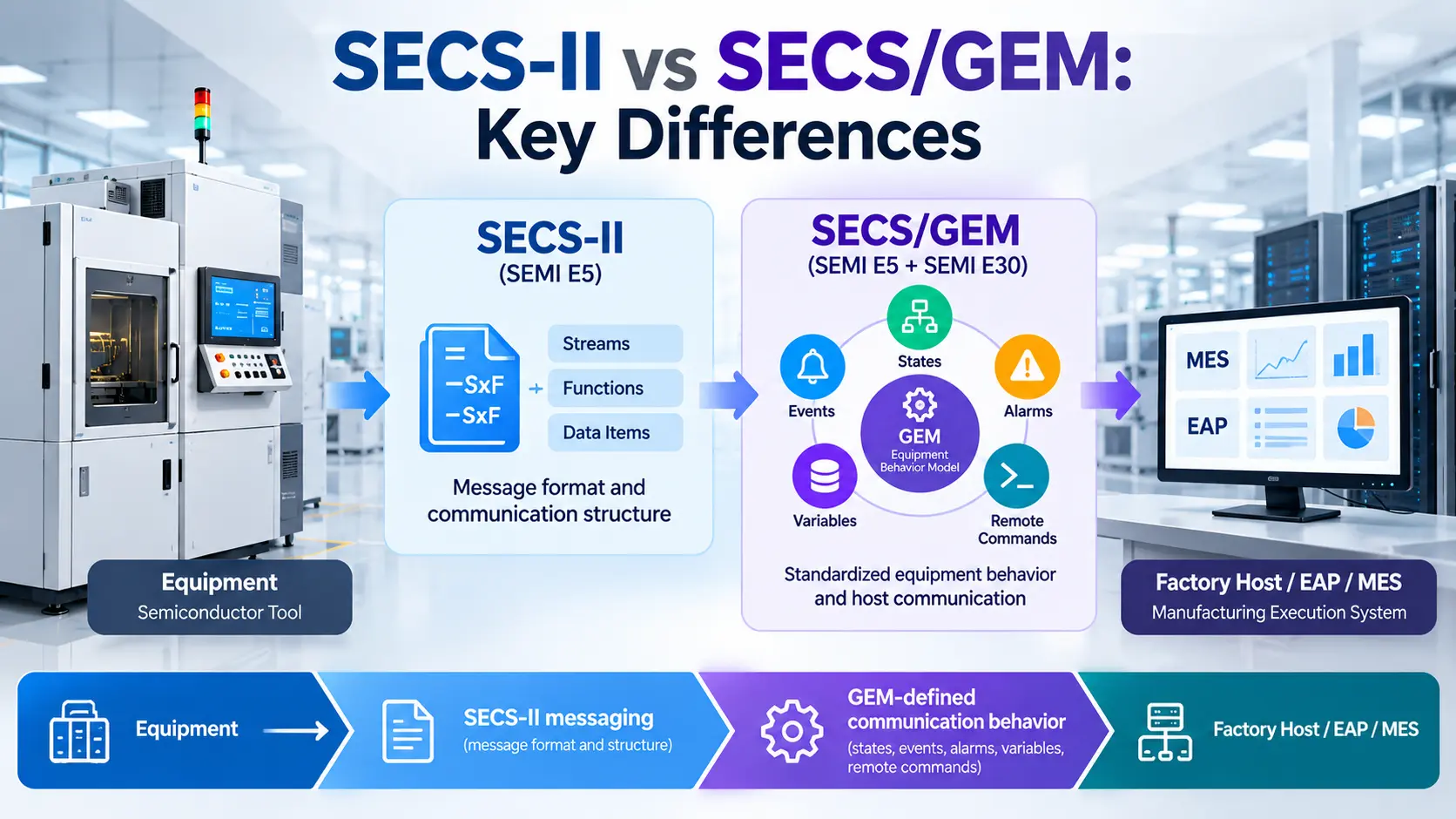
Semiconductor manufacturing depends on equipment that can talk to the factory host system reliably and in a standardized way. Without a common communication language, every tool would need custom integration work, which slows down fabs and adds cost. This is where SECS-II vs SECS/GEM becomes an important distinction to understand. The two terms are closely related, but they are not the same thing, and knowing how they differ matters for anyone working on equipment integration.
What Is SECS-II?
SECS-II stands for SEMI Equipment Communications Standard 2, defined under SEMI E5. It is a messaging standard that describes how semiconductor equipment and host systems exchange information.
At its core, SECS-II defines:
- The structure of messages sent between equipment and host
- Streams and functions, which organize message types by purpose
- Data items, which carry the actual information inside a message
Think of SECS-II as a shared vocabulary and grammar. It tells equipment and host systems how to format a message so both sides can understand it. What it does not do is tell equipment how to behave, what events to report, or how to manage its own states. SECS-II alone gives you a communication format, not a full equipment behavior model. That gap is exactly what GEM was created to address.
What Is SECS/GEM?
SECS/GEM refers to the combination of SECS-II with GEM, the Generic Equipment Model, defined under SEMI E30. GEM builds on top of the SECS-II messaging framework and adds a standardized way for equipment to behave and communicate.
Where SECS-II is the message format, GEM defines:
- Equipment states and state transitions
- Standard events and alarms
- Equipment variables and data collection
- Remote commands from the host
- A consistent model for how a host application should expect equipment to behave
In practice, GEM is what lets a factory host, MES, or EAP system integrate with equipment from different vendors without needing custom logic for every tool. It standardizes the behavior, not just the message syntax.
SECS-II vs SECS/GEM: Key Differences
| Factor | SECS-II | SECS/GEM |
|---|---|---|
| Standard / Specification | SEMI E5 | SEMI E5 + SEMI E30 |
| Primary Purpose | Message format and communication structure | Standardized equipment behavior and host communication |
| Message Structure | Defines streams, functions, and data items | Uses SECS-II messages within a defined behavior model |
| Equipment Behavior | Not defined | Defines equipment states and transitions |
| Host Communication | Basic message exchange | Structured, predictable host-equipment interaction |
| Events and Alarms | No standard model | Standardized event and alarm reporting |
| Data Collection | Not defined | Defines variable and data collection reporting |
| Remote Commands | Not defined | Defines standard remote command handling |
| Equipment State Management | Not addressed | Core part of the model |
| Factory Integration | Limited on its own | Designed for consistent factory-wide integration |
| Typical Use | Foundation-level messaging | Full equipment-to-host integration in modern fabs |
How SECS-II and GEM Work Together
SECS-II and GEM are not two competing or unrelated protocols. They work as layers of the same overall communication approach.
SECS-II provides the messaging framework: the format that messages must follow to be understood by both equipment and host. GEM sits on top of that framework and defines what those messages actually represent in terms of equipment behavior — states, events, alarms, variables, and remote commands.
Without SECS-II, GEM would have no message format to work with. Without GEM, SECS-II messages would have no standardized behavioral meaning across different equipment types. The two are designed to function together, not as substitutes for one another.
SECS-II vs SECS/GEM: Which One Does Semiconductor Equipment Need?
There is no universal “better” choice between the two, because they serve different layers of the same communication stack. The right approach depends on the equipment’s factory integration requirements, the host system’s expectations, and which SEMI standards the fab requires from its equipment suppliers.
That said, modern semiconductor fabs commonly require GEM-compliant equipment communication rather than basic SECS-II messaging alone. This is because factory host systems, MES platforms, and EAP applications are generally built around the standardized behavior model that GEM provides. Equipment that only implements SECS-II messaging, without GEM, typically cannot meet these integration expectations on its own.
Why SECS/GEM Matters for Semiconductor Equipment Integration
GEM compliance brings practical benefits to equipment integration projects:
- Standardized equipment-to-host communication that reduces custom development work
- Faster integration timelines, since host systems already expect GEM-defined behavior
- Better interoperability across equipment from different vendors
- Consistent event and alarm reporting for monitoring and response
- Structured equipment data collection for analysis and traceability
- Remote control capabilities that support automated factory operation
- Smoother integration with MES, EAP, and other factory host systems
- A foundation that supports broader smart manufacturing and Industry 4.0 initiatives
These benefits can vary depending on the specific equipment, host system, and implementation, but the underlying standardization is what makes GEM valuable at the factory level.
SECS-II and SECS/GEM in Equipment Integration
A simplified way to picture the communication flow: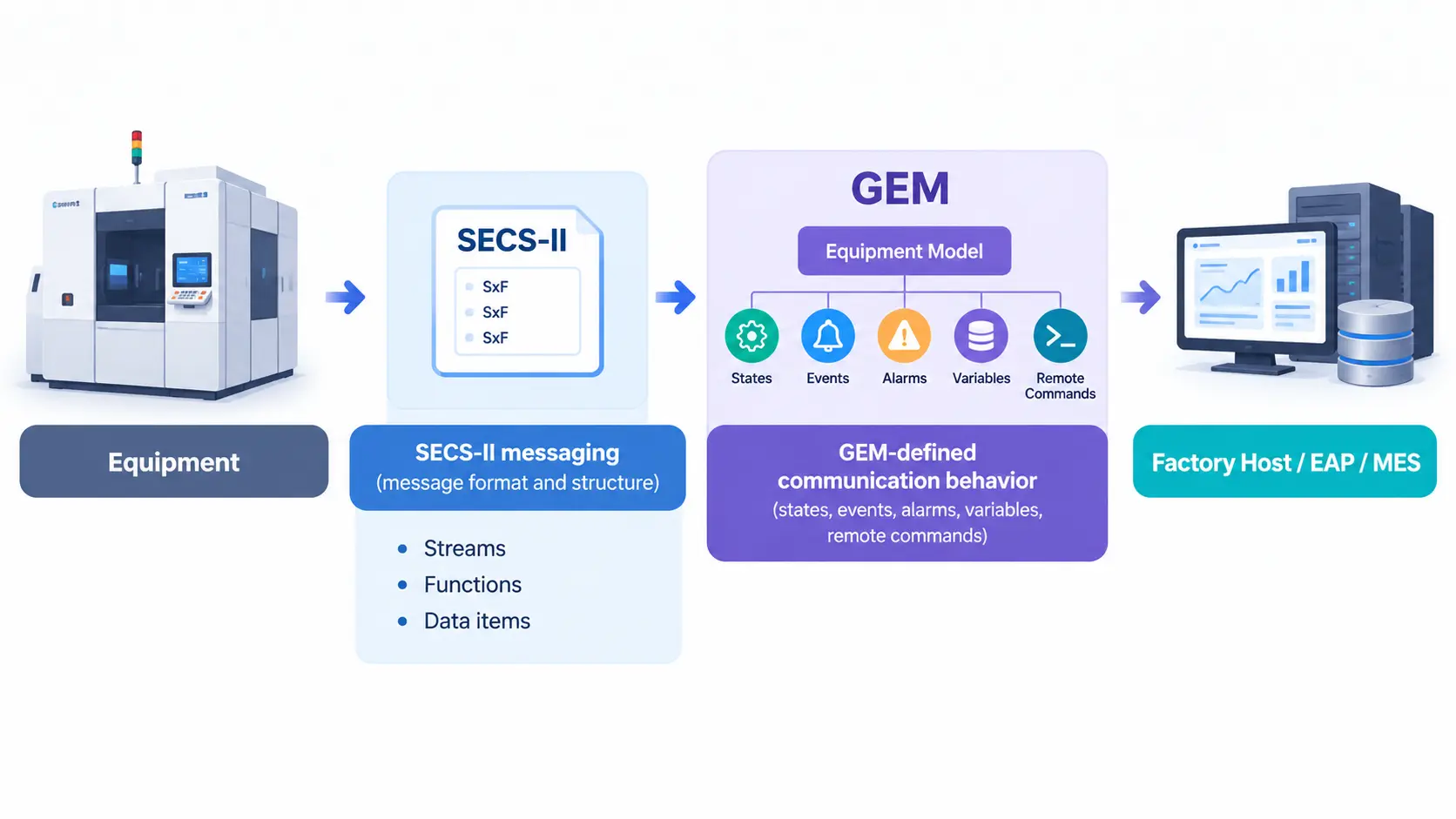 In this flow, SECS-II handles how the message is packaged, while GEM defines what the equipment reports and how it responds to host requests. The factory host system then interprets this standardized behavior to monitor, control, and collect data from the equipment.


