
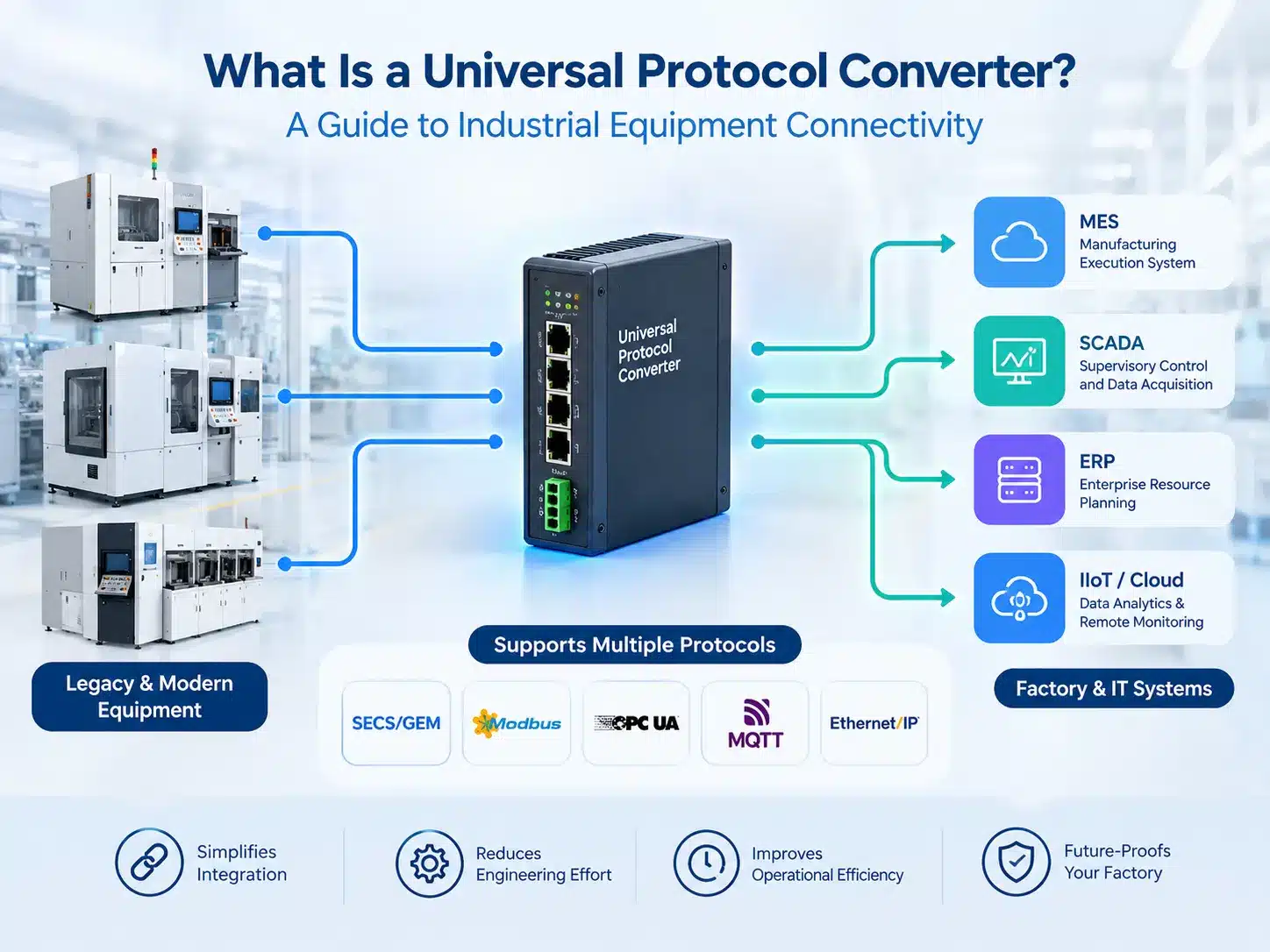
A factory floor rarely speaks one language. A newer machine may use OPC UA, an older PLC may rely on Modbus RTU over RS-485, and a legacy tool may expose only a serial port. When the MES or SCADA system needs data from all of them, integration becomes slow and expensive.
A universal protocol converter can act as a connectivity layer between these systems. This guide explains what it is, how it works, where it fits, and how to decide whether it suits your equipment.
What Is a Universal Protocol Converter?
A universal protocol converter is a hardware or software layer that lets equipment and systems using different communication protocols exchange data. A protocol converter does the translation so each side can keep using its native language.
“Universal” describes the goal of supporting multiple protocols. It does not mean one device supports every protocol. Actual support depends on the specific product, its interfaces, and your application requirements.
A simple example looks like this:
Legacy Machine → Protocol Converter → Modern Industrial Network → MES/SCADA
The converter handles three jobs:
- Protocol translation: reading the source protocol and producing the destination protocol
- Data mapping: matching values such as registers, tags, or messages to the fields the receiving system expects
- Communication interfaces: providing the physical and network connections, such as serial ports or Ethernet
Why Do Industrial Systems Need Protocol Conversion?
Most plants grow over time. They add machines from multiple vendors, keep older PLCs and controllers running, and layer new systems on top. Each addition may bring another protocol.
Protocol conversion helps with several common pressures:
- Legacy equipment: older machines often lack modern network interfaces.
- Multiple vendors: different suppliers favor different protocols.
- MES integration requirements: the MES needs consistent data from every machine.
- Factory modernization and Industry 4.0 connectivity: analytics and smart manufacturing programs depend on accessible equipment data.
- Cost control: connecting a working machine can be less disruptive than replacing it.
The business value is straightforward. Better industrial automation connectivity gives teams visibility into equipment without rebuilding the whole line.
How Does an Industrial Protocol Converter Work?
The process follows a consistent pattern:
- The converter receives data from the source equipment.
- It interprets the source protocol.
- It maps or translates the required data.
- It converts the data into the destination protocol or format.
- It sends the information to another industrial system.
The architecture is simple:
Equipment / PLC → Protocol Converter → SCADA / MES / Host
For example, a PLC protocol converter might read values from a controller over Modbus and publish them to a SCADA system over OPC UA. Functionality depends on the converter, its interfaces, the protocols involved, and your application requirements, so confirm each of these early.
Common Industrial Communication Protocols
You do not need to master every protocol, but you should know which ones sit on each side of the conversion.
| Protocol / Interface | Typical Use | Interoperability Note |
|---|---|---|
| Modbus RTU / Modbus TCP | PLCs, sensors, meters, and field devices | Common industrial protocols; Modbus RTU typically uses serial communication, while Modbus TCP uses Ethernet |
| RS-232 / RS-485 | Serial communication on legacy and industrial equipment | These are physical/electrical interfaces, not complete application protocols; the protocol running over them must also be identified |
| OPC UA | Industrial data exchange, SCADA, MES, and automation systems | Vendor-neutral architecture designed to support structured and secure industrial data exchange |
| EtherNet/IP / PROFINET | PLCs, controllers, I/O, and industrial automation networks | Widely used in industrial Ethernet environments and often associated with specific automation ecosystems |
| CAN | Machinery, controllers, sensors, and embedded systems | Commonly used for device-level communication; the specific CAN-based protocol should be identified |
| MQTT | IIoT, edge-to-cloud, and machine data distribution | Lightweight publish/subscribe messaging protocol commonly used for connected industrial applications |
| SECS/GEM | Semiconductor equipment-to-host communication | Widely used for semiconductor equipment automation; support depends on the specific connectivity solution |
Protocol Converter and Legacy Equipment Integration
Older machines often run reliably but cannot talk to modern systems. Legacy equipment integration closes that gap by adding a connectivity layer:
Existing Equipment → Connectivity Layer → Modern Factory Systems
Depending on the equipment interface and integration requirements, manufacturers may extend the useful life of a functional machine instead of replacing it. This works best when the equipment exposes usable data through a serial port, fieldbus, or controller. Without an accessible interface, additional engineering may be needed.
Protocol Conversion in Semiconductor Manufacturing
Semiconductor fabs, OSATs, and ATMPs run equipment from many generations. Semiconductor equipment connectivity usually centers on SECS/GEM, which lets tools communicate with a host system for control, status reporting, and data collection. The MES then uses that information for equipment automation and production tracking.
Keep these ideas separate. SECS/GEM is an equipment communication standard, and an MES is the manufacturing execution system that consumes the data. They are not the same thing.
A general-purpose protocol converter is also not a complete SECS/GEM implementation. A converter can translate between protocols. A SECS/GEM implementation must handle the standard’s messaging, state models, and host behavior. Not every protocol converter provides SECS/GEM compliance. For 300 mm environments, GEM300 requirements are implementation-dependent and should be confirmed against the specific tool and fab expectations.
For legacy tools, the real task is often to expose equipment data and connect it to a SECS/GEM interface so the host can communicate with it. eInnoSys focuses on this kind of SECS/GEM integration.
Key Benefits of Protocol Conversion
- Connect legacy equipment to current systems
- Reduce integration complexity
- Improve interoperability across multi-vendor equipment
- Support MES connectivity and PLC to MES communication
- Extend equipment lifecycle and avoid unnecessary replacement
- Support factory automation through gradual modernization
Actual results depend on the equipment, the interfaces available, and how the integration is designed.
How to Choose a Protocol Converter
Use these criteria when evaluating a solution:
- Supported protocols: confirm the exact protocols and versions you need
- Physical interfaces: check serial, Ethernet, and fieldbus options
- Data mapping capabilities: look for flexible mapping and scaling of tags or registers
- Communication speed and real-time requirements: match latency and throughput to your process
- Reliability and diagnostics: logging and troubleshooting tools save time during commissioning
- Security: review authentication, encryption, and network segmentation support
- MES/SCADA compatibility: verify the destination systems and data formats
- Scalability and vendor support: plan for more machines, and check documentation and long-term availability
Test with a representative machine before rolling out across the plant.
Protocol Converter vs. Equipment Replacement
Neither option fits every situation. Evaluate each machine on its own merits.
| Factor | Protocol Conversion | Equipment Replacement |
|---|---|---|
| Best when | Equipment is reliable and exposes a usable data interface | Equipment is obsolete, unreliable, or cannot meet future needs |
| Disruption | Often lower, since the machine stays in place | Typically higher, with installation and requalification |
| Investment | Focused on the connectivity layer | Covers the full tool |
| Limitations | Depends on the interfaces the equipment provides | Spare parts, process capability, and safety may drive the decision |
How eInnoSys Can Help
eInnoSys provides industrial equipment connectivity and automation solutions, with a focus on semiconductor manufacturing. The team works on industrial equipment connectivity, legacy equipment integration, and MES integration for fabs, OSATs, and electronics manufacturers.
For SECS/GEM connectivity, eInnoSys offers EIGEMBox and EIGEMEquipment. is relevant when you need to connect equipment to a host without major changes to the tool. The right approach depends on your equipment interface and requirements, so a technical review is the best starting point.
If you are planning broader equipment automation solutions , eInnoSys can help you assess what to connect, what to convert, and what to replace.
Conclusion
A universal protocol converter can be a practical part of industrial equipment connectivity and modernization. It helps different machines, PLCs, and systems communicate, and it can extend the life of equipment that still works.
Protocol support always depends on the product and the application, and in semiconductor environments a converter is not the same as a full SECS/GEM implementation. To explore your options, review eInnoSys’s Industry 4.0 and smart manufacturing solutions or contact the team with your equipment connectivity and integration requirements.


