
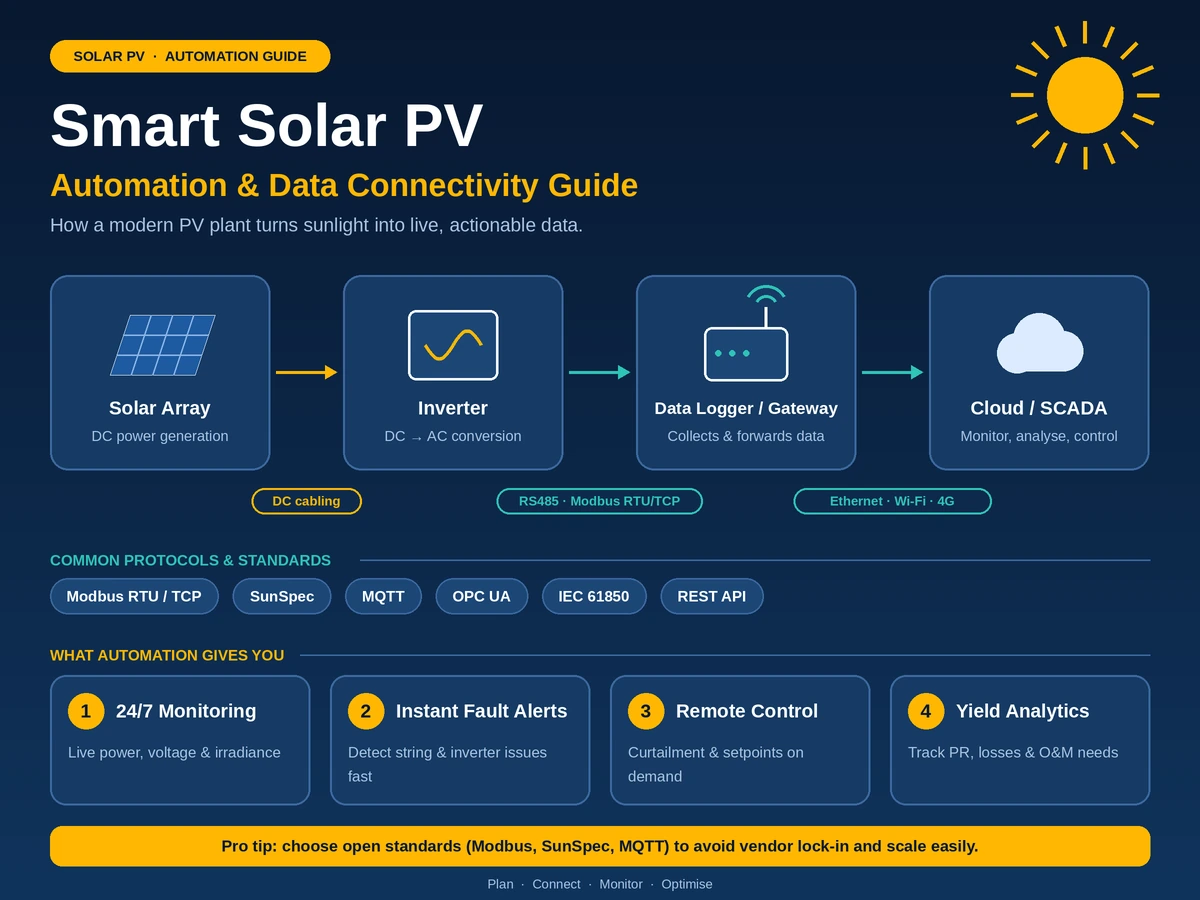
Solar demand keeps growing, and so does the pressure on factories. Manufacturers must produce more modules, hold quality tight, and control costs at the same time. Yet many plants still run on isolated machines and manual reports.
That is where Smart Solar PV manufacturing makes a difference. By connecting equipment, collecting data in real time, and automating decisions, plants gain clear visibility and steadier output. This guide explains how it works and what it delivers.
What Is Smart Solar PV Manufacturing?
Smart Solar PV manufacturing links every stage of production into one data-driven system. Cell stringers, laminators, IV testers, and EL inspection tools all share information automatically. As a result, plant teams see what is happening on the line right now, not hours later.
Three elements make this possible:
- Automation reduces manual handling and repeat tasks.
- Equipment connectivity lets machines talk to each other and to factory systems.
- Real-time data collection turns machine signals into usable insights.
Together, these elements create a connected factory that can respond quickly to problems.
Why Disconnected Equipment Slows Solar Production
Most solar lines combine machines from several vendors. Each machine often speaks its own “language.” Consequently, data stays trapped inside individual tools.
This creates several everyday problems:
- Operators record data by hand, which invites errors.
- Managers wait for shift reports before they can act.
- Quality issues are found late, after more defective units are built.
- Traceability gaps make audits and customer claims harder to answer.
In short, poor connectivity hides problems until they become expensive. Fixing it starts with Solar Equipment Connectivity.
How Solar Equipment Communication Software Works
Solar Equipment Communication Software acts as a translator between machines and plant systems. Many factories rely on established standards such as SECS/GEM to exchange data and commands. With a standard interface, a host system can read equipment status, receive alarms, and collect process data automatically.
The flow is simple:
- The machine generates data, such as status, recipes, alarms, and process values.
- A connectivity layer captures and standardizes that data.
- The factory system, such as an MES, uses it for monitoring, control, and analysis.
Because every machine follows the same pattern, adding new equipment becomes far easier. This is the foundation of Solar Equipment Integration.
Key Benefits of Automation and Data Connectivity
A connected line improves performance in measurable, practical ways.
1. Greater production visibility. Live dashboards show equipment state, throughput, and downtime in one place. Plant managers can spot a stopped machine within moments.
2. Higher equipment effectiveness. When teams see the causes of downtime, they can reduce them. Over time, this lifts OEE and keeps lines running longer.
3. Better quality control. Real-time process data helps engineers catch drift early. Therefore, fewer defective cells and modules move downstream.
4. Full traceability. Each cell, string, and module can be linked to its process history. This supports audits, warranty claims, and root-cause analysis.
5. Faster decisions. Automated alerts replace guesswork. Teams act on facts instead of waiting for reports.
6. Easier scaling. A standard integration approach lets you add lines or new equipment without starting from scratch.
Solar Manufacturing Equipment Integration: The Building Blocks
A strong integration stack usually combines several components. eInnoSys offers a connected set of tools designed for this purpose.
- EIGEMBox is a gateway that helps connect equipment to factory systems, including older machines that lack modern interfaces.
- EIGEMEquipment adds standard communication capability on the equipment side, so machines can exchange data with a host.
- EIGEM300Equipment supports advanced equipment automation requirements for more demanding environments.
- EIGEMLink helps link equipment data with host and factory applications.
- EIGEMHMI gives operators a clear interface to monitor and interact with equipment.
- EIGEM84 supports automated material handoff interfaces between equipment and transport systems.
- EIGEMSim simulates equipment and host behavior, so teams can test integrations before going live.
Using a simulator is especially valuable. You can validate communication logic without stopping production, which reduces commissioning risk and saves time.
When to Choose Custom Solar Software Development
Not every plant fits a standard template. Some lines use unique machines. Others need special reports, rules, or links to existing systems. In these cases, Custom Solar Software Development closes the gap.
A capable Solar Software Company will study your process, map your data points, and build software around your workflow. Good Solar PV Software Development Services also include testing, documentation, and support after launch. As a result, the software fits your plant instead of forcing your plant to fit the software.
For a wider view, explore our Solar PV Software Solutions. These Photovoltaic Software Solutions cover connectivity, monitoring, and integration under one roadmap.
How to Start Your Smart Solar PV Journey
You do not need to connect everything at once. A phased plan works best.
- Audit your equipment. List each machine, its age, and its available interfaces.
- Pick a pilot line. Start where downtime or quality issues cost the most.
- Define key data. Focus on status, alarms, recipes, and yield data first.
- Simulate and test. Validate communication before connecting live equipment.
- Roll out and expand. Apply lessons from the pilot to other lines and plants.
This approach keeps risk low while delivering early wins. It also suits manufacturers across many regions, from Asia and the Middle East to Europe, Africa, and North America.
Conclusion
Smart Solar PV manufacturing turns scattered machines into a connected, data-driven operation. Automation reduces manual work. Connectivity unlocks real-time data. Integration brings it all together, which improves visibility, quality, and efficiency.
eInnoSys helps solar manufacturers make this shift with proven connectivity tools and custom software expertise. If you want a plant that is easier to see, control, and scale, now is the time to begin.
Related Blogs:-
- Solar Plant Monitoring: How Real-Time Data Improves Performance & Efficiency
- SECS/GEM for Solar Manufacturing: A Complete Guide to Equipment Automation
- Smart Gateways Connect Solar Equipment, Data & Systems


