
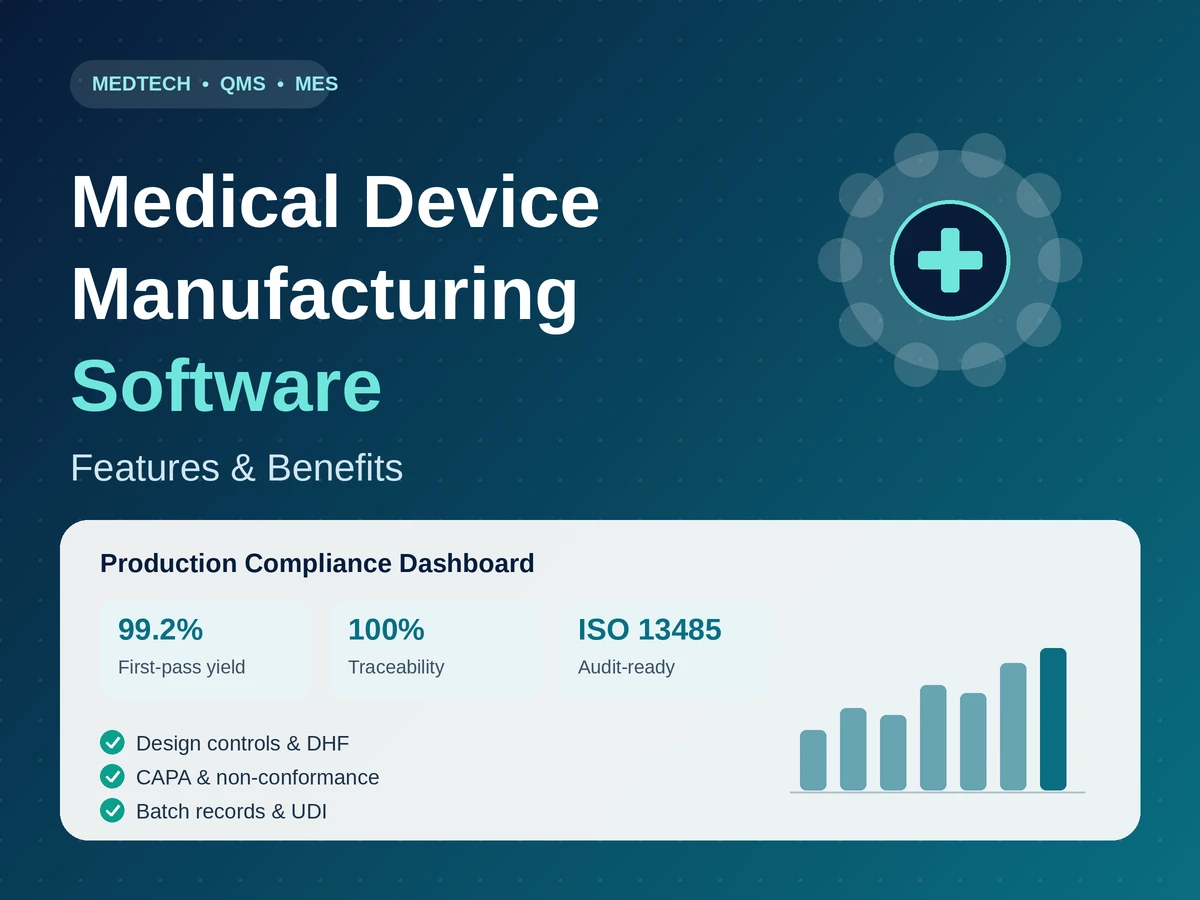
Medical device manufacturing software is a set of digital tools that controls, tracks, and documents production. It connects machines to a Manufacturing Execution System (MES), records every batch and component, and supports compliance with FDA and EU MDR rules. The result is better traceability, fewer defects, and faster audits.
Medical devices are made in a tightly regulated environment. A single missing record can delay a shipment, and one undetected defect can trigger a recall. Paper logs and disconnected machines make both risks harder to manage.
That is why medical device manufacturing software has become a core part of modern production. This guide explains what it is, its key features and benefits, how MES fits in, and how to choose the right solution.
What Is Medical Device Manufacturing Software?
Medical device manufacturing software digitizes and controls production on the shop floor. It collects data from equipment, enforces approved processes, and stores records for every unit built.
Most medical device production software includes these layers:
- Equipment connectivity: pulls data from machines and controllers.
- MES: manages work orders, procedures, and quality checks.
- Reporting and analytics: turns production data into decisions.
Together, these layers give manufacturers one reliable view of what is happening on the line.
Key Features of Medical Device Manufacturing Software
Strong medical device manufacturing software solutions share several core capabilities.
1. End-to-end traceability and genealogy
The software links each finished device to its raw materials, components, machines, operators, and process settings. If a supplier lot is flagged, you can find affected devices in minutes instead of days.
2. Electronic device history records (eDHR)
An eDHR replaces paper travelers. Each step is recorded automatically with time stamps and user IDs, which helps support the data-integrity expectations behind FDA 21 CFR Part 11 and Part 820.
3. Real-time equipment data collection
Direct machine data removes manual entry errors. Teams see status, alarms, and process values as they happen.
4. Quality management and in-process checks
Built-in inspections, hold-and-release rules, and nonconformance workflows stop bad product early. They also support ISO 13485 quality system requirements.
5. Recipe and process control
The system makes sure each machine runs the approved recipe. This prevents unauthorized changes and keeps results consistent.
6. Audit trails and document control
Every change is logged. Auditors can review who did what and when, without searching through binders.
7. Integration with ERP, QMS, and PLM
Production data flows to business systems, so planning, quality, and engineering work from the same facts.
Benefits of Medical Device Production Software
The benefits are measurable and apply across regions.
- Stronger compliance: Electronic records and audit trails make it easier to meet FDA requirements in the US and EU
- MDR in Europe. They also help with markets such as the UK, Japan, India, and the Gulf region.
- Faster recalls and investigations: Genealogy data narrows the scope of an issue quickly, which limits cost and risk to patients.
- Higher quality: In-process checks catch problems earlier, which reduces scrap and rework.
- Improved efficiency: Less paperwork and fewer manual steps mean higher Overall Equipment Effectiveness (OEE).
- Shorter audit preparation: Records are searchable and complete.
- Scalable growth: Standardized digital processes let you replicate a line or site more easily.
Role of MES in Medical Device Manufacturing
A medical device manufacturing execution system is the operational brain of the factory. It sits between business systems such as ERP and the machines that make the product.
A medical device MES does four main jobs:
- Executes work orders and guides operators step by step.
- Enforces approved procedures and quality gates.
- Records all production data for the device history record.
- Reports performance, yield, and deviations in real time.
This is why MES for medical device manufacturing is often the center of a digital plan. However, an MES is only as good as the data it receives. That brings us to integration.
MES Integration with Manufacturing Equipment
MES integration for medical devices connects machines, inspection stations, and material-handling systems to the MES. Without it, operators re-type data, and records can contain errors.
Common integration challenges include:
- Legacy machines with no modern communication ports.
- Mixed equipment brands that speak different protocols.
- Operator interfaces that are not linked to the MES.
- Testing risk, since connecting live machines without simulation can disrupt production.
Standards-based communication helps. SECS/GEM and GEM300 are widely used equipment communication standards, best known in semiconductor manufacturing. They are increasingly useful in precision medical device production as well, especially for automated and cleanroom processes.
A practical integration approach usually covers:
- Legacy equipment connectivity using edge devices such as EIGEMBox.
- HMI and operator integration through EIGEM-HMI.
- SECS/GEM communication with EIGEMEquipment.
- GEM300 automation with EIGEM300Equipment.
- Equipment-to-host links through EIGEMLink.
- Safe testing with EIGEMSim, which simulates equipment communication before go-live.
How to Choose Medical Device Manufacturing Software
Use this checklist when you evaluate a medical device manufacturing software company:
- Regulatory fit: Does it support FDA 21 CFR Part 11 and 820, EU MDR, and ISO 13485 needs?
- Validation support: Can the vendor provide documentation that helps with computer system validation?
- Equipment coverage: Can it connect both new and legacy machines?
- Open integration: Does it work with your ERP, QMS, and PLM systems?
- Scalability: Can it grow from one line to multiple sites and countries?
- Usability: Will operators adopt it without heavy training?
- Vendor experience: Does the provider understand regulated manufacturing?
- Support model: Is implementation and long-term support available in your region?
Start with a pilot line. Prove the value, then expand.
How eInnoSys Supports Medical Device Manufacturing Automation
eInnoSys focuses on equipment connectivity and factory automation. Its Medical Devices Industry solutions help manufacturers connect machines, integrate with MES, and build reliable data flows from the shop floor upward.
The platform covers legacy retrofits, operator interfaces, SECS/GEM and GEM300 communication, and simulation. This lets teams modernize step by step instead of replacing everything at once.
Conclusion
Medical device manufacturing software gives manufacturers the control, traceability, and speed that regulated production demands. The strongest results come when machines, operators, and the MES share one connected data flow.
eInnoSys helps medical device manufacturers build that flow, from legacy equipment connectivity to SECS/GEM and GEM300 integration, so production stays compliant, efficient, and audit-ready.
Related Blogs:-
- Medical Device Product Development: From Design to Production
- Medical Device Software Solutions for Smarter Manufacturing
- Medical Device Software Development Companies: Services & Solutions


