
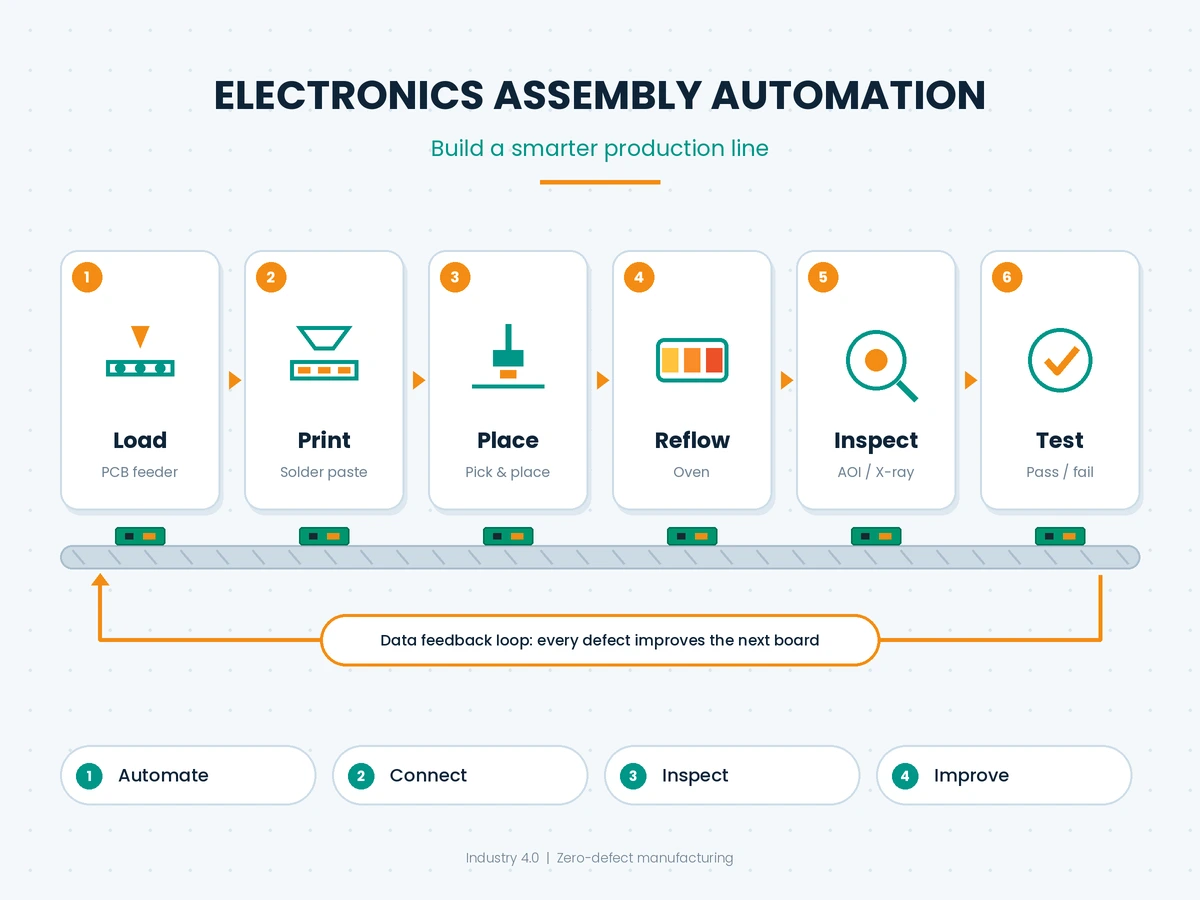
Electronics assembly automation connects SMT equipment, software and MES so the line shares data, controls recipes and reacts to problems in real time. Standards such as SECS/GEM make this connection possible across machines from different vendors.
A modern SMT line can place thousands of components per minute. Yet many factories still depend on manual data entry, USB-stick recipe transfers and disconnected machines. The equipment is fast, but the information around it is slow.
Electronics assembly automation closes that gap. This guide explains what it is, why traditional lines struggle, which technologies matter and how to implement it step by step.
What Is Electronics Assembly Automation?
Electronics assembly automation is the use of connected equipment, software and data standards to run an SMT line with minimal manual intervention. It covers more than robotic placement. It includes how machines talk to each other, how recipes are loaded, how defects are traced and how production data reaches decision-makers.
A typical automated SMT line connects:
- Stencil printers and SPI systems
- Pick-and-place machines
- Reflow ovens
- AOI and inspection equipment
- MES, ERP and analytics platforms
When these systems share data through standard interfaces, the factory moves from reactive firefighting to proactive control. This is the core idea behind electronics factory automation.
Key Challenges in Traditional SMT Production Lines
Even well-equipped factories run into the same problems.
- Equipment silos: Machines from different vendors use different protocols, so data stays trapped inside each one.
- Manual recipe handling: Operators load programs by hand, which raises the risk of wrong-recipe errors and slow
- changeovers.
- Weak traceability: Without automatic data capture, tracing a defect to a machine, lot or parameter takes hours.
- Limited visibility: Managers see yesterday’s reports instead of live line status, downtime and yield.
- Legacy machines: Older equipment often has no modern communication interface at all.
- Costly integration: Custom, one-off connections for every machine are slow to build and hard to maintain.
Essential Technologies for a Smarter Production Line
A smarter line rests on four building blocks.
1. SMT Equipment Connectivity
SMT equipment connectivity is the foundation. Each machine must expose its status, alarms, process data and recipes in a consistent way. Without it, nothing above it works.
2. SECS/GEM Standards
SECS/GEM is a widely used equipment communication standard. It defines how a machine reports events, accepts remote commands and manages recipes. Using SECS/GEM for electronics manufacturing gives you a common language across mixed-vendor lines instead of a different integration for every machine.
3. Operator Interfaces
A clear HMI lets operators see machine state, respond to alarms and follow guided steps without digging through vendor screens.
4. MES and Analytics Layer
The MES uses connected data to enforce process rules, track every board and calculate OEE and yield. This layer turns raw machine signals into decisions.
Benefits of SMT Software and Equipment Connectivity
Good SMT software solutions and connectivity deliver gains you can measure:
- Faster changeovers: Recipes download automatically and reduce setup mistakes.
- Full traceability: Every board links to machine, parameters and time.
- Less downtime: Real-time alarms and status let teams act early.
- Higher yield: Process data exposes drift before it causes defects.
- Better OEE visibility: Availability, performance and quality come from live data.
- Scalability: Standard interfaces make it easier to add machines or lines.
In short, SMT automation software replaces guesswork with evidence.
How SECS/GEM and MES Integration Improve Manufacturing
SECS/GEM handles the machine side. The MES handles the factory side. Together they create a closed loop.
- The MES sends the right recipe to the machine through SECS/GEM.
- The machine reports events, alarms and process data back in real time.
- The MES checks them against process rules and logs traceability records.
- If something is wrong, it can hold the lot or alert engineers right away.
This is what MES integration for electronics manufacturing looks like in practice. The result is fewer manual steps, fewer errors and a line that explains itself. Reliable electronics equipment integration also shortens the time needed to bring new machines online.
Steps to Implement Electronics Assembly Automation
You do not need to automate everything at once. A phased approach lowers risk.
- Audit your line. List every machine, its age, its interfaces and its data capabilities.
- Define goals. Choose measurable targets such as changeover time, traceability depth or OEE.
- Standardize connectivity. Use SECS/GEM where machines support it and a gateway or software layer where they do not.
- Simulate before going live. Test host and equipment behavior in a safe environment to catch issues early.
- Integrate with MES. Connect recipe management, traceability and reporting.
- Pilot on one line. Prove results, then roll out across other lines.
- Monitor and improve. Use live data to refine processes continuously.
How eInnoSys Supports SMT Factory Automation
eInnoSys offers a suite of SMT manufacturing solutions built around SECS/GEM connectivity. Each product addresses a different step in the journey:
- EIGEMBox helps connect equipment to the factory network, including machines without native SECS/GEM support.
- EIGEMEquipment adds SECS/GEM capability to equipment software, which suits OEMs and machine builders.
- EIGEM300Equipment supports 300 mm equipment requirements.
- EIGEM-HMI provides a clear operator interface for equipment control and monitoring.
- EIGEMLink links equipment with host and MES systems.
- EIGEM84 supports additional equipment connectivity needs.
- EIGEMSim simulates host and equipment behavior so you can test integrations before deployment.
Together, these tools support SECS/GEM electronics equipment projects from first connection to full MES integration. To see how they fit your factory, explore our SMT industry solutions.
Conclusion
Electronics assembly automation is no longer a luxury. It is how competitive SMT factories reduce errors, speed up changeovers and see what is happening on the line in real time. The path is clear: connect your equipment, standardize on SECS/GEM, integrate with MES and improve with data.
eInnoSys helps electronics manufacturers, OEMs and automation teams take that path with proven connectivity and integration solutions. A smarter production line starts with a single connected machine.
Related Blogs:-
- SMT Automation Solutions for Electronics Manufacturing
- SMT Automation: How It Improves Electronics Manufacturing Efficiency
- SMT Factory Automation: A Complete Guide to Smart Electronics Manufacturing


