
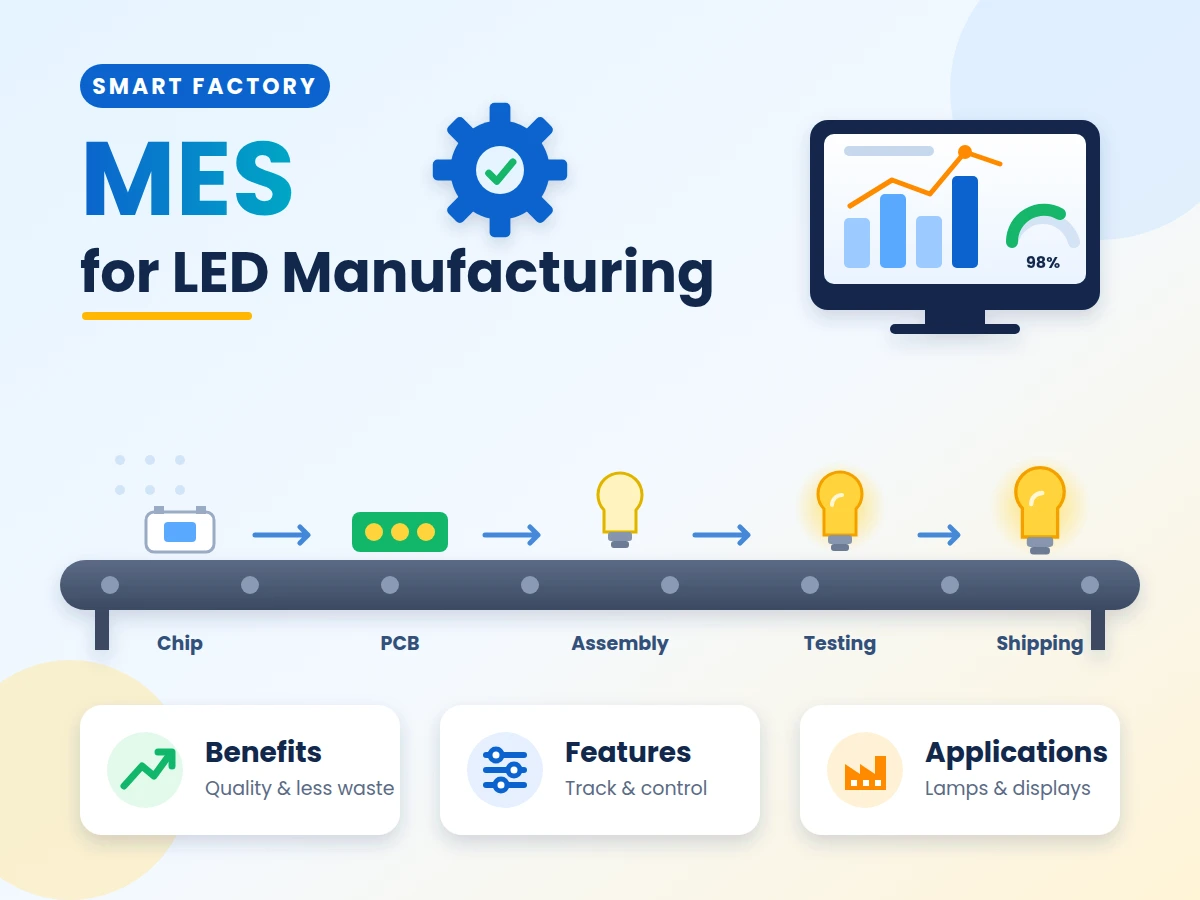
MES for LED manufacturing is a system that tracks, controls, and records every step of LED production in real time. Combined with LED manufacturing software, it connects equipment, enforces quality rules, and builds full traceability from wafer to finished product.
LED production is precise and fast-moving. Small shifts in temperature, bonding, or phosphor application can change brightness, color, and yield. Many plants still depend on spreadsheets, paper travelers, and disconnected machines, which leaves blind spots on the shop floor.
LED manufacturing software closes those gaps. This guide covers what a manufacturing execution system (MES) does for LED plants, the features that matter, the benefits, and where it applies.
What Is MES for LED Manufacturing?
A manufacturing execution system sits between your ERP and your shop floor. It manages work in progress, tracks materials, monitors machines, and records quality data as production happens.
MES for LED manufacturing is configured for LED workflows such as epitaxy, chip fabrication, die bonding, wire bonding, phosphor coating, encapsulation, testing, and binning. A good LED manufacturing MES captures data at every step, so managers see what is happening now rather than at the end of the shift.
LED production software also handles the high volume of small parts, strict binning rules, and tight process windows that make LED manufacturing different from general assembly.
Why LED Manufacturers Need Dedicated Software
LED factories face challenges that generic tools handle poorly:
- Tight process control: Small deviations affect lumen output, color temperature, and consistency.
- Mixed equipment: Plants often combine new machines with older tools that use different communication protocols.
- Strict traceability: Customers in automotive, display, and lighting expect lot-level history.
- High-volume, low-margin production: Yield losses and downtime reduce profit quickly.
- Manual data entry: Paper records cause delays, errors, and missing history.
LED manufacturing automation addresses these problems by replacing manual records with automated, connected workflows.
Key Features of LED Manufacturing Software
1. Real-Time Production Monitoring:-
LED production monitoring software shows live output, work-in-progress status, and line performance on one dashboard. Supervisors can spot bottlenecks within minutes and rebalance the line before targets slip.
2. Equipment Connectivity and Data Collection:-
LED equipment monitoring software collects machine status, alarms, recipes, and process parameters directly from tools. Standards such as SECS/GEM make this exchange consistent across vendors. Automatic collection removes manual logging and gives your team trustworthy data.
3. Lot Tracking and Full Traceability:-
Every wafer, die, and finished lot carries a digital history: materials used, machines, operators, parameters, and test results. If a quality issue appears, you can isolate the affected lots quickly instead of recalling an entire batch.
4. Quality Control and SPC:-
Built-in checks compare live process data against specification limits. The system can flag out-of-range readings, hold suspect lots, and trigger corrective actions automatically. Statistical process control (SPC) charts help engineers catch drift before it creates scrap.
5. Recipe and Process Management:-
Recipe control makes sure the correct parameters load on the correct machine for each product. This prevents wrong-recipe errors, a common cause of yield loss in LED lines.
6. Binning and Sorting Support:-
LED sorting depends on accurate test data. LED production management software can link test results to bin rules so that parts are graded consistently and shipped to the right customer specification.
7. OEE and Downtime Analysis:-
Overall equipment effectiveness (OEE) tracking shows availability, performance, and quality losses for each tool. Reason codes for downtime reveal where improvement effort will pay off most.
Benefits of LED Manufacturing Automation Software
Plants that adopt LED manufacturing automation software usually see gains in several areas:
- Better visibility: One live view of production replaces end-of-shift reports.
- Higher yield: Early detection of process drift reduces scrap and rework.
- Faster root-cause analysis: Digital history shortens investigations from days to hours.
- Less downtime: Alarm tracking and trend analysis support proactive maintenance.
- Audit readiness: Complete records simplify customer and regulatory audits.
- Lower manual effort: Automated data capture frees engineers for improvement work.
- Scalability: New lines and tools can be added without redesigning your data flow.
Common Applications in LED Production
LED factory automation with MES supports many areas of the plant:
- Wafer and chip manufacturing: Track process steps, recipes, and equipment states across fab operations.
- Packaging and assembly: Control die bonding, wire bonding, and encapsulation with lot-level history.
- Testing and binning: Connect testers to grading rules and store results by unit or lot.
- LED flat panel and display lines: Monitor high-volume assembly and inspection with consistent traceability. Explore LED flat panel manufacturing solutions for this segment.
- Legacy equipment integration: Bring older machines online without replacing them.
How to Choose the Right LED Manufacturing Software
Use these questions when evaluating vendors:
- Does it support open standards? SECS/GEM and related protocols reduce lock-in.
- Can it connect old and new tools? Mixed fleets are the norm.
- How fast can it deploy? Look for modular, phased rollouts.
- Is operator access simple? Clear screens reduce training time.
- Can you test before going live? Simulation lowers commissioning risk.
- Does the vendor understand your industry? Domain experience shortens implementation.
Connecting Your Equipment: The Einnosys EIGEM Approach
The value of any MES depends on reliable equipment data. Einnosys offers a connected set of products for this layer:
- EIGEMBox helps connect equipment to your factory systems.
- EIGEM-HMI provides an operator interface at the tool.
- EIGEMEquipment supports equipment-side communication and automation.
- EIGEM300Equipment addresses 300 mm equipment communication needs.
- EIGEMLink links equipment with host and factory systems.
- EIGEM84 supports additional equipment integration needs.
- EIGEMSim lets teams simulate and test connectivity before deployment.
Together, these tools support LED manufacturing automation from the machine level up to the MES.
Implementation Tips
- Start with one line. Prove value on a pilot before scaling.
- Define your data first. Decide which parameters, alarms, and events matter.
- Simulate before go-live. Testing connections early prevents production disruption.
- Involve operators. Their feedback shapes screens people will actually use.
- Track a few KPIs. Yield, OEE, and downtime are a strong starting set.
Conclusion
MES and LED manufacturing software give LED producers the visibility, control, and traceability needed to compete on quality and cost. By connecting equipment, automating data collection, and enforcing quality rules in real time, plants reduce waste and respond to problems faster.
Einnosys helps LED manufacturers build this foundation with equipment connectivity, HMI, and simulation solutions that fit both new and legacy tools. If you are planning your next step in LED factory automation, Einnosys can help you start with a practical, low-risk approach.
Related Blogs:-
- Best LED Manufacturing Software for Production Management
- How LED Manufacturing Software Improves Production Efficiency
- Key Features to Look for in LED Manufacturing Software


