
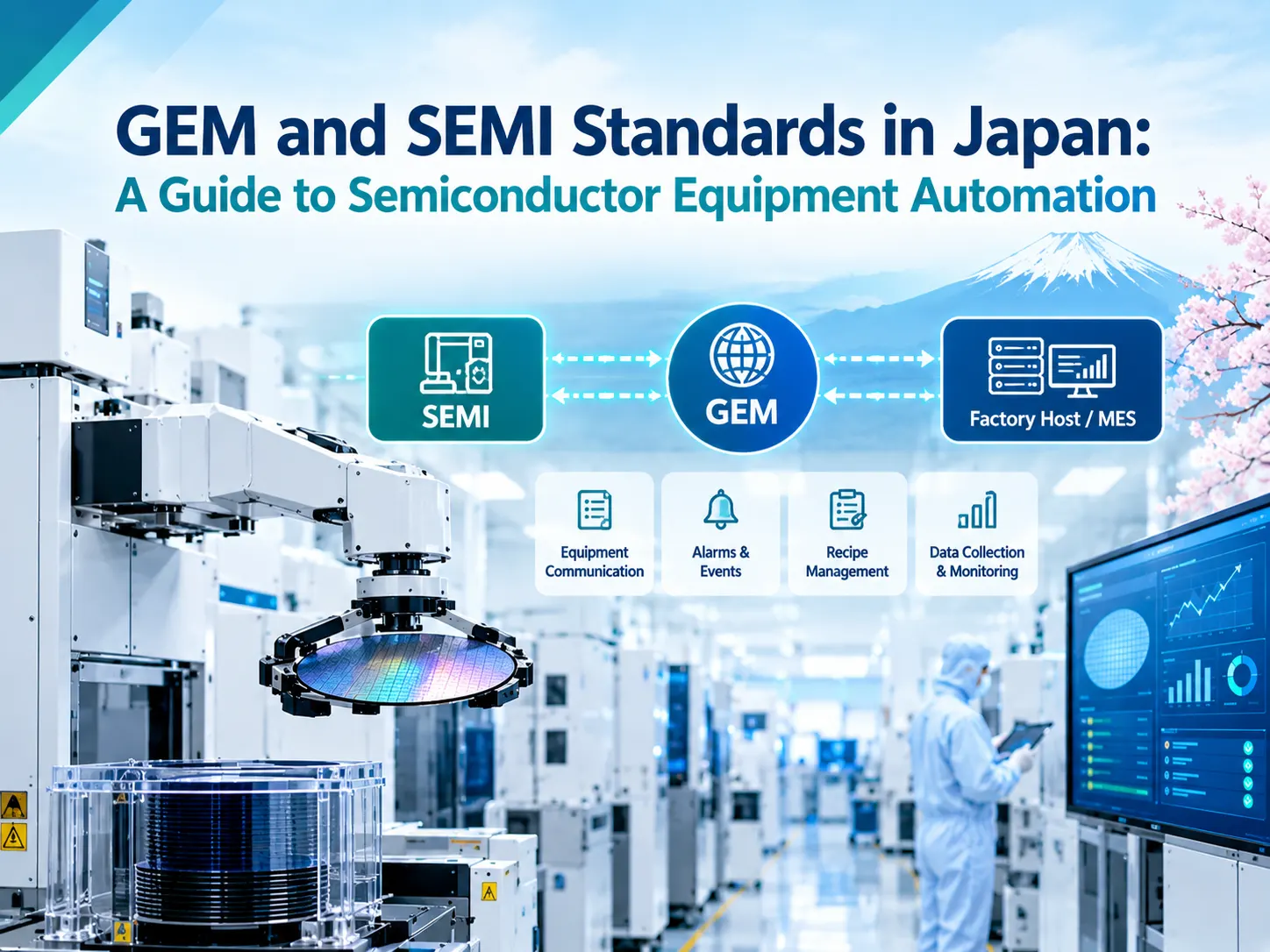
Semiconductor manufacturing in Japan depends on precise, repeatable and traceable processes. Fabs, OSAT facilities and equipment makers all need tools that report their status, accept commands and share data with factory systems in a predictable way.
That is the job of GEM and SEMI standards. SEMI publishes the standards, SECS/GEM is the best-known communication and control model among them, and together they let equipment from different vendors talk to the same host or MES. This guide explains how they fit together and how to approach SECS/GEM integration, including for older tools.
Understanding GEM and SEMI Standards
SEMI is the global industry association that publishes the standards used across semiconductor and related manufacturing. For equipment automation, four terms matter most:
- SECS-II (SEMI E5) defines the content of messages, such as status requests, alarms and remote commands.
- HSMS (SEMI E37) defines how those messages travel over a TCP/IP network. The older SECS-I (SEMI E4) does the same over a serial link.
- GEM (SEMI E30) defines how equipment should behave and what capabilities it should expose to a host.
Protocols vs. equipment behavior
A useful way to separate them: SECS-I, HSMS and SECS-II describe how data is exchanged. GEM describes what the equipment does and which capabilities it offers. These include state models, event reporting, alarm handling, data collection, remote commands, equipment constants and process program (recipe) management.
In practice “SECS/GEM” is shorthand for the whole set. A tool can use HSMS and SECS-II and still fall short of GEM if it lacks the required behaviors. For a broader primer, see eInnoSys’s introduction to SECS/GEM.
Important SEMI Standards for Semiconductor Equipment Automation
Not every standard applies to every tool. The right set depends on equipment type, wafer size, material handling and the host system’s requirements.
| Standard | Purpose | Practical Application |
|---|---|---|
| SEMI E4 (SECS-I) | Message transfer over serial connections | Communication with older equipment using serial links |
| SEMI E5 (SECS-II) | Defines message structure and content | Exchanging equipment status, alarms, recipes, and commands with the host |
| SEMI E30 (GEM) | Defines the generic equipment communication and control model | Host connectivity, equipment status reporting, and data collection |
| SEMI E37 (HSMS) | Provides high-speed SECS message services | TCP/IP-based communication between equipment and host systems |
| SEMI E40 | Defines processing management (process jobs) | Managing process-job execution |
| SEMI E84 | Defines enhanced carrier handoff between equipment and material-handling systems | Automated material handoff at load ports |
| SEMI E87 | Defines carrier management | Managing carrier identification, load ports, and carrier states |
| SEMI E90 | Defines substrate tracking | Tracking wafer locations within equipment |
| SEMI E94 | Defines control job management | Managing and coordinating control jobs |
| SEMI E116 | Defines equipment performance tracking | Monitoring equipment states and time for utilization analysis |
For 300 mm factories, E40, E87, E90 and E94 are the standards most commonly grouped under GEM300. E116 is often discussed alongside them for performance tracking. Always confirm exactly which standards a given tool and factory require. eInnoSys also maintains a reference library of SEMI standards.
Why Japanese Semiconductor Manufacturers Need SECS/GEM Integration
Japanese manufacturers and equipment makers work in globally connected supply chains, where equipment from many vendors must run under one factory control environment. SECS/GEM supports this in several ways:
- Standardized communication. The same host logic can work across different tool brands.
- Production visibility. Hosts and MES receive equipment states, events and process data in a consistent format.
- Alarm reporting. Alarms reach the factory system in a structured way instead of staying on the tool screen.
- Recipe management. Process programs can be uploaded, downloaded and verified from a central system.
- Factory automation. Remote commands and event-driven workflows reduce manual handling and transcription.
The benefit is a more consistent, traceable and automatable factory. It comes from structured data and remote control, not from any fixed percentage gain.
Common Semiconductor Equipment Integration Challenges
Integration rarely starts from a clean slate. These are the issues teams meet most often:
| Challenge | Impact | Potential Solution |
|---|---|---|
| Legacy Equipment Without SECS/GEM | Equipment cannot communicate directly with the host or MES through SECS/GEM. | Retrofit connectivity using Legacy Equipment Connectivity Solutions. |
| PLC/HMI-Based Tools | Equipment data remains in the PLC or HMI without a suitable GEM interface. | Use a PLC/HMI integration solution such as EIGEMHMI. |
| Incompatible Interfaces | The equipment and host cannot exchange messages reliably. | Implement protocol conversion and a properly tested GEM interface. |
| Missing or Non-Standard Data | The host does not receive all the variables required for monitoring and control. | Map equipment data carefully and add supplementary data capture where needed. |
| GEM300 Requirements | Carrier handling, process jobs, and substrate tracking require additional automation functionality. | Implement GEM300 capabilities covering the applicable standards and equipment requirements. |
How to Implement SECS/GEM in Japan
A structured approach avoids rework. Typical steps:
- Assess the equipment. Identify the controller, operating system, PLC/HMI architecture, available data and whether source code is accessible.
- Select the standards. Confirm with the factory which standards are required. A basic tool may need E30, E37 and E5, while a 300 mm tool with automated handling may also need GEM300 standards and E84.
- Choose an integration approach. Embed an SDK in the equipment software, run it as a separate process, add a bridge for PLC/HMI tools, or use a retrofit for legacy tools.
- Configure the host. Define equipment IDs, connection settings, data collection reports, events and alarms.
- Test thoroughly. Use a simulator and the factory host to verify messages, state models and error handling before production. A tool like EIGEMSim supports this stage.
- Integrate with MES. Confirm that lot tracking, recipe handling and alarms behave correctly end to end, and plan support such as MES migration and support where needed.
eInnoSys Solutions for Semiconductor Equipment Automation
eInnoSys offers several approaches, each suited to a different situation.
- EIGEMEquipment is a SECS/GEM SDK and implementation service for equipment makers. eInnoSys lists E30, E4, E5 and E37 support, with C#.NET, C++, Java and REST API options on Windows and Linux. It suits OEMs adding SECS/GEM to new or existing controller software.
- EIGEMBox is a plug-and-play option for legacy equipment. Per eInnoSys, it connects through the tool’s display output and optional keyboard/mouse ports, without installing software on the tool. It suits older tools where modifying the controller is risky or impossible.
- GEM300 integration (EIGEM300Equipment) is an SDK and services offering for 300 mm tools needing GEM300 capabilities.
- SECS/GEM and GEM300 integration solutions cover broader OEM projects that combine both.
The choice depends on architecture, source code access, wafer size and the host’s requirements. A short technical discussion usually settles it.
Conclusion
GEM and SEMI standards give Japanese fabs, OEMs and integrators a common language for equipment connectivity. Understanding which standards apply, choosing the right integration approach and testing before go-live are the main steps to reliable factory automation. That holds for new tools and for legacy equipment alike.


