
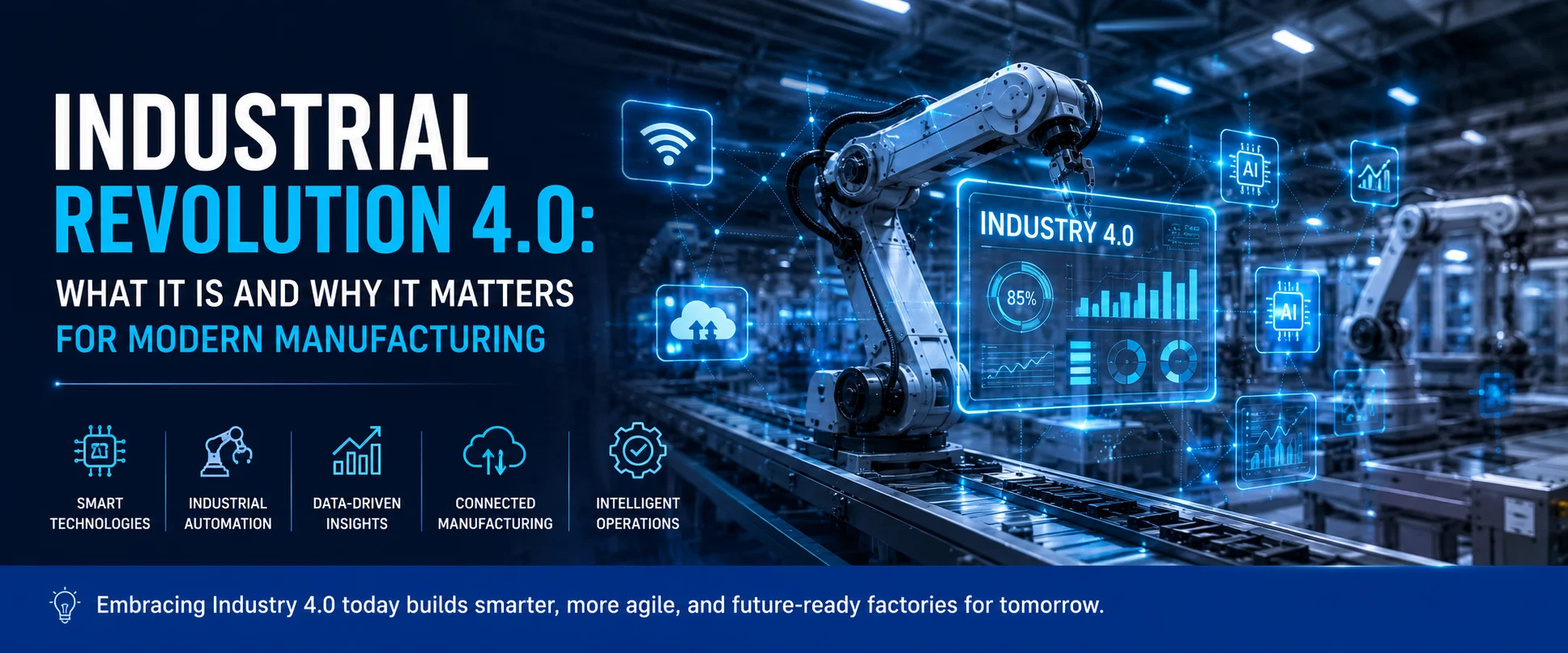
What Is Industry 4.0?
Industry 4.0 Explained simply refers to the digital transformation of manufacturing and industrial operations through connected technologies. It is called the Fourth Industrial Revolution because it follows the previous three industrial revolutions:- Mechanization using steam power
- Mass production using electricity
- Automation using computers and electronics
- Intelligent automation using AI, IoT, and real-time data
Core Technologies Behind Industry 4.0
The success of Industry 4.0 Solutions depends on several advanced technologies working together. These technologies form the foundation of Smart Manufacturing and modern industrial ecosystems.1. Industrial IoT (IIoT)
The Industrial Internet of Things connects machines, sensors, and equipment to centralized systems. This enables real-time monitoring of production lines, machine health, energy consumption, and process performance. In semiconductor manufacturing, IIoT systems can monitor vacuum pumps, ovens, motors, and critical process tools continuously to prevent unexpected failures.2. Artificial Intelligence and Machine Learning
AI and ML are transforming Industry 4.0 for Manufacturing by enabling predictive maintenance, automated quality inspection, and intelligent process optimization. For example, AI-powered predictive maintenance systems can identify abnormal vibration, temperature, or current patterns before equipment failure occurs. This reduces downtime and improves overall equipment efficiency.3. Industrial Automation
Modern Industrial Automation systems combine robotics, PLCs, MES platforms, and intelligent software to automate complex production processes. Automated systems improve consistency, reduce human error, and increase throughput. Automation is especially important in semiconductor fabs where precision and process repeatability are critical.4. Cloud Computing and Edge Computing
Cloud-based platforms enable centralized monitoring across multiple facilities, while edge computing allows real-time data processing directly at the equipment level. Together, they support scalable and flexible Digital Transformation in Manufacturing initiatives.5. Digital Twins
Digital twin technology creates virtual models of machines, processes, or factories. Manufacturers can simulate operations, test process changes, and predict equipment performance without disrupting actual production.Why Industry 4.0 Matters for Modern Manufacturing
The rise of Modern Manufacturing Technologies is changing how industries compete globally. Manufacturers adopting Industry 4.0 gain significant advantages in productivity, quality, and operational efficiency.Improved Operational Efficiency
One of the biggest Benefits of Industry 4.0 is improved production efficiency. Real-time equipment monitoring and intelligent analytics help manufacturers identify bottlenecks and optimize production flow. In a Smart Factory, machines can automatically communicate process data, maintenance alerts, and production status to centralized systems. This reduces manual intervention and improves response times.Reduced Downtime Through Predictive Maintenance
Unexpected equipment failures can result in major production losses. Predictive maintenance systems powered by AI and IoT can detect early warning signs before failures occur. For semiconductor manufacturers, predictive maintenance is essential because even small equipment issues can affect yield, productivity, and product quality.Better Product Quality
Advanced analytics and automated inspection systems improve quality control by detecting defects in real time. Intelligent monitoring systems help manufacturers maintain process consistency and reduce scrap rates.Faster Decision-Making
Real-time dashboards and analytics provide plant managers with instant visibility into operations. This enables faster and more informed business decisions.Increased Flexibility and Scalability
Industry 4.0 Applications allow manufacturers to adapt quickly to changing customer demands and market conditions. Smart production systems can support mass customization and flexible manufacturing processes.Industry 4.0 in Semiconductor Manufacturing
The semiconductor industry is one of the biggest adopters of Industry 4.0 in Manufacturing because fabs require high levels of automation, precision, and data integration. Modern semiconductor factories use:- SECS/GEM communication systems
- AI-powered predictive maintenance
- Automated material handling systems
- MES integration platforms
- Real-time equipment monitoring
- Yield management analytics
Industry 4.0 Solutions for Smart Factories
A successful Smart Factory requires more than just automation. It needs integrated systems that combine equipment connectivity, analytics, AI, and enterprise-level software platforms. Key Smart Factory Solutions include:- Manufacturing Execution Systems (MES)
- Predictive Maintenance Platforms
- AI-Based Equipment Monitoring
- Real-Time OEE Monitoring
- Automated Visual Inspection Systems
- Industrial Data Analytics Platforms
- Factory Automation Software
Challenges of Implementing Industry 4.0
Although the advantages are significant, implementing Industry 4.0 Technology also comes with challenges.Legacy Equipment Integration
Many factories still operate older machines that were not designed for modern connectivity. Integrating legacy equipment into digital ecosystems can require custom communication interfaces and middleware solutions.Cybersecurity Risks
As factories become more connected, cybersecurity becomes increasingly important. Manufacturers must protect production systems and sensitive operational data from cyber threats.Workforce Training
Employees need training to manage advanced analytics, automation systems, and AI-driven technologies effectively.
High Initial Investment
Building a fully connected Smart Manufacturing environment may require investments in sensors, software platforms, infrastructure, and technical expertise. Despite these challenges, the long-term return on investment often outweighs the implementation costs.The Future of Industry 4.0
The future of manufacturing will be driven by greater connectivity, AI adoption, and intelligent automation. Emerging technologies such as generative AI, autonomous robotics, and advanced analytics will continue to enhance Manufacturing Automation capabilities. Manufacturers that embrace Digital Transformation in Manufacturing today will be better positioned to compete in tomorrow’s global industrial landscape. Industries such as semiconductor manufacturing, electronics, automotive, and pharmaceuticals are already moving toward highly autonomous and data-driven production systems.Conclusion
The Industrial Revolution 4.0 is reshaping the future of global manufacturing. By combining AI, IoT, cloud computing, and advanced Industrial Automation, manufacturers can create intelligent, connected, and highly efficient production environments. From predictive maintenance to real-time analytics, Industry 4.0 Solutions provide manufacturers with the tools needed to improve productivity, reduce downtime, and maintain competitive advantage. As industries continue adopting Smart Manufacturing strategies, the transition toward fully connected Smart Factory environments will accelerate rapidly. For modern manufacturers, adopting Industry 4.0 is no longer optional — it is essential for long-term growth, operational excellence, and digital competitiveness in the era of the Fourth Industrial Revolution.Contact Us Today


