
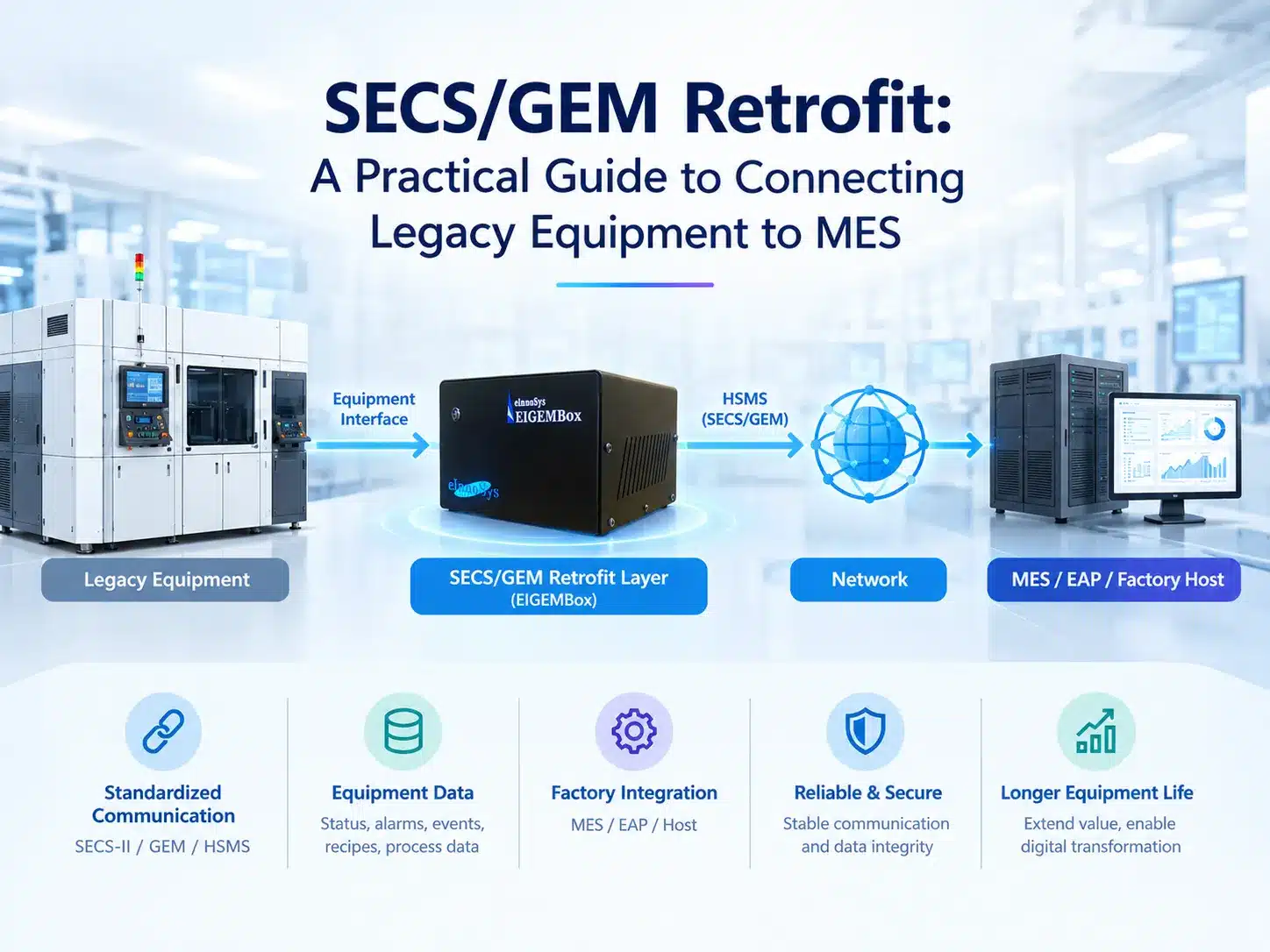
Many fabs and OSAT/ATMP facilities still run equipment that is ten, twenty, or even thirty years old. These tools often remain mechanically sound and process-qualified, and replacing them means capital cost, requalification effort, and lost production time. The problem is that many of them were built before standardized host communication became routine.
That gap shows up when the factory wants centralized monitoring, traceability, or automation. A modern MES or EAP expects structured equipment data, and a legacy tool may offer only a proprietary port, a local display, or nothing at all. A SECS/GEM retrofit is a practical way to close that gap. It adds standardized communication to an existing machine, so replacing the whole tool is not always necessary.
What Is SECS/GEM Retrofit?
A SECS/GEM retrofit adds a SECS/GEM communication layer to equipment that does not natively support it. The layer collects data and events from the tool, presents them in a standard form, and exchanges messages with a host. The equipment keeps running as before. What changes is that the factory can now talk to it in a common language.
Three terms are worth separating:
- SECS-II defines the message structure, meaning how requests, replies, and data are formatted.
- HSMS is the Ethernet-based transport that carries those messages between equipment and host.
- GEM defines how equipment should behave from the host’s point of view, including state models, alarms, event reporting, and remote commands.
SECS/GEM is the communication standard, not the MES. The MES, EAP, or factory host sits on the other side and uses SECS/GEM to exchange information with the tool.
Why Legacy Equipment Struggles to Connect to MES
Connecting older tools is rarely a single-obstacle problem. The common challenges include:
- No native SECS/GEM interface. The tool has no standard host communication at all.
- Proprietary or outdated communication methods. Serial links, vendor-specific protocols, or discontinued software stacks are common.
- Limited data access. Useful signals may exist inside the controller but not be exposed externally.
- Older controllers. Limited processing capability and legacy operating systems constrain what can be added.
- No host communication. Operators may start lots, load recipes, and record results manually.
- Hard-to-collect alarms, events, and parameters. Without structured access, these stay local to the tool.
- Risk and cost of modification. Changing a qualified production tool carries real process and downtime risk.
The table below summarizes how a retrofit addresses each.
| Legacy Equipment Challenge | SECS/GEM Retrofit Approach |
|---|---|
| No native SECS/GEM interface | Add a suitable SECS/GEM communication layer to enable host connectivity. |
| Limited equipment data access | Identify available equipment data and map relevant variables for collection. |
| Proprietary communication | Use an appropriate interface or protocol conversion approach to access equipment data. |
| Difficult MES connectivity | Establish standardized SECS/GEM host communication between the equipment and MES/EAP. |
How SECS/GEM Retrofit Connects Legacy Equipment to MES
The architecture is straightforward in concept:
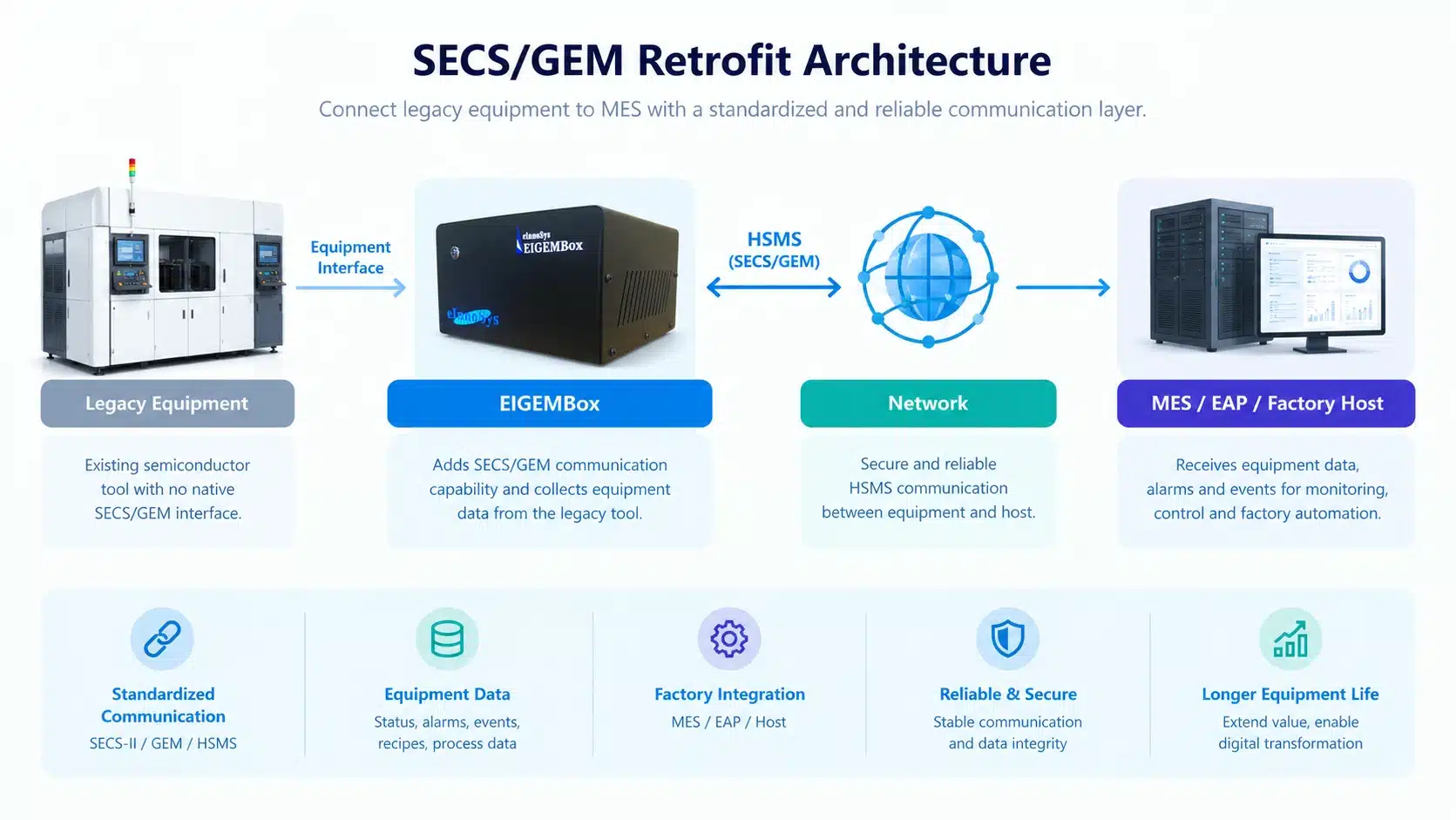
- Legacy equipment. The tool continues to run its own process. Its controller, sensors, and I/O are the source of any data the retrofit can use.
- Retrofit layer. This layer connects to the tool through whatever interface is available, such as serial, Ethernet, PLC or I/O signals, or another protocol. It translates that data into GEM-compliant states, events, alarms, and variables.
- HSMS communication. The retrofit layer exchanges SECS-II messages with the host over a standard Ethernet connection.
- MES, EAP, or factory host. The host receives equipment data and, depending on the design, can send commands or recipe-related requests back. Where an EAP sits between the tool and the MES, it often handles that translation.
What Data Can Be Exchanged?
Typical data categories include:
- Equipment status and control state
- Alarms and alarm clearing
- Events, such as process start, process complete, or door open
- Process parameters and equipment variables
- Recipe information
- Lot or carrier information, where applicable
- Production status
- Data collection for monitoring and traceability
Not every legacy machine can provide every item. What is available depends on the equipment’s controller, sensors, interfaces, and the retrofit design. For that reason, a data availability review early in the project is more useful than assuming full coverage.
SECS/GEM Retrofit Implementation Process
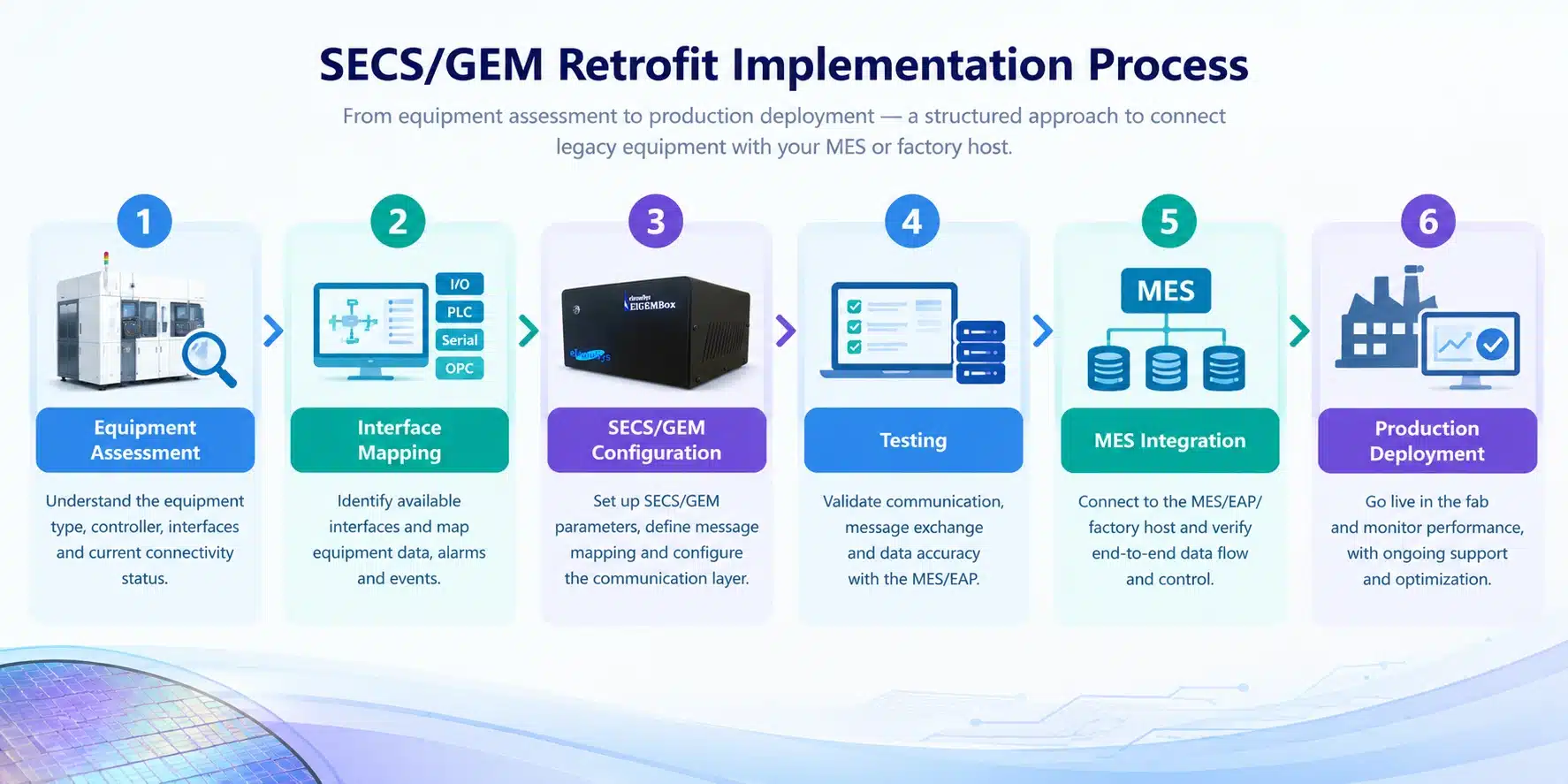
A structured sequence keeps risk low on a live production tool:
- Equipment assessment. Review the tool’s controller, documentation, and condition.
- Identify available interfaces and data. Determine what signals and protocols can actually be accessed.
- Define host/MES requirements. Confirm which messages, events, and commands the host expects.
- Select the retrofit architecture. Choose the communication approach that suits the tool.
- Configure SECS/GEM communication. Set up HSMS parameters, state models, and message handling.
- Map equipment data and events. Link tool signals to GEM variables, events, and alarms.
- Connect to the MES/EAP/host. Establish the live communication link.
- Test communication and messages. Verify message behavior against host expectations.
- Validate production scenarios. Run realistic lot flows, alarms, and recovery cases.
- Deploy and monitor. Release to production and watch early operation closely.
Benefits of Retrofitting Legacy Equipment
Depending on the tool and the project scope, a retrofit can offer these benefits:
- Extend the useful life of equipment that still performs well
- Avoid replacing tools that are not yet at the end of their usefulness
- Connect older tools to modern factory systems
- Improve equipment visibility and centralized monitoring
- Collect better equipment data for traceability
- Support factory automation and semiconductor equipment automation goals
- Prepare for future analytics and Industry 4.0 initiatives
Actual results vary by equipment and implementation, so teams should set expectations from their own assessment rather than generic figures.
SECS/GEM Retrofit vs Equipment Replacement
| Factor | SECS/GEM Retrofit | Equipment Replacement |
|---|---|---|
| Existing equipment | Retained | Replaced |
| Initial disruption | Typically lower | Typically higher |
| Equipment life | Can extend the useful life of existing equipment | Provides a new equipment lifecycle |
| MES connectivity | Added through SECS/GEM integration | Usually designed into the new system |
| Best suited for | Capable legacy equipment that can be integrated | Equipment that cannot meet current production or automation requirements |
Retrofit tends to make sense when the tool still meets process needs and the main gap is connectivity. Replacement may be the better choice when the equipment can no longer hold process capability, lacks spare parts or support, or has no accessible data to build on. Many fabs evaluate this tool by tool.
What to Check Before Starting a SECS/GEM Retrofit
Before committing, review these areas:
- Controller and interface availability
- Supported communication protocols
- Required MES or EAP interface
- Required SEMI standards, and whether a GEM300 scope applies, which depends on the implementation
- Data availability
- Alarm and event requirements
- Recipe requirements
- Network and security requirements
- Production downtime constraints
- Validation and testing requirements
Common SECS/GEM Retrofit Challenges
- Incomplete equipment documentation. Older tools often lack current manuals. Address this with hands-on signal tracing and input from experienced equipment engineers.
- Proprietary controller interfaces. Closed interfaces limit access. A protocol conversion approach or I/O-level connection can sometimes provide a workable path.
- Missing data points. Some values are not exposed at all. Define the minimum data set the host needs, then confirm what is realistically available.
- Communication configuration. HSMS settings, device IDs, and timers must match on both sides. Document these early and test them on a bench before the tool is touched.
- Message mapping. Mismatches between tool signals and host expectations cause most integration delays. Agree on a mapping specification with the MES team up front.
- Legacy software limitations. Old operating systems may restrict what can run alongside them. An external retrofit layer can avoid altering the tool’s own software.
- Host/MES compatibility. Hosts differ in how they interpret GEM behavior. Use host simulators and early joint testing to expose differences.
- Testing without disrupting production. Use simulators, offline validation, and scheduled maintenance windows to keep live output protected.
When Should You Consider a Professional SECS/GEM Retrofit Solution?
Specialist support is worth considering when:
- You have multiple legacy equipment models to connect
- Your host or MES requirements are complex
- Equipment uses proprietary interfaces
- You need standardized SECS/GEM communication across the fab
- Internal SECS/GEM expertise is limited
- Testing and commissioning support is required
- You need connectivity that can scale across more tools
How eInnoSys Supports Legacy Equipment Connectivity
eInnoSys works in semiconductor equipment connectivity and factory automation. Its support centers on SECS/GEM integration for equipment that needs standardized host communication, including older tools without native interfaces.
Where a retrofit approach fits, EIGEMBox is one option to evaluate. For OEMs and teams building communication into their own equipment software, a SECS/GEM SDK may be more appropriate. eInnoSys also supports host and MES communication, equipment data collection, and equipment-specific integration, along with testing and implementation support. Because each tool differs, the right approach starts with an assessment of the specific equipment. More background is available on equipment data collection and semiconductor equipment automation .
Conclusion
A SECS/GEM retrofit gives fabs and OSAT/ATMP facilities a practical path to connect legacy equipment to MES and factory automation systems without automatically replacing the tool. The right outcome depends on what data the equipment can expose, what the host needs, and how carefully the project is tested.
Have legacy equipment that needs MES or host connectivity? Talk to eInnoSys about a SECS/GEM retrofit and equipment integration approach tailored to your tool. For a starting point, explore our SECS/GEM integration and MES integration resources.


