
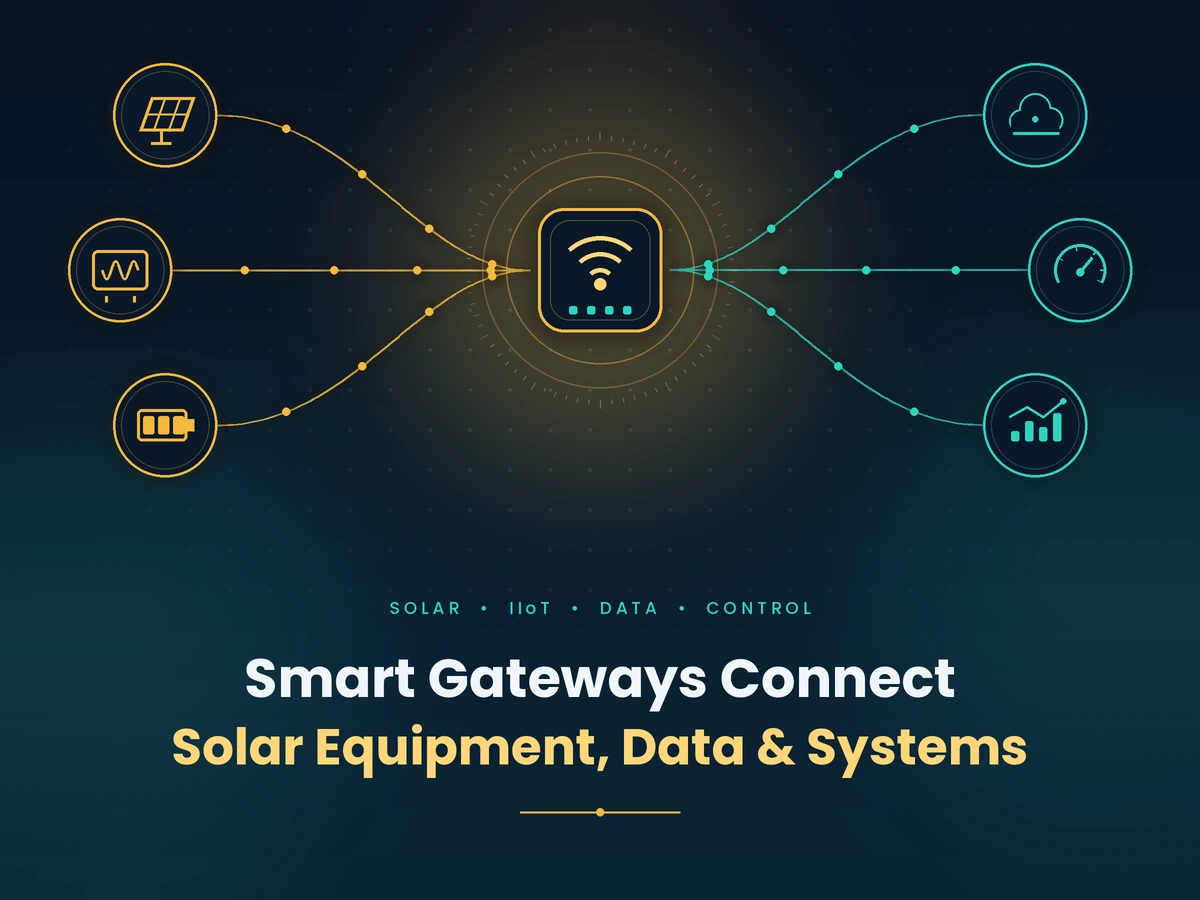
Smart gateways connect solar manufacturing equipment to the software that runs the factory. They translate protocols, collect machine data, and pass it securely to MES, SCADA, and analytics platforms. For plant managers and automation engineers, this turns isolated machines into one connected, traceable production line.
This guide explains how smart gateways work, which challenges they solve, and how they apply to wafer, cell, and module manufacturing.
What Are Smart Gateways in Solar Manufacturing?
A smart gateway is an edge device or software layer between shop-floor equipment and factory IT systems. It does more than forward data. It reads signals from machines, converts them into a standard format, adds context, and delivers them to the right system.
In a smart solar PV system for manufacturing, a gateway typically handles four jobs:
- Connecting to equipment through its native interface
- Converting proprietary protocols into standard ones such as SECS/GEM
- Buffering and validating data at the edge
- Sending structured data to MES, SCADA, and analytics tools
Without this layer, each machine becomes a data island.
Why Solar Equipment Connectivity Is Hard
Solar fabs rarely buy all equipment from one vendor. A single line may mix tools from different OEMs and different decades. This creates several challenges for solar equipment connectivity:
- Mixed protocols. Machines use proprietary interfaces, serial links, OPC UA, Modbus, or SECS/GEM, often in the same plant.
- Inconsistent data models. Two tools may report the same parameter under different names and units.
- Legacy equipment. Older tools often have no network interface at all.
- Manual data capture. Operators log values by hand, which is slow and error-prone.
- Scaling pressure. Adding a new line means repeating the integration work.
These gaps cause real losses. Engineers spend time on custom connections instead of process improvement. Quality teams cannot trace a defect to its source. Managers see yesterday’s numbers instead of live ones.
Protocol Conversion and Equipment Integration
Protocol conversion is the core function of a smart gateway. The gateway speaks each machine’s language on one side and a standard language on the other.
For solar manufacturing equipment integration, the process usually follows these steps:
- Connect to the tool through its available interface.
- Map machine variables, alarms, and events to a common data model.
- Convert the data into a standard such as SECS/GEM or OPC UA.
- Publish the data to host systems in a consistent format.
Standardization is the biggest payoff. Once every tool reports in the same way, the host software no longer cares which vendor built the machine. Adding a new tool means mapping it once, not rewriting the integration.
For OEMs, this also shortens delivery. A tool that ships with a standard interface is easier to commission at the customer’s site. That is where solar equipment communication software earns its value.
Integration with MES, SCADA, and Analytics
Gateways are only useful if the data reaches the right place. Three destinations matter most.
- MES (Manufacturing Execution System). The MES manages lots, recipes, and work orders. Through the gateway, it can download recipes to a tool, receive process results, and track each wafer, cell, or module through the line.
- SCADA. Supervisory systems need live status, alarms, and process values. The gateway streams this data so operators can monitor the whole plant from one view.
- Analytics platforms. Yield analysis, predictive maintenance, and AI models need clean, time-stamped, contextual data. A gateway supplies it at the source, so data scientists spend less time on cleanup.
In short, the gateway sits in the middle and feeds all three. One connection per tool serves every system, instead of a separate integration for each.
Key Benefits of Smart Gateways
- Real-time data. Machine states, alarms, and process values flow continuously. Teams react to a drifting parameter in minutes, not at the end of a shift.
- Traceability. Every substrate can be linked to its tool, recipe, process parameters, and time. If a quality issue appears, you can isolate affected lots quickly. This also supports customer audits and warranty claims.
- Improved production visibility. Managers see throughput, downtime, and bottlenecks as they happen. Decisions rest on live data, not manual reports.
- Lower integration cost. Reusable mappings and standard interfaces cut repeated engineering work.
- Better OEE. Faster alarm response and clearer downtime reasons raise overall equipment effectiveness.
Practical Applications Across the Production Line
- Wafer manufacturing. Gateways connect slicing, cleaning, and inspection tools. They record wafer thickness, defect counts, and tool status, then pass them to the MES for lot-level tracking.
- Cell manufacturing. Cell lines include texturing, diffusion, passivation, printing, and firing. Each step has tight process windows. Gateways capture parameters such as temperature profiles and gas flows. They help engineers link process drift to efficiency loss.
- Module manufacturing. Stringers, laminators, and testers generate a stream of quality data. Gateways collect it and tie it to serial numbers. Final flash-test results then connect back to upstream cell and material data, giving full module genealogy.
eInnoSys Solutions for Solar Equipment Connectivity
eInnoSys is a solar software company with deep experience in equipment communication. Its portfolio covers each layer of the connectivity stack:
- EIGEMBox is a gateway for connecting equipment and exposing standard interfaces, including for older tools.
- EIGEMHMI provides an operator interface for monitoring and controlling connected equipment.
- EIGEMEquipment adds SECS/GEM equipment-side communication to tools.
- EIGEM300Equipment supports 300 mm-style equipment interfaces and automation requirements.
- EIGEMLink links equipment with host and factory systems.
- EIGEM84 supports SEMI E84 handoff between carriers and load ports.
- EIGEMSim simulates equipment and host behavior so teams can test integrations before going live.
These are part of a broader set of photovoltaic software solutions. For projects that need something unique, eInnoSys also offers custom solar software development and solar PV software development services. You can explore the full range on the Solar PV Industry page.
Implementation Challenges: Compatibility and Cybersecurity
Gateways bring clear value, but projects need planning.
- Compatibility. Check each tool’s available interfaces and firmware early. Some legacy machines need hardware adapters or signal-level integration. Define a common data model before you begin, so mappings stay consistent across vendors.
- Testing. Never commission an integration directly on a live line. Use simulation to test messages, alarms, and recipes first. This reduces downtime during rollout.
- Data quality. Decide which variables matter. Collecting everything creates noise and storage cost. Start with the parameters tied to yield, quality, and downtime.
- Cybersecurity. A gateway connects the factory floor to IT networks, so it must be secured. Good practice includes:
- Network segmentation between operational and corporate networks
- Role-based access and strong authentication
- Encrypted communication where the protocol supports it
- Regular patching and logging of gateway activity
Treat security as part of the design, not an afterthought.
Conclusion
Smart gateways connect solar equipment, data, and systems into one working whole. They convert protocols, feed MES, SCADA, and analytics platforms, and give teams real-time data, traceability, and production visibility from wafer to module. The best results come from standard interfaces, early testing, and secure design.
eInnoSys helps solar manufacturers and OEMs build this connected foundation, from gateways and SECS/GEM interfaces to simulation and custom development. If you are planning a new line or modernizing an existing one, eInnoSys can help you connect it.
Related Blogs:-
- MES Manufacturing Execution System for Solar PV Manufacturing
- Solar Plant Monitoring: How Real-Time Data Improves Performance & Efficiency
- Solar PV Software: How Digital Solutions Improve Manufacturing Efficiency


