
Imagine a factory where every machine talks to every other machine, problems are flagged before they stop production, and every chip can be traced from raw wafer to final shipment. This is no longer a vision for the future. It is happening now, and microelectronics manufacturing software is the engine behind it.
Microelectronics production is one of the most demanding industries in the world. Components are tiny, tolerances are razor-thin, and a single hour of unplanned downtime can cost thousands of dollars. Manual processes and disconnected machines simply cannot keep up.
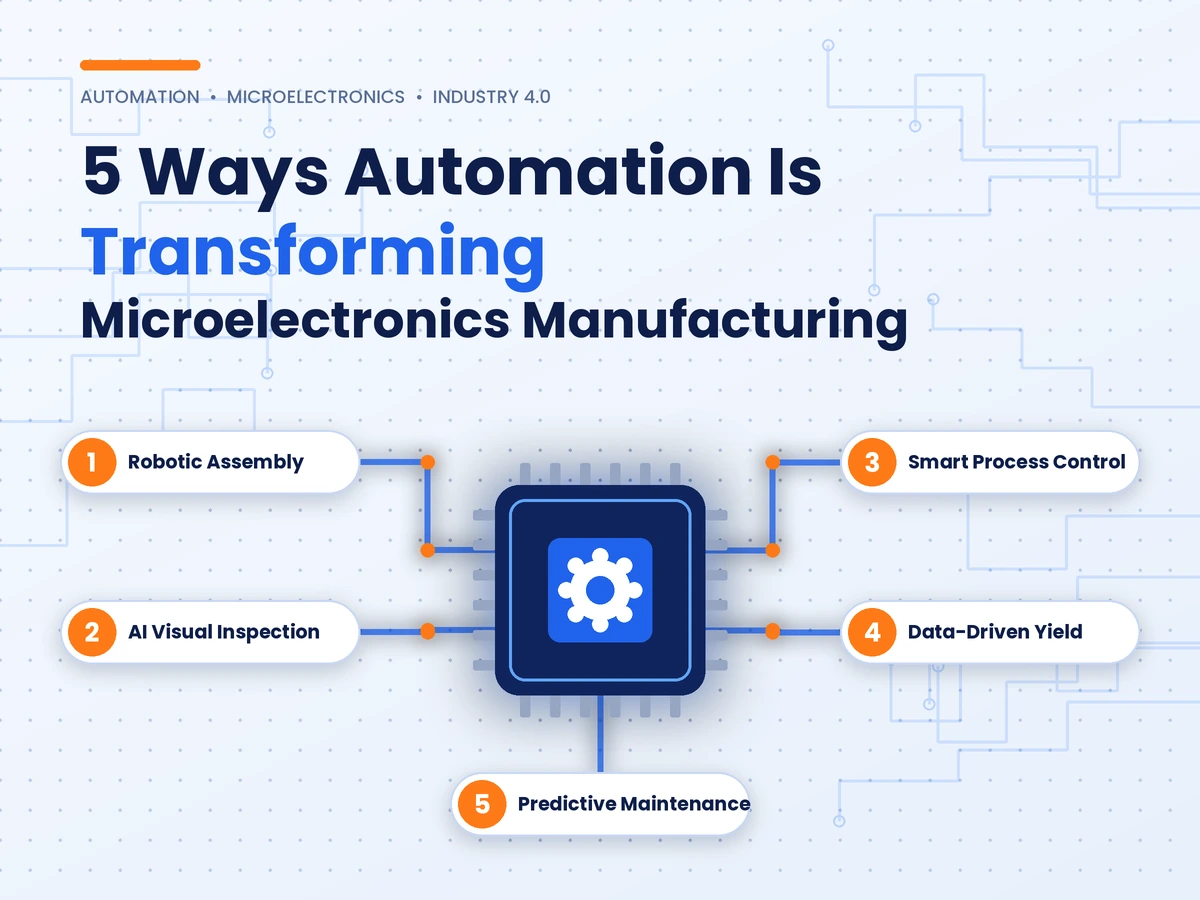
In this guide, we explain five ways automation is reshaping microelectronics manufacturing operations, in plain language, so that engineers, managers and decision-makers can all follow along.
1. Automated Equipment Connectivity: Getting Every Machine to Talk
A typical microelectronics fab runs equipment from many vendors and many decades. Some machines are brand new and support modern standards. Others are older workhorses that were never designed to share data.
This is where microelectronics equipment integration becomes essential. Automation connects all equipment, old and new, using industry-standard protocols:
- SECS/GEM: The semiconductor industry’s standard language for equipment-to-host communication.
- OPC UA: A secure, platform-independent protocol for sharing industrial data.
- Modbus: A simple, widely used protocol found on many legacy controllers and sensors.
When these protocols work together, machines send real-time data to a central system automatically. Operators stop copying numbers by hand, errors drop, and decisions are based on live facts rather than yesterday’s reports.
If you have older tools without built-in connectivity, a retrofit solution like EIGEMBox for legacy equipment connectivity can bring them online without costly replacement.
2. MES Integration and Production Tracking: One Clear Picture
A Manufacturing Execution System (MES) acts as the brain of the factory. It tracks what is being made, where it is, and how it is progressing. But an MES is only as good as the data it receives.
That is why microelectronics MES software integration is such a powerful step. When equipment feeds data directly into the MES, manufacturers gain:
- Full traceability: Know exactly which materials, machines and process steps touched every lot.
- Better visibility: See work-in-progress, queues and bottlenecks at a glance.
- Smoother workflows: Automatically route lots, enforce process rules and reduce manual handoffs.
Traceability matters even more when a quality issue appears. Instead of searching through paper logs for days, teams can find the root cause in minutes and limit the impact to a few affected lots.
3. Predictive Maintenance Using AI and Machine Learning
Traditional maintenance follows a calendar: fix the machine every few weeks, whether it needs it or not. Or worse, wait until it breaks. Both approaches waste time and money.
Microelectronics predictive maintenance takes a smarter path. Sensors and equipment data feed AI and machine learning models that learn what “normal” looks like for each tool. When vibration, temperature, pressure or cycle times drift away from normal, the system raises an early warning.
The result:
- Fewer unexpected breakdowns
- Maintenance scheduled at the right time, not too early or too late
- Longer equipment life and lower repair costs
- More consistent output and yield
Think of it like a smartwatch for your machines. It does not wait for a crisis. It spots the warning signs and tells you to act early.
4. Real-Time Equipment Monitoring: Seeing Performance as It Happens
You cannot improve what you cannot see. Real-time monitoring gives production teams a live window into the entire factory.
Centralized dashboards pull data from every connected tool and display the numbers that matter most:
- OEE (Overall Equipment Effectiveness): How well each machine is really performing, combining availability, speed and quality.
- Alarms and events: Instant alerts when something goes wrong, with the context needed to fix it fast.
- Throughput and utilization: Which tools are running, idle or waiting.
This kind of microelectronics factory automation helps supervisors react in seconds instead of hours. It also helps leadership spot long-term trends and make better investment decisions. If operators need an easier way to interact with their tools on the floor, an automation interface such as EIGEM-HMI for equipment automation can simplify daily operations.
5. Automated Recipe and Process Control: Consistency at Scale
In microelectronics, a recipe is the set of instructions that tells a machine exactly how to process a product: temperatures, times, pressures, speeds and more. Even a small mistake, such as loading the wrong recipe, can scrap an entire lot.
Automated recipe management removes that risk. It allows factories to:
- Store and version-control recipes in one secure place
- Download the correct recipe to the correct tool automatically
- Prevent unauthorized or accidental changes
- Verify that process parameters stay inside approved limits
The outcome is microelectronics manufacturing automation that delivers the same quality on every shift, every tool and every day. Consistent processes mean higher yield, less rework and happier customers.
Benefits for Microelectronics Manufacturers
When these five areas work together, the improvements add up quickly. Manufacturers typically see:
- Higher yield and quality through tighter process control
- Less downtime thanks to early problem detection
- Faster decisions powered by live data
- Lower costs from reduced scrap, rework and manual effort
- Stronger compliance with complete traceability and audit trails
- Easier scaling as new equipment joins the network
In short, automation turns a collection of separate machines into one connected, intelligent operation
How eInnoSys Supports Microelectronics Automation
eInnoSys specializes in equipment connectivity and factory automation for semiconductor and microelectronics manufacturers. Its solutions are built to connect the equipment you already own and the equipment you plan to buy:
- EIGEMBox brings legacy equipment online with reliable data connectivity.
- EIGEMEquipment helps equipment OEMs add SECS/GEM integration to their tools quickly.
- EIGEM-HMI supports equipment automation with an intuitive operator interface.
- EIGEMLink connects industrial protocols so that different systems can share data smoothly.
You can learn more on the Microelectronics Industry Solutions page.
Conclusion
Automation is no longer optional for microelectronics manufacturers who want to stay competitive. From connecting equipment and integrating the MES, to predicting failures, monitoring performance in real time and controlling recipes, each step makes the factory smarter, faster and more reliable.
The right microelectronics manufacturing software ties all of these capabilities together. With deep experience in SECS/GEM, OPC UA and industrial connectivity, eInnoSys helps manufacturers and equipment OEMs turn automation goals into everyday results. The best time to start is now, and you can begin with a single machine or a single line.
Related Blogs:-
- Microelectronics Automation Software: Connecting Processes, Machines, and Data
- Microelectronics Manufacturing Software: How Digital Tools Improve Production Control
- How Semiconductor Manufacturing Software Supports End-to-End Production Management


